This time England? Is it coming home from World Cup 2026?
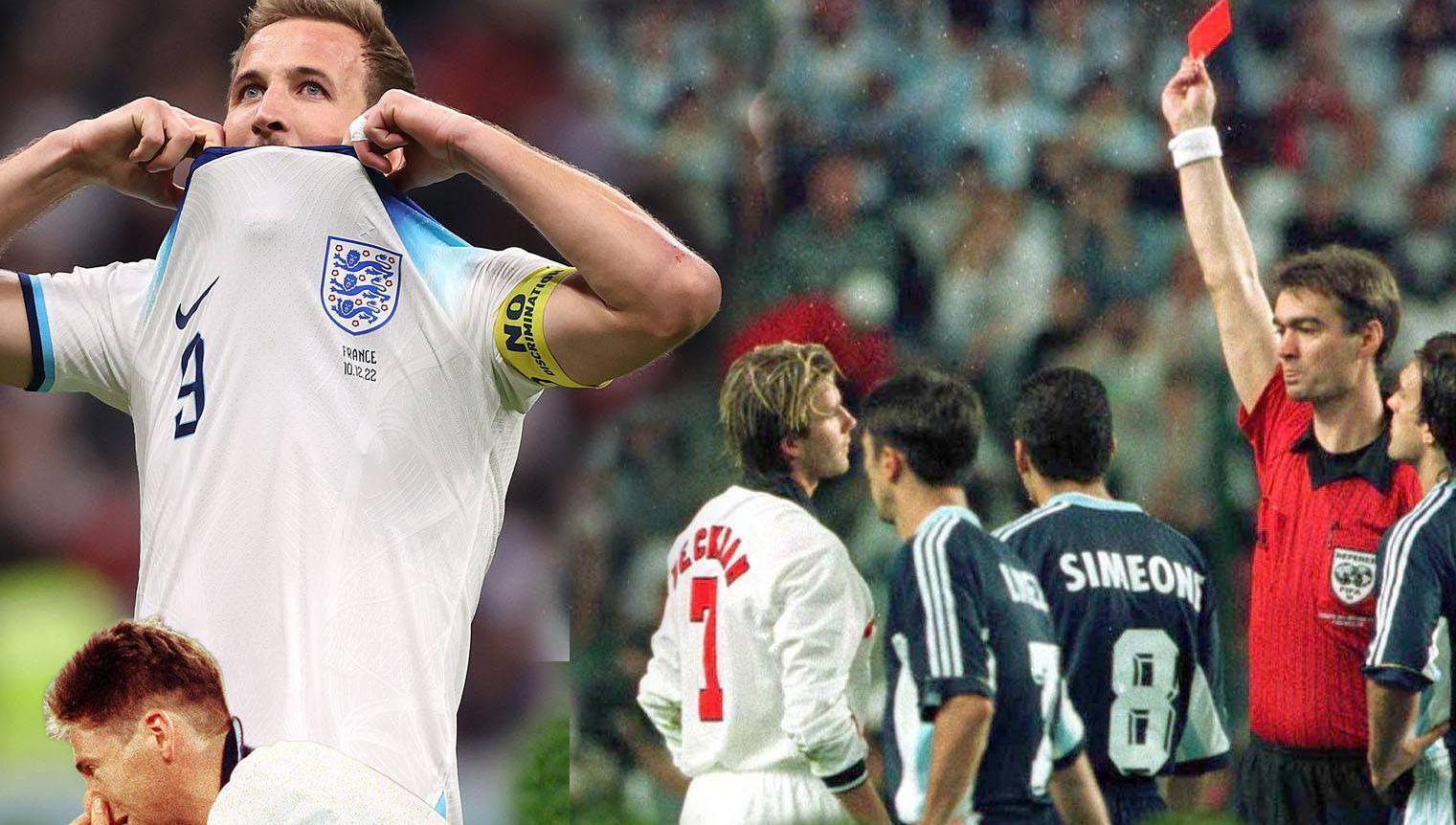
FALL GUYS: Harry Kane and David Beckham are among many players who have been castigated after England fell short in major tournaments.
Twenty years ago, in 2006, Sven-Goran Eriksson famously ended his last press conference at the World Cup in Germany by warning England’s media and fans not to ‘kill’ their ‘special talent’ Wayne Rooney after he was sent off in a quarter-final defeat against Portugal.
“You’re going to need him,” he warned, following an exit on penalties which marked the end of the Swede’s time in charge in what felt like an emotional and surprisingly honest farewell speech.
For those present it was not only good copy but also a thought-provoking experience.
It came eight years after David Beckham was castigated for being sent off against Argentina in the World Cup finals in France in 1998; with an effigy of him hauntingly hung in east London.
Looking back now, Eriksson’s words were a warning worth heeding. But nobody really listened – and that it could all happen again in the United States?
England go into the tournament as one of the favourites but the excuses and the blame games have already started since Thomas Tuchel named his squad and left out Trent Alexander-Arnold, Phil Foden and Cole Palmer – three of their most talented players.
A string of pundits and columnists joined the queue to suggest that if England fail this summer, it will be Tuchel’s fault and The FA, who controversially handed him an extended contract before the World Cup has even kicked off, may come to regret their enthusiasm.
Concerns that the German will also leave talisman Jude Bellingham on the bench have been eased since the Real Madrid man was handed the number 10 shirt in England’s World Cup squad, but there’s still a feeling that Tuchel is the one that people are gunning for if the tournament doesn’t go England’s way.
Others may be in the firing line too, including Bellingham who hasn’t quite fulfilled the hero gap chiselled out for him in English football despite a promising Euros two years’ ago.
Even captain Harry Kane, England’s greatest goalscorer, felt it in that tournament when he was lambasted for being too old, too slow and unable to play like a modern high-pressing forward. There were calls for him to be dropped – from fans and pundits alike.
Just ask Bayern Munich supporters whether those criticisms were valid and you’ll get an unequivocal answer. Kane has gone on to prove he is at his absolute peak and – after scoring 66 goals for club and country in 2025-26 - will arrive in the United States as (almost) untouchable in terms of his status as a Three Lions starter.
But unless England lift the trophy, you can be pretty sure someone will be getting it in the neck.
England’s habit of searching for a scapegoat every time they go home early has been almost ever-present since they won the World Cup in 1966.
Four years later, goalkeeper Peter Bonetti was the victim chosen, after England (missing injured Gordon Banks) went 2-0 up against West Germany in the 1970 World Cup, only to lose the game 4-2.
In Japan & South Korea in 2002, David Seaman allowing a Ronaldinho free-kick to sail over his head put him in the firing line for being past his best - and by 2010, in South Africa, coach Fabio Capello got the brunt of the kick-back following another quarter-final exit (although Rooney’s woeful form and a split in the camp over John Terry didn’t help).
It’s not only England players and managers who have taken the flak, either.
In South Africa, referee Jorge Larrionda was in the firing line after failing to spot that a Frank Lampard goal against Germany had clearly crossed the line.
Cristiano Ronaldo was enemy number one after appearing to wink when Rooney was sent off against Portugal in Germany (he was booed at every ground in the Premier League the following season) – and referee Mauricio Cordosa, who waved the red card, received numerous threats on social media.
England are not alone in this kind of obsession. Italy and Argentina always seem to have a conspiracy theory when something goes wrong and Colombia’s Andres Escobar was famously murdered after scoring an own goal at the 1994 World Cup – which is on an entirely different level, of course.
But fear of being scapegoated as an England player or manager is real and cannot be healthy.
The racist abuse suffered by Marcus Rashford, Bukayo Saka and Jadon Sancho when they missed penalties in the Euro 2020 Final shoot-out highlights how deep it runs (and that isn’t even half the story when it comes to the way that black players are persistently and disproportionately targeted online when results don’t go right).
So, what can we learn from Eriksson’s words all those year ago?
The former Lazio and Manchester City manager had a slightly unusual relationship with the English media back then.
He made salacious headlines off the pitch but was so charming in press conferences and media huddles, willing to answer any question no matter what had been written about him, that it was difficult for the pack to turn on him.
Instead, it was the fact that he held England’s golden generation in his hands - but failed to make the most of it - that tarnished his time in charge.
On reflection, his words that day in July 2006 were selfless and meaningful, hinting at an underlying problem in English football that went beyond who was in charge on the training field.
It was something that Gareth Southgate subsequently worked hard to tackle but ultimately found it impossible to eradicate, as proven by the reaction Rashford & Co faced in 2021.
The reality is Eriksson’s words were never really listened to deeply enough - and certainly not acted upon – and the social media frenzy that accompanies England makes it almost impossible to change that now.
What Tuchel can do, and what he is doing, is to create a team of equals who buy into a team ethic and give everything to support and protect each other.
If he feels that togetherness is better achieved without Alexander-Arnold, Foden or Palmer, maybe that’s his way of taking Sven’s opinions on board.
In a year in which the Swede sadly passed away, it would be fitting if England found a way to either win the tournament or to lose it gracefully and without offering up a scapegoat.
CONNECT WITH US TODAY



Be the first to know the latest news and updates