‘It’s not bad business that you can clear your mortgage within 10 years’
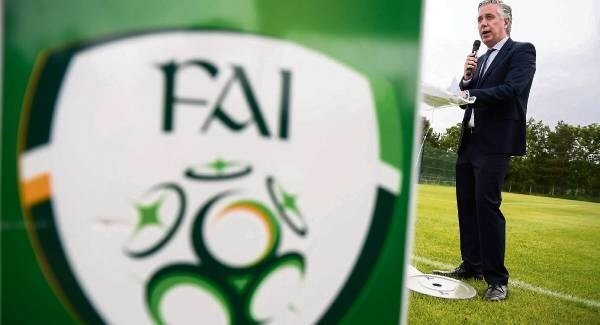
It’s the riddle that won’t go away and Football Association of Ireland chief executive John Delaney added further mystique to their debt-free plans by stopping short of confirming whether they’d still be in the red after 2020.

On inspection of the latest accounts published by the association yesterday, up to December 2017, it would seem quite a task to shift €38.2m of borrowings over a two-year period but Delaney was at his usual bullish best by insisting everything was on track.
Exactly how the FAI will generate enough cash to wipe the burden Irish football has been crippled with for the past eight years wasn’t quite forthcoming at a media briefing.
That, he vowed, would be articulated to delegates at their annual general meeting, this year being held at the Rochestown Park Hotel in Cork, on August 18.
An audience of the coveted football family housed within the main function room will be told, probably more than once, that turnover fell slightly to €49m, another surplus of €2.8m was delivered and bank debt had dropped for the first time to below €30m.
Bank debt, when Delaney was probed, related solely to the amount owed to their banking partner which, since last year, is Bank of Ireland. There’s other liabilities rising the figure to €38.2m, such as the historical loan from Uefa of €5m which he declined on comment on yesterday.
“We had a debt of €70m and now for the first time we owe €29.5m to our banking partner,” said Delaney.
Next year it will be less than €20m and we’ll be debt-free by 2020 if we choose. At the AGM, we’ll outline how we can do it and how we will do it.
Switching to a mainstream bank will definitely assist, albeit not guarantee, that mission being accomplished. The FAI departed Danske Bank in late 2013 to an American investment house, Kohlberg Kravis Roberts (KKR), trumpeting a gross write-down of €12.5m yet not so vocal on the terms of the agreement.
Major equity firms aren’t renowned for operating to a humanitarian ethos, so it was hardly surprising that the annual interest payments spiked to around €5m, thereby eroding most of the gain from the deal.
The equivalent charge last year with the new company amounted to just €2m, raising the question as to whether it was wise in the first place to negotiate the choppy waters of international wholesale markets.
“This is like judging someone over 90 minutes of football, seeing at the end of the game if it was any good,” Delaney reasoned in response to the proposition.
You can talk about yellow card, mistimed tackles, corners, all of that in a football context but the bottom line is that we started with an asset worth €410m which we own 50% of.
“Some of the media get so caught in the narrative of how much the stadium will cost, trying to look through a very narrow prism. It’s an incredible asset for the association and we’ve done well to manage it through a difficult period for the Irish economy.
“It’s not bad business that you can clear your mortgage within 10 years.”
That would constitute some feat, and the Cork summit next month promises to finally shed light on its potential.
Predicting another drop of €10m on the debt might have something to do with the renewal of naming rights on Lansdowne Road by Aviva announced in January.
There’s no reason to think the FAI won’t adopt the same policy as the original approach when they traded their half of the €40m paid to the IRFU and themselves to accept a discounted amount in advance.
Conservative estimates indicate the association are banking €6m in a one-off payment this year.
Beyond that, the success of the senior team will shape the majority of revenue streams. When Delaney last year claimed that a decision on the 2020 vow would be made following the first quarter of 2018, qualification for the World Cup was cited as a factor.
Season ticket sales, which like premium tickets are available at vastly-reduced prices, have apparently reached a record level of 16,000 but the uptake for next year’s European Championship qualifiers are likely to depend on the smaller Uefa Nations League campaign from September and November.
Perhaps by then, 2020 will only be known as the year when Ireland co-host their first ever major tournament.