Ciarán O'Sullivan: 'I have thought about that silence more than any answer I have given in a classroom or on a court'
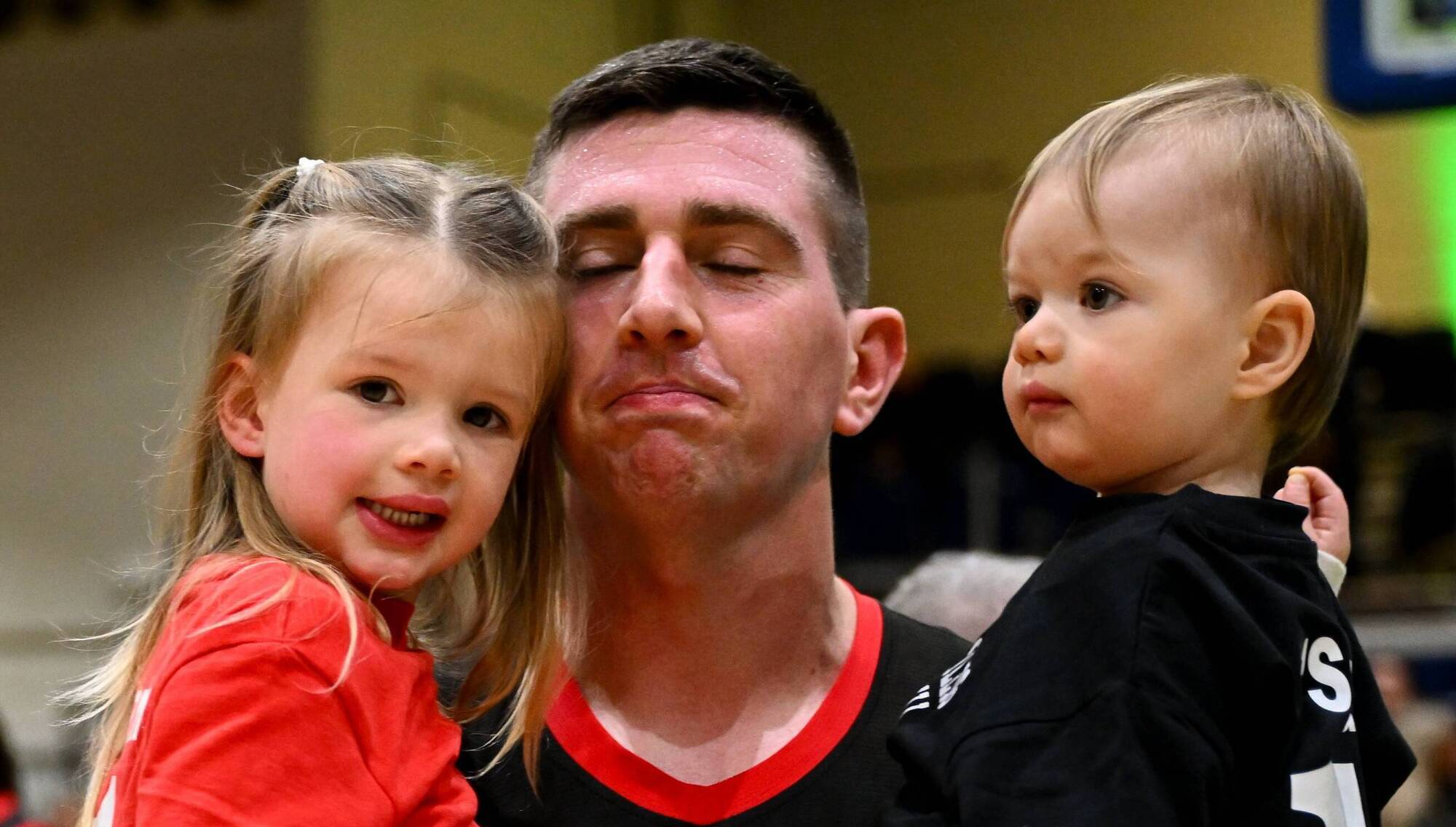
SILENCE CAN BE GOLDEN: Ballincollig head coach Ciarán O'Sullivan celebrates with his children Emma and Dylan after their Superleague Cup final win over Garveys Tralee Warriors at the National Arena. Pic: Shauna Clinton/Sportsfile
THERE are teachers who command a room and there are teachers who change one, and the distance between those two achievements is roughly the distance between authority and wisdom.
Cathal Leahy was the second kind, which is to say the rarer kind, and a boy who walked into his classroom in Colaiste Choilm, Ballincollig carrying the easy conscience of the unprepared did so at his own peril — not because Mr Leahy would embarrass him, but because Mr Leahy would see him, which in the end is a far more unsettling thing.
I let him down once. Basketball game later that day, textbook still in the bag.
I slid into a seat at the back and tried to make myself smaller — 17 years old and still half-believing invisibility was an option. He walked over. Looked at me a moment, eyes steady and kind in a way that pinned you without force.
Then the question, the way he always asked it. I hadn't done the reading. There was no point pretending otherwise.

"Ciaran," he said, "that is a bit disappointing — because you really like History."
Six words to do what another man might have needed six minutes for, and less kindly at the end of it. He did not roar. He did not make a show of me in front of the class. No performance. Just the true thing, said quietly, and the sense that he'd decided you were worth it. That was worse than any roaring.
He had not shamed me. He had named me.
Read More
Most coaches were never taught to ask. We were taught to know.
To have the answer ready, the correction prepared, the next drill queued before the last one ends. Silence feels like lost ground, an admission of weakness in a subculture that mistakes noise for control.
So we fill it — with instruction, with certainty, with the sound of ourselves. The question never gets asked. The player never gets found.
Mr Leahy had a line he brought out every September. The three most important dates in history — no pause — 1914 — the start of World War I and the year Clare won their first All-Ireland hurling title. And 1995 and 1997, when they added the second and third.
The room always fell for it.
I like to think of him years later in that same room, running the same routine with the same grin — 2013 quietly added to the list, then 2024. The pause probably no shorter. The pleasure no smaller.
There was a profound steadiness to him — not a rehearsed calm, but an attention that made thinking feel safe. Not easy; safe. He shifted the emphasis towards reading — 10 or 12 pages a night. Not summaries. The actual pages. Because for Mr Leahy history was never about rote learning. It was about understanding: why people acted, what they feared, what moral weight they carried.
Then every morning came the ritual. He would move through the room — unhurried, diagonal, always towards whoever he had decided needed the next question. He would stop beside a desk, sometimes sitting on the edge of the one in front, and ask.
Then he would wait. Not the tactical pause of a man checking his watch, but the waiting of genuine attention. The class always felt it. Even the students at the back — the ones who had perfected the art of looking occupied while being entirely elsewhere — would go slightly still.
I stand on basketball courts now, watching a huddle look to me for certainty. The urge to fill the silence is a heavy, collective pressure. I am still trying to learn how to inhabit that space between questions.
The first person who taught me that was Mr Leahy. The second was Ronnie Hurley.
Mr Leahy's genius was in his calibration. To the student drifting at the back, one eye already on the car park, the question would be direct.
"What year was the Easter Rising?"
Specific. A rope thrown.
"And what was happening in Europe at the time that made the IRB think the moment was right?"
One step further. Not enough to panic, enough to pull him a little deeper into the room than he had intended to be.
History was not a sequence of rote events to be memorised and recited. It was a moral problem. When Muhammad Ali refused the Vietnam draft — I ain't got no quarrel with them Viet Cong — it cost him his title and the version of himself the world had decided on. He refused to outsource his conscience anyway.
You were not being asked what happened. You were being asked what you would have done, what you thought Michael Collins feared most, whether the men who signed the Treaty were pragmatists or cowards or both.
Jack Lynch was not merely a list of political achievements, more a tunnel with multiple exits. Mr Leahy would describe a man who won six consecutive All-Irelands for Cork — five with the small ball, one with the big ball — before going on to study law and then politics.
The lesson was not about the titles. It was what lay underneath them — the discipline, the capacity for pressure, the ability to hold your nerve when the situation requires it. Sport, he believed, was part of the architecture of a person.
Not a detour from real life. A preparation for it. I believed him then. I believe him more now, on this side of a coaching life.
Except for one.
Mid-November, fifth year. The Treaty. Mr Leahy stopped beside a desk near the window. If you had been a nationalist leader in 1921, what would you have accepted and what would you have walked away from?
The boy looked up. A beat. "I do not know."
He tried again, softer now. "What do you think Collins feared most?"
Another beat. "I do not know."
The words hung there longer than I wanted. The silence felt heavier than any correction.
I have thought about that silence more than any answer I have given in a classroom or on a court. Not what it revealed about my preparation. What it revealed about the cost of being seen and coming up short. The specific shame of it — not punishment, just exposure — stayed with me longer than any grade.
******
My fondest memory of Ronnie Hurley is him in the front row at the Marquee, Jackson Browne on stage, arms folded, watching. The stillness of a man who knew exactly what he was listening for. Family friend, successful businessman — someone who socialised in the margins.
After gigs, corner tables, music conversations that somehow became coaching conversations and ran far later than they should have. Hundreds of interviews had done something to his questions. Angled them. Made them high-order, patient things — not built to trap but to pull something real out of whoever was sitting across from him.
He had a leather jacket for all seasons of weather, and on a given night he could take out a pair of Sennheiser headphones he would produce without ceremony — "Here, try these" — the way you might offer someone a photograph of something beautiful you had seen and wanted to share.
He had a method with music the same way Mr Leahy had a method with history. You could not skip or go directly into something iconic because it's well known or on a list. You had to build up to it.
"You want John Coltrane?" he'd say. "Start with Art Blakey. Moanin'. Then Horace Silver — Song for My Father. You might be able to access it then."
He was not being precious about it. He understood that the difficult thing only opens if you have earned the approach.
Coltrane's A Love Supreme, he'd say, might land for you twice a year. You might listen ten times, but those two occasions will be better than any other listening experience you have had all year. You do not chase the other eight. You just keep showing up.
He'd tell you to drive with The Doors' L.A. Woman on — the whole album, windows down, somewhere with a straight road. Or try keeping under the speed limit during Paul Gonsalves' solo on Duke Ellington's Diminuendo in Blue or better yet Compared to What by Les McCann.
The point was not music theory. The point was attention. How you listened. Whether you were actually in the room, growing an appreciation.
One night at the Idle Hour, Hallelujah came on. Ronnie went quiet for a moment the way he did when something had his full attention. Sparkling water in front of him, jacket on, just in from somewhere.
"Dylan and Cohen," he said. "People think they're the same kind of artist. They're not."
He set down his glass.
"Cohen spent a decade returning to the same problem. Eighty stanzas for Hallelujah. Most of them gone — verses that would have been the best thing another songwriter ever wrote, and he left them on the floor. Not because they were wrong. Because the question wasn't finished. Because he was still inside it."
He nodded toward the speaker.
"Now it's everywhere. People hear it at weddings and funerals not knowing the heartache that went into every line."
He looked at his glass.
"The question outlived the man who couldn't stop asking it."
After a night at the Marquee — the good kind of late, when no one wants to be first to call it — he put both forearms on the table and looked across at me. You love Joni Mitchell's Blue, he said.
Stripped back. Piano, acoustic. No hiding place in it. No wasted notes.
So if you stripped coaching back the same way — took away the diagrams and the language and the set plays — what would still be there? What is the acoustic version of your coaching philosophy.
Men grabbed their glasses so fast. Not to drink. To think.
The question did what all his best questions did. It reframed the problem in terms that made evasion structurally impossible. I had no answer. He smiled. Something to ponder, he said, when you're getting those jazz albums under your belt.
He knew me well enough to know where I hid. After gigs, one to one, corner table, he would say it straight — the passion only comes out in a one to one, you step back in groups. Pull back when you have something to offer. He could find that in you without ever making you feel the heat of it. Just turned the light on the thing you were avoiding and waited. A critical friend.
There comes a day when you realise you cannot make that phone call anymore. Cannot sit across that table. Cannot hear the voice that knew the difference between what you were saying and what you meant. The gigs still happen. The conversations don't. And grief, when it arrives for someone like that, is not just the loss of the person. It is the loss of the version of yourself that only existed in their company.
He is gone now. And still, in certain rooms, when I feel myself pulling back — when the easier thing would be silence — I hear it. Not a memory exactly. Something more present than that. His voice, close and certain.
You have something here. Say it.
The questions outlive the questioner. A player says something on the walk out of the gym and you realise the conversation isn't finished. A problem follows you home. A season ends. Another begins. Somewhere between the drive and the front door, you hear the question.
I thought for a long time that the men who shaped me had given me answers. Mr Leahy never did. Ronnie Hurley never did. What they gave me instead was the ability to stay in the room after the certainty had left it.
Cathal Leahy asked his questions in a classroom in Ballincollig. Ronnie Hurley asked his across tables after gigs had ended and everyone else was ready to go home.
The voices change. The questions remain. Those conversations are still going. They've just changed where they live.
A collection of the latest sports news, reports and analysis from Cork.
CONNECT WITH US TODAY



Be the first to know the latest news and updates