Colin Sheridan: Argentina should be celebrated, not criticised
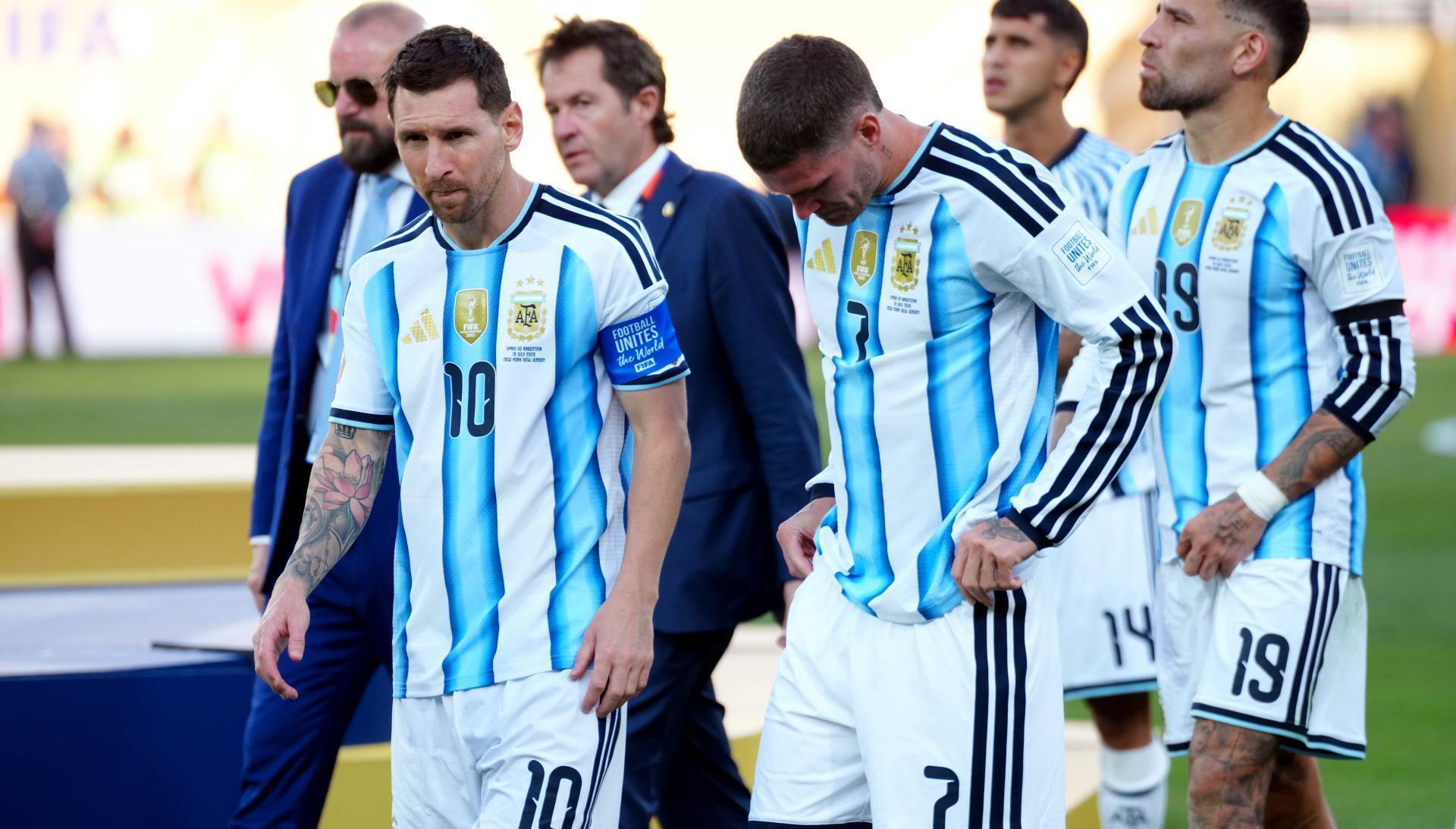
Argentina's Lionel Messi and teammate Rodrigo De Paul dejected following the FIFA World Cup 2026 final. Pic: Nick Potts/PA Wire.
Stop complaining about Argentina. They were the World Cup's greatest work of art.
There is an old Jorge Luis Borges line that reality is under no obligation to be interesting. Football, thankfully, is. And no team at this World Cup understood that better than Argentina. Spain were the best team. Let's get that out of the way before somebody starts angrily typing. They passed better. Pressed better. Controlled games better. They deserved to be champions.
But football has never merely been about identifying the best team. If it were, we'd all watch spreadsheets instead. Argentina gave us something infinitely rarer. They gave us theatre. While everyone else spent the month trying to perfect football, Lionel Scaloni and his battered bastards spent it trying to survive it.
Modern football has become obsessed with systems. Every player presses. Every player runs. Every player defends. Every player occupies Zone 14 before inverting into a false something-or-other while a data analyst somewhere applauds the heat map.
Argentina looked at all of that and replied, " "
Instead, they built an entire World Cup campaign around a 39-year-old genius who spent half the game wandering around like a grandparent trying to read a text on his phone. Messi didn't press or chase or tackle. Messi barely acknowledged the existence of opposition full-backs. He simply wandered unitl he was ready.
The remarkable thing wasn't that Argentina tolerated it, but that an entire squad of elite athletes collectively decided it was worth sacrificing themselves so one man could remain free.
In an era obsessed with ego, there was almost no ego at all. Every tackle was made for Messi. Every covering foul. Every harassment of a referee.
They understood something football often forgets: equality is not always fairness. Sometimes the greatest act of teamwork is allowing one extraordinary individual to be extraordinary. The rest of the tournament was simply chaos wrapped around that beautiful idea.
Against Egypt they produced the greatest match of the competition, somehow escaping from a position that should have buried them. They also produced the goal of the tournament. Messi's finish wasn't just technically magnificent; it belonged in a gallery. Head over the ball. Balance perfect. Strike delayed until the final possible instant. There are perhaps five footballers on earth capable of executing it.
Against England they delivered the emotional sucker punch of the World Cup.
For 80 minutes they allowed England to believe football was coming home, and the sinking of the Begrano wsa justified.
Ten minutes later Argentina had reminded them that football possesses the memory of an elephant and the cruelty of a cat.
History doesn't repeat itself, Mark Twain supposedly said, but it often rhymes. Las Malvinas echoed through those closing minutes, whether anyone wanted to admit it or not.
Then there was Leandro Paredes. Every masterpiece needs its villain. Michelangelo had tortured popes. Martin Scorsese had Joe Pesci. Argentina had Paredes. How he remained on the pitch in the final remains one of the tournament's genuine miracles. He fouled, delayed, irritated and generally behaved like the footballing equivalent of somebody chewing loudly beside you in a quiet library.
He was magnificent.
The final itself has somehow become the exhibit used against Argentina.
Apparently they didn't attack enough, they wasted time, they lay down and complained and tried to run out the clock.
But really, all Scaloni and his players did was recognise reality, and try to trick it.
Reality was this. Spain were better. Probably much better. Scaloni knew it. His players knew it. Messi certainly knew it. So instead of pretending otherwise, Argentina devised perhaps the only plan available to them. They rope-a-doped. Like Ali leaning against the ropes in Kinshasa, they invited punishment in the hope that one perfect moment would eventually appear.
For 120 minutes, it almost did.
Even their final attack - a free kick 40 yards from the Spanish goal - revealed something extraordinary about them. Every commentator in the world screamed the same instruction.
"Get it into the box."
Instead, Messi ignored the crowd. Of course he did. He played the free-kick short. One pass. Then another. Suddenly Giuliano Simeone burst free and flashed a wicked cross through the Spanish six-yard box. Waiting at the far post was what looked like destiny itself.
Then came Pau Cubarsí. A teenager. One slide. Perfect timing. Perfect courage. Perfect technique. The clearance of the tournament. Had he mistimed it by half an inch he would probably have scored an own goal, and sent the game to peanlties. Instead, he rescued Spain's World Cup.
That, too, was theatre.
Perhaps that's ultimately why Argentina deserve celebrating rather than criticising.
This was their third World Cup final in four tournaments, winning one, and narrowly losing two. On paper they were inferior in every single one. And yet they kept finding ways to drag themselves into the final Sunday of football's greatest show.
There is something wonderfully Argentinian about that. Like Borges writing labyrinths that seemed impossible to escape. Like Astor Piazzolla turning melancholy into music. Like Diego Maradona convincing the world that genius and madness might actually be roommates.
This team never pretended perfection, it simply embraced imperfection with enough intelligence, courage and occasional cynicism to give genius one final stage.
Perhaps that was Lionel Messi's greatest gift to football. Not the goals, nor the dribbles. Not even the impossible passes. It was persuading an entire nation that greatness sometimes begins with knowing exactly what you cannot do.
Spain deserved the trophy.
Argentina deserved the standing ovation.
Sport has a cruel habit of reminding us that momentum is never guaranteed. Only a matter of weeks ago, it seemed Sharlene Mawdsley could do no wrong. The Newport AC sprinter had pieced together the finest season of her career, established herself as one of Irish athletics' brightest stars, and capped it all with a landmark sponsorship deal with Nike. It felt as though this was destined to be her summer. It still might be. But the image of Mawdsley pulling up injured in Saturday night's 200m final at the National Championships, before slumping to the track in obvious distress, was a sobering reminder that elite sport offers no guarantees. One awkward stride can change an entire season. On the very same track, in the very same race, another story was unfolding. For Rhasidat Adeleke, 2026 had become a year of frustration. Hamstring problems and disrupted preparation had replaced the effortless progress that had defined her career. Questions had begun to replace expectations. Then, when she needed it most, Adeleke produced the performance of the championships. Her brilliant 22.80 seconds not only secured the national title but also booked her place at next month's European Championships, a timely reminder that champions rarely forget how to compete. Such are the margins in high-performance sport. One athlete's season can appear to unravel while another's is suddenly reborn, separated by little more than a few seconds and the randomness that every competitor fears but none can control. Perhaps that is why the Irish National Championships have become such compelling theatre. Never before have they attracted this level of public interest, sponsor investment, media attention and elite talent. Once viewed as little more than a domestic meeting, they are now a genuine sporting occasion. Irish athletics isn't simply producing world-class athletes anymore. It is producing world-class stories. That may be the surest sign yet that we are living through a golden age for the sport.
LeBron James deserves credit (finally!). At 41, with nothing left to prove and enough money to outlive several generations, he has chosen one last gamble over one long goodbye. His move this week to the Philadelphia 76ers isn't about sentimentality or the dollar; it's about chasing a fifth NBA title before time finally posterises him. Whether he succeeds is almost beside the point. This final roll of the dice will almost certainly close one of the most compelling, celebrated and divisive careers in American sport. Loved, loathed, endlessly debated, James has spent two decades refusing to be ignored. Even his ending promises to be unforgettable.
Credit, too, to Bryson DeChambeau. Not for claiming the controversial two-shot penalty he received at The Open cost him the Claret Jug, as he did this week. The penalty was harsh perhaps, but entirely justified under the rules. No, he deserves credit for sticking to the bit. Golf needs characters, and for the better part of a decade DeChambeau has embraced the role of the game's resident antagonist with remarkable consistency. Every sport needs an asshole - someone to provoke, frustrate and divide opinion. DeChambeau has never shied away from that responsibility. For better or worse, golf is rarely dull when he's around.