No short cuts: The skill and finesse needed to ‘pull like a dog’
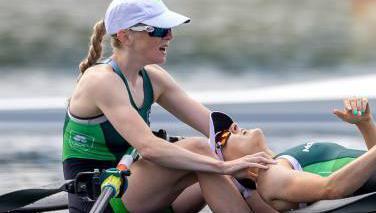
WORK DONE: Aoife Casey and Margaret Cremen after their lightweight double sculls semi-final. Pic: Morgan Treacy, Inpho
HE pat phrase goes that there are no guarantees in sport. Not in rowing. A little over 500 men and women will sit perched on the start line at the Vaires-sur-Marne on the eastern outskirts of Paris during the 2024 Olympics and every one of them will take it for granted that pain lurks in the waters.
There’s no sure way of calculating which sport is the most testing.
Swimming, distance running, and cycling all demand extraordinary physical and mental endurance. Bleacher Report declared water polo to be the “toughest” back in 2016 based on strength, endurance, speed, agility, skill, and physicality.
Rowing carries weight in these conversations.
To watch boats glide along the surface at regattas is to be disabused of the agony raging within.
The payment exacted is only ever published once the finish line has been breached and athletes gasp for breath and brace for biology to progress through it’s motions. Vomiting is common and in no way the most extreme repercussion.
Most of this goes uncaptured by the cameras but there are high-profile cases.
Germany’s Marcel Hacker collapsed out of his boat and required medical assistance after finishing fourth in the men’s double sculls in Rio in 2016. GB’s Mark Hunter threw up after losing consciousness and being dragged from the boat after winning gold in the same event in 2008.
When New Zealand’s Mahé Drysdale retained his single sculls title in Rio eight years ago, he had to be helped from the boat and off the slip. He admitted later that he had ‘crossed the line’ physically but Drysdale had required every morsel of himself to claim gold, beating Croatia’s Damir Martin on a photo finish after recording identical times.
There are simply no short cuts here.
Matthew Pinsent, who retired after winning the last of his four gold medals for Great Britain at the Athens Games in 2004, revealed how it is not uncommon for rowers’ senses, such as their hearing and even their vision, to be powered down as the body funnels every atom of energy to the task at hand.
“Towards the end, everything starts to go a bit weird,” he told Yahoo in 2012. “It all starts to go. Your senses are not in control anymore and they start to leave you… Your body starts to close down anything it doesn’t need at that moment. It prioritises to the parts of the body that are in trouble, like your muscles suffering the agony of the row.”
Maybe the best visible representation of all this came out of competition when Steve Redgrave collapsed in a pile off a rowing machine while training and it was captured by a TV crew filming the ground-breaking Gold Fever documentary. Redgrave went on to win a fifth gold in as many Games in Sydney months later.
“If anyone sees me go anywhere near a boat you have my permission to shoot me,” he said after winning the fourth of them, in Atlanta, in 1996. “I do not ever want to get in a boat again. I’ve had enough.” Why then did he sign back up? What is it that draws any of them to this strange kind of glory and grind?
Is it possible that this can be somehow… enjoyable?
Fintan McCarthy laughs before he answers. McCarthy smiles and laughs a lot. He has won six gold medals across all the major events — Olympics, Worlds, Europeans — alongside Paul O’Donovan in the lightweight double sculls but that stuff is the payoff not the process.
It’s three years since the Skibbereen pair took just over six minutes to cover the 2,000m at the Sea Forest Waterway in Tokyo and claim Olympic gold on a course defined by choppy water and in a regatta that played out in brutally humid conditions.
To do that they needed outsized lung capacities, huge VO2 maximums, and a rare tolerance to lactate buildup. This is every race and the repercussions are written in ink on the contracts they sign in their minds. Inviolable and constant.
McCarthy is no conscript.
“Yeah. It’s very ‘Type One’ enjoyment, for sure, but adrenalin and all that… At the end of the day, it is chemical and you can get addicted to it. I don’t know any other feeling like being in the middle of a World or Olympic final and you’re about to be the best in the world.
“So that side of it is really enjoyable. Physically, obviously, it’s painful and your brain is telling you to stop. It wants you to stop because it is putting stress on your body, but it is very hard to compare that feeling to anything else.”
World Rowing interviewed Juergen Steinacker, the then chair of the Fisa Sports Medicine Commission, five years ago. The good news, according to Steinacker? The first 100m are ‘free’ as the rower runs on anaerobic energy already stored in the muscles.
The bad news? Everything after that.
Our supply of anaerobic energy is limited. It dissipates quickly so the body turns to plan B and we breathe heavier to get oxygen to the muscles. That lasts maybe 80 seconds. Then we reach “maximum oxygen consumption” and the body is already building lactate to compensate.
Lactate doesn’t go directly to the blood, it takes time to find its way there, and the body hits maximum lactate levels in the blood by the third minute. That’s halfway through the race for O’Donovan and McCarthy. Halfway! There are no more reserves to call on after that, no red button for the brain to push.
It’s suck it up or quit.
“At 1000m you don’t have a big reserve anymore, you are running at your maximum. You need to be mentally able to sustain this speed… and then the real race starts,” said Steinacker. All this and the knowledge with it that too much lactate buildup too early in the race can hurt muscle efficiency and performance down the stretch.
Daniel James Brown describes this beautifully in his book The Boys in the Boat, which tells the story of a University of Washington crew made up of working-class boys who emerged from the Great Depression to win the men’s eight gold medal for the USA at the 1936 Berlin Games.
Brown explained how the endlessly complicated sequence of movements required to make a boat go faster become consequentially more difficult again as that speed increases.” Put another way,” he wrote, “beautiful and effective rowing often means painful rowing.” This isn’t an equation most people would care to solve.
The book highlights the psychological paradox that the athlete requires. Rowers who must be both oil and water, fire and earth. People in possession of limitless self-confidence, strong egos, and gargantuan willpower but who are immune to frustration. Rowing demands, Brown said, an abandonment of the self.
Seriously, what kind of person would wantonly do this?
“You have to be a bit crazy,” laughs Aifric Keogh who won bronze in the women’s coxless four in Tokyo and rows again in Paris. “If you ask any of our friends who don’t row they will say, ‘yeah, there is something not right up there’, but it feels a bit normal in such a massive group.
“Rowing is a very simple movement but it isn’t easy. It’s not just about outworking the people next to you. I always work very hard but that doesn’t mean I will be the fastest out there. Sometimes all the effort you put in can actually slow down the boat.
“So it is a balance of skill and finesse while also using the physiology that you have used years and years to build up. It is a game of patience. You don’t often see someone in 12 months shoot onto an international team and start winning medals so it’s rewarding to see the reward come from it. So, a bit crazy and a lot of patience.”
Skill and finesse aren’t words we associate with a sport where ‘pulling like dogs’ became the catchphrase but Keogh’s point is well made. Some rowers are single scullers but most are members of a crew of either two, four, or eight, so coaches spend endless months agonising over the ideal combinations and skillsets.
It’s as much art as it is science and, once chosen, it falls to the rowers to maintain a collective rhythm even while their lungs and their legs are screaming and burning and their arms are aching. Jack Dorney, a member of Ireland’s fours this past season, describes the pain as an itch where the urge to scratch is the thought of stopping.
Antonio Maurogiovanni, Ireland’s high-performance director, has put it that sports like volleyball and basketball are games while rowing is a discipline. Dorney loves that and, like pretty much every rower you talk to about this almost unnatural pursuit, is happy to embrace the suffering for the “ecstasy” that comes with pushing first past that post.
Thing is, there will be 138 rowing medals handed out in Paris. So for almost one in four of those putting their minds and bodies through all this ‘the action will have to be the juice’ as Tom Sizemore’s character more or less put it in the movie Heat when balancing the risks of a daring bank heist with the odds of making it out alive.
In rowing, the consequences don’t end at the finishing line regardless of the result. All the scientific data shows that a rower’s lactate might peak five minutes after the race so long stints
pumping their legs on the peloton of stationary bikes on-site are the only means of flushing the system and preventing an even higher level of torture.
Dorney remembers his first experience at the World U23 Championships, in Racice in the Czech Republic three years ago, when his crew claimed a silver medal in a particularly tough race and his stomach was so troubled that he wasn’t able to eat until he returned to Ireland the following day.
All sorts go through a rower’s mind on the water. Some can zone out, others have their own mantras to stay in the moment. There are metronomic strokes that can be counted, tactics to be churned and computed. All of these can be used to take precedence over a physical penance that is byproduct rather than goal but one that won’t ever not be there.
“The pain would kind of set in a minute after the start,” says Margaret Cremen, one half of Ireland’s women’s lightweight double in Paris. “You’re kind of looking at six minutes of pain but I suppose it’s [about] experience and you get used to being in pain and pacing yourself and just being in the fight. That’s what I’d nearly describe our races as, like a fight.”


CONNECT WITH US TODAY



Be the first to know the latest news and updates