Split season a challenge for Semple Stadium sod
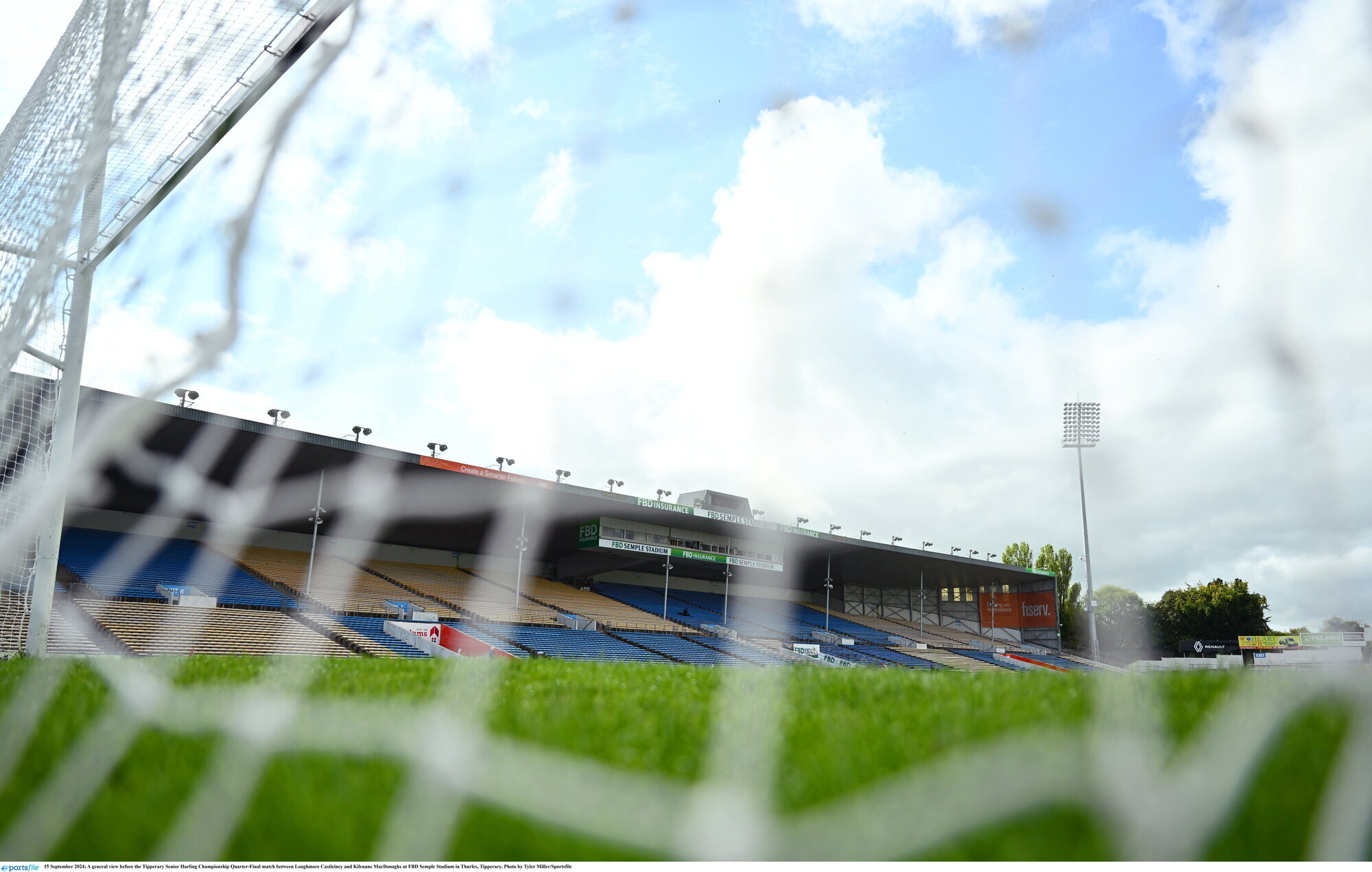
A general view before the Tipperary Senior Hurling Championship Quarter-Final match between Loughmore Castleiney and Kilruane MacDonaghs at FBD Semple Stadium in Thurles, Tipperary. Photo by Tyler Miller/Sportsfile
The nature of the GAA’s split season schedule has made the upkeep of pitches more arduous, according to a leading groundsman.
Pádhraic Greene, who has been tending to the FBD Semple Stadium playing surface since 2021, says maintaining it is tougher because of the high volume of matches in the early and late parts of the year.
Thurles’ hallowed turf was in immaculate condition for this past weekend’s Tipperary SHC quarter-finals but Greene put some of that down to the lack of fixtures in the stadium over the summer.
The pitch had suffered in February due to a perfect storm of seven games in eight weeks and wet weather, which compelled Greene to install drains at the Killinan End and close the stadium for a few weeks.
Among the games it hosted was a Limerick v Antrim Allianz Hurling League game as TUS Gaelic Grounds was unavailable due to the pitch requiring repair work following a harsh early winter period.
For Greene, the split season has caused headaches. “It’s way more difficult because in Thurles we’re getting more games at the start and the backend of the year when the growth is starting to slow down.
"Thurles, as a natural draining pitch, had no drains until this recent year where we had issues with pools on the pitch.
“Unfortunately with the split season the way it is, you’re getting more winter games and a lot of the pitches are probably not designed for so much winter use. It’s definitely becoming harder.
“The one thing I’m finding with the league going straight in the championship, there’s an expectancy that the pitch will be absolute mint all of the time. With the wet winter we had, we were going from hosting a Division 1 final and within a couple of weeks you’re into championship and you’re hosting minor and U20 championship games because they’re starting earlier and you’ve no window to get the pitch back right.”
A member of the GAA’s national pitch workgroup headed up by his former boss, Croke Park head groundsman Stuart Wilson, Greene knows many of his colleagues face the same issues.
For Semple Stadium, the winter sun often isn’t high enough over the Kinane (Old) Stand to thaw out frost on that side of the field as was evidenced in January’s All-Ireland club semi-final between Castlehaven and St Brigid’s.
“When you’re so reliant on the weather in order for grass to grow, take away one of light, heat and water and you have a challenge,” says Greene. “Grass or ground frost, golf courses are closed. If I had said that game wasn’t going ahead because half the pitch was in grass frost, I’d probably have been laughed at.
“Some of the pitches depend on what way the stands are orientated and some of them can be in 60% shade six months of the year. The grass isn’t growing so you’re getting the pitch as strong as you can going into the winter and trying to manage until the growth kicks back in the spring.”
Greene is understandably protective of the Semple sod. “Pitches are like people – they need breaks. It was not great for Tipperary being out of the championship early doors but the pitch was given a rest and that’s how you can extend the life of them.
“There are pitches getting absolutely battered and for me stadium pitches are not training pitches. If you want a good, quality stadium pitch to host all of these bigger games, it can’t be a training ground. People expect Semple Stadium to be good and with that expectation there has to be a rest period.
“In the elite Premier League soccer grounds, they have a renovation window. It’s all very easy for them because their season ends in May and they get June and July, the peak growing seasons, and have a new pitch for August.
“Croke Park and Páirc Uí Chaoimh are the only hybrid pitches in the country and in order to maintain them there has to be a renovation factor. After concerts, they are scraping the top off the pitch and reseeding.”
Presenting a surface that can be played on is the most important factor for Greene. “You have to trust what you learned in college, trust your experience. Obviously, there’s pressure but you want to put out a pitch to the best of your ability.
“Number one for me is playability. Number two, if you can present it very well, brilliant and if you do it in the winter even better because you can’t get machines on when you need to. But playability is the priority.”
CONNECT WITH US TODAY



Be the first to know the latest news and updates