Andre Quinn: ‘I’ve coached six players that had cancer. I’m the seventh’
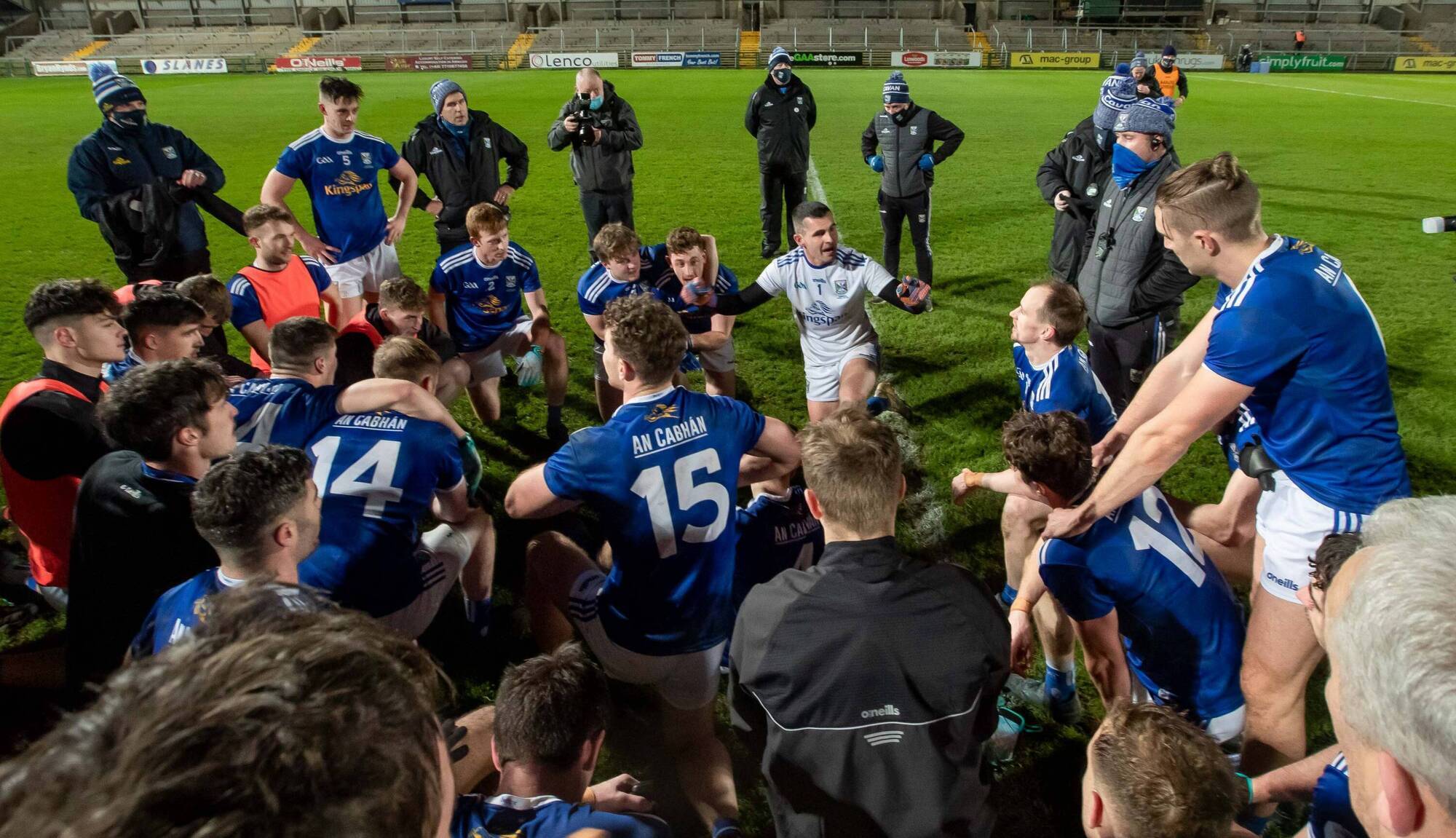
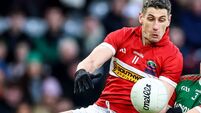
MOVEMBER MARVELS: Cavan players celebrate beating Donegal in the 2020 Ulster final. Pic: Morgan Treacy, Inpho
Something always has to give. In any field, theory and practice can clash. When that collision comes, theory has to bend. Life has an exasperating ability to get in the way.
In theory, Andre Quinn should never have left a professional sport to work in an amateur one when heaps of the industry were desperate to go the opposite direction. He shouldn’t have recently left a job he enjoyed as much as he did. He shouldn’t have been concerned with training and individual programmes at the same time as he was undergoing cancer treatment and Covid was rampant.
Quinn spent five years in total with Cavan GAA, three as the Head of Athletic Performance and two as Head of Performance. He worked with every group from the academy to senior until he recently departed. Before that, the Down native was with London Irish for a combined nine and a half seasons spending two years with Harlequins in between.
In 2018, the rugby club’s ownership changed coaching personnel once again, with Les Kiss and Declan Kidney coming on board. The constant churn combined with his partner’s desire to move home. Quinn saw an advertisement for a position with Cavan GAA and applied.
“I did do a lot of homework on it and nobody I asked said to take it,” Quinn recalls. “Everybody said to me that people are leaving the GAA to go work in professional sport. But then all these jobs are great in many different ways.
“You can get frustrated and there are moments you can enjoy. In my first year, I had very low expectations. I expected it to be less professional than it was. I was expecting way more conflict. After three or four months, I couldn’t have been more complimentary.
“The players were fantastic and open-minded. The management team, Mickey (Graham), Dermot (McCabe), Martin Corey, John Denning, they were all collaborative and clear in what they were trying to do. I felt like a bit of an outsider until the first year was finished. Then in the years after I was invested to a whole other level.”
In the GAA, strength and conditioning is a bit like economics. So many have an opinion on it no matter what their background or proficiency. Of course, everyone is entitled to a take. That doesn’t mean they don’t belong on a curve.
The same is true for the level of expertise within a backroom. Not all of the current S&C coaches offering their services are of the same quality. Nutritionists, analysts, psychologists; some are better than others. What exactly is good practice? How can an S&C coach make a difference?
Quinn’s impact in Cavan was transformative, top to bottom. Players routinely pointed to his influence, unprompted. Asking a squad member on the record to assess a current coach can be a pointless endeavour. What exactly is a player going to say publicly about someone with whom they are still working? That sort of praise is better furnished than sought.
It goes beyond dumbbells and shuttle sprints. They brought in Matt Wilkie, the IRFU's Head of Coach Development and his colleague Colin Moran, National Training and Education Manager, to host workshops and upskill coaches. Cavan built a kitchen under the stand in Breffni Park so all catering could be done in-house.
All of that advancement made his role exciting. The job shouldn’t have set borders, it spills across different departments and competencies. Quinn is a reluctant interviewee but that should not be mistaken for introversion. It must be a full commitment. He engages intensely and completely in the conversation for hours. Distinctions and details matter. Each explanation is not so much a paragraph as it is a chapter. He cares about this passion and profession.
“You've got four components to sports preparation,” he explains. “The technical, tactical, psychological and the physical. The S&C guy is universally understood to be the custodian of the physical pillar.
“It is not specific to the GAA, but I think over a period of time what you're seeing is in order to move the dial one bit further, you need to have more expertise in all the different areas.
“For example, this stuff about an S&C culture now, in any given professional team you will have multiple S&C coaches and they can distribute staff across players. Some might have a speciality within S&C or a subcategory.
“One person might be more involved with the players returning from injury, another person might be more involved with younger players transitioning from underage to senior. One might be more speed/power-based.
“There are layers. In a professional environment, the teams that I was with were data-heavy. We measured everything we possibly could. We analysed everything we possibly could. We were looking for patterns. We were looking for anything that would help give us an edge. But that wasn't at the expense of coaching.
“I remember a conversation with a Southern Hemisphere coach who said to me about being out on the field while I was working with one of the injured players. He said, ‘he can do that by himself.’
“And I said, ‘well he can. But there are levels to this in the same way that those players can go outside and play rugby without you there.’ Everybody needs a coach. Everybody needs feedback, even professional athletes who have competed for 25 years in individual sports like track, weightlifting and powerlifting.
“I would have come away every day pretty much having seen virtually every rep of every exercise. I had a very good comprehensive understanding of every single player I worked with that day. What exactly they did to the nth degree, which does make the difference, and so all the data analysis wasn’t at the expense of coaching at the coalface.”
No current churns the rumour mill quite like training gossip. One crowd are at it six days a week, another are flat out for seven. 6am training, Christmas day training, two trainings in one day. This coach is loath to engage with any of that soft talk.
“I know it was said a lot, people were even saying it to me, that Cavan were training seven days a week, 28/29 days in November and all this in the 2019/20 season. They’d say isn’t that why Cavan were successful in 2020? I've never trained a team that much; it would be counterproductive. No way. Never happened. I have the schedules mapped out for two months, November and December. The team trained a total of 33 times. On and off the pitch combined. And only one player did all 33 due to college demands, work, club and injuries.
“That is why when rumours go around about what one team or another is doing, I’d be foolish to comment on it. Who knows if it is true? I hear people use terminology like ‘they were dogged. Ran into the ground for weeks. Heavy, heavy training.’ I think it's rubbish because if you were to say to any professional coach, what are the factors that might lead somebody to get injured, carrying fatigue into competition, excessive fatigue, would be one of those factors.
“Another one, ‘the team who won were better conditioned’ as the reason why teams win 90% of the time. I find that is not what happened in the game. I’m watching the same two teams and can’t see the physical differences as being the main difference between who won or lost.
“I remember working with the London Irish Academy team in 2019 and there was a big talking point about the players not being fit enough. A coach explained what a player was meant to be doing but he was dead on his feet after several rucks. Then I checked it. He was meant to go to ruck 2, ruck 4, ruck 6, ruck 8. This kid was going from 1 to 2 to 3 to 4. So by being tactically inefficient, you’re going to have a physical cost to that. Fitness can’t be viewed through the physical lens only.
“Fitness is the ability to meet the demands of a task, and the task is the combination of the physical, the technical, the tactical and the psychological, all within the context of the occasion. The 70th minute in a must-win championship game isn’t the same as the 70th minute in the in-house game as part of a training session. In the simplest terms, a team in the modern game is trying to apply a press. If the press gets broken, then everybody has to run back towards their own goal.
“All it takes is one chink in the armour and everybody all of a sudden starts to look pretty unfit. However it is because they have to run all the way back after one person made a tactical mistake high up the field.”
So, what did happen in 2020 as Cavan bridged a 23-year gap and won an Ulster title?
“I felt leading up to that things were going well with Cavan internally, there was good stuff going on from top to bottom. A brand-new gym opened in early February. From July 2019 to February 2020, we had no gym. That was a challenging period to make things work.
“But we got a brilliant facility. Then in mid-March, the country was shut down. I found out three days later the cancer I had relapsed. There was uncertainty about the world and the football season. I had to restart treatment, up and down to Belfast.
“While that was happening, we were in unchartered territory with preparing the team. What could we do with players stuck at home alone? Thankfully with the new gym, we could divvy out equipment among players. We had a small panel, 33/34 players. They all went on individual schedules. Some trained nine times every six days because that is what they wanted.
“Some lads were still working on a farm or whatever, so they trained less. We did workshops on Zoom and divided the group into four teams. We ran competitions, 1km or 2km runs, max push-ups, players got a kick out of it. It was loads of fun. As strange a time as it was, we used it as well as anyone could. When we came out of lockdown and did assessments, players were in the best physical shape we ever had them in. They were hitting PBs.”
He was just about to hit two years testicular cancer-free when the CT scan unearthed a relapse. The treatment took its toll. A surreal season became ludicrous.
“I’d chemotherapy and three weeks of radiotherapy. It was fine, I knew it would be cured. My last day of treatment was June 1st. Everyone responds differently to treatment. Throughout my career, I’ve coached six players that had cancer. I’m the seventh person. You want to talk about a first-hand experience, I’ve seen it.
“Chemo did not affect me, but radiotherapy was really tough. The fatigue, it’s nothing like tiredness from exercise. It is difficult to get up. All the work I was doing was phone-based or on the laptop. I’d ask Sarah to bring in my laptop because I felt I could work and within five minutes I’d be asleep with the laptop on my lap. It was 24 days of constant stomach pain. But my work was through text messages and WhatsApp, so the plan didn’t change.”
He shows more hurt at Cavan's collective struggles than he ever does of his own. Relegation to Division 4 in 2021 was beyond a low point. A bubble of optimism erected popped up in 2022 but the Tailteann Cup final defeat hit it like a dart. Lifting the Anglo-Celt exists on the opposite end of the spectrum.
“There was so much unique about it. It will be etched in my mind forever. My first experience winning a championship. The boys were actually doing Movember. All the moustaches… we were travelling by ourselves.
“The celebrations, we weren’t allowed to travel the county, so they organised the back of a truck in Breffni Park and supporters came in like a drive-thru. It went on for four or five hours until 1am. Absolutely freezing, end of November, but every player stayed out. I understand that if it was a normal year people say the experience could have been better, but it is just so memorable in my mind.”
He wants to talk about the job. He wants to stress the context and correct application of the job. The gig is still haunted by damaging myths. Take GPS. In his experience, it can be used live when you know what you are using it for. What exactly would you use it for? GPS is like the odometer in the car, not a fuel tank gauge. It doesn’t reflect how much energy is a player has and it shouldn’t be used for that.
“I hear all the time about players being withdrawn because ‘the GPS was saying there were gassed.’ “Full-back Padraig Faulkner is operating at 90 metres per minute. Midfielder Conor Brady is at 140 metres per minute. You can’t look at that and say Padraig is less fit than Connor is. He is fit to meet the demands of his task; his role is different.”
That is how it works. Set the goal and know the course to get there. Avoid the potholes and ditches along the way. Don’t seek a shortcut along the way because more often than not it is a dead end.
“You have to be clear on terminology. For example, there is a difference between a conditioned game and a conditioning game. A conditioned game uses constraints or rules to achieve a technical/tactical outcome, such as a rule that leads to more forward kick passing, or wider pitch dimensions to encourage width in attacking play. A conditioning game is when the primary aim is physical fitness and would be used for similar reasons you would have players run up and down the field. But I hear these terms used interchangeably all the time, leading to confusion.
“When I was at London Irish, we used an end zone game. A standard conditioning game, but nobody could score unless everybody was in the end zone. So that meant that you couldn't stay away 20 metres back or stand still in the backfield. Everybody had to work to get there, right?
“We used a live heart rate monitoring system at the time, and we had this rule set when if a player dropped below 90% of their max heart rate, they were given a nudge by a coach to lift it. There would be ten-plus staff around the edge, firing a ball back in whenever it went out. If a ball came out of play, it came straight back in again, so there was no stopping.
“The game never stopped within the block of two minutes. It was 12 sets of two minutes. Two minutes on, one minute off. All the coaches had radios. I’d radio across and say, ‘hey, he has dropped. He's just dropped down to 86%. Dodge (Paul Hodgson) give him a nudge there.’ And Dodge would be on his case, go, go. You're below 90% and he would know what we're trying to do. Get the finger out and get up above 90% again.
“I applied the same type of game as end zone with Cavan. We added another layer to it, end zone and break to the outside of the grid and back in again. We had poles outside the grid. Let’s say it was 8 vs 8 and it was 45 metres wide by 65 metres long. To score everyone had to get inside a ten-metre zone. Outside the width of the pitch, there were poles 10 metres wider again. Classic long poles.
“Maybe four of them spread along the length on one side and the other. And if I blew the whistle randomly within the two-minute block, the players had to immediately leave the grid, get around one of the poles and then back into the game again. We had players hitting over 200 metres a minute doing this across the two-minute blocks on average, across six sets.
“Now do the math on that. Compare it to running up and down the field. If we do 17 minutes of end zone, six blocks of two minutes, and five minutes total of rest. For us the equivalent distance running up and down the field would take us 15 and a half minutes. We’re only 90 seconds quicker and there is no ball. That sort of running, there is no decision-making or thinking.
“But the point here is that the above games were just examples of conditioning games where the physical outputs were the primary aim, and the technical aspects were non-specific, and the tactical aspects were zero. So you wouldn’t use it in place of training time needed for tactical work, but you might consider it as an alternative to just running.”
Unexpected obstacles always appear. When he started out in the noughties, every coach had their own silo and communication wasn’t always forthcoming. That is an inevitable consequence of working with people. And yet a basic requirement is to consider every piece.
How can anyone be responsible for the performance of an engine if they are in the dark about the fuel going into it? How can you truly understand a player’s performance without factoring in lifestyle, behavioural and cultural influences? The crux is combining resources and working together.
Quinn was announced as part of new Cavan Manager Raymond Galligan’s recent appointment but has since resigned. “It didn’t end the way I hoped it would, but the main thing now is I just want to see all the players do well,” he replies when asked about that decision. “I’ve huge affection for that group and want to see them do as well as possible, on and off the field.”
He is job hunting now. There is every possibility that means moving abroad. This path could lead anywhere. The story of his life.
I don’t know what’s next. I’m open-minded to any project of any kind, but I’m not looking to rush into anything either.”


CONNECT WITH US TODAY



Be the first to know the latest news and updates