You could always blame the headphones
I see the Sloan Sports Analytics Conference was held a couple of weeks ago at Massachusetts Institute of Technology (MIT).
This event is in my black book ever since they snubbed my application for accreditation a while back, but being the kind of person I am, I have moved past that insult. Forgiveness, thatâs the keynote.
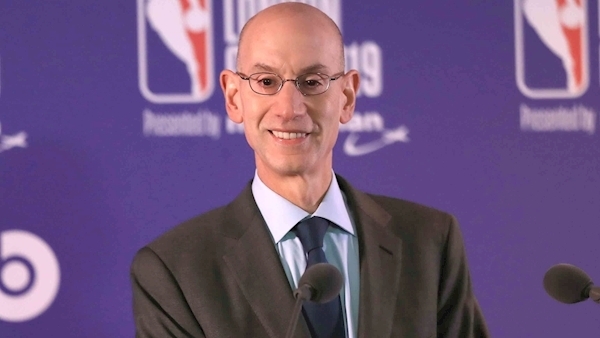
Anyway, US National Basketball Association (NBA) commissioner Adam Silver spoke at the conference and made some interesting points about players in his league.
âWhen I meet with them, what surprises me is that theyâre truly unhappy,â said Silver. âA lot of these young men are generally unhappy.â
Referring to a conversation heâd had with a prominent NBA star, Silver said: âHe said to me, âFrom the time I get on the plane to when I show up in the arena for the game, I wonât see a single person,â
âThere was a deep sadness around him.ââ
I donât know if you can see where this is going, but I can. And sure enough, Silver went on to discuss how championships are âwon on the busâ, as in, theyâre won by players who bond together as a team, not necessarily in training or games but in the way the players gel off the field or basketball court... We havenât quite hit our target yet, but weâre getting there.
The NBA chief also acknowledged mental health isnât just a sports or basketball issue. âI donât think itâs unique to these players, I donât think itâs something thatâs just going around superstar athletes. I think itâs a generational issue,â - but then he swerved out of that lane and screeched up onto the hard shoulder, as it were.
âIf youâre around a team, there are always headphones on,ââ Silver said. â[The players] are isolated, and they have their heads down.ââ
Itâs the headphones.
Iâve lost count of the number of times Iâve heard people complain about sportspeople of every stripe wearing headphones.
How can they be concentrating? Why are they in a world of their own?
Yours truly is old enough to remember when the Walkman arrived in Ireland (âWalk . . . man? What?â), but that technological breakthrough now seems like a different century compared to the wireless buds that presumably relay ETâs fart noises from deepest space. The athlete in headphones is an obvious target because he or she looks remote, detached, uncommunicative, aloof and, if truth be told, you canât wear those vast cans without looking like a bit of a gom.
But the logic of blaming headphones doesnât stand up to scrutiny.
Why blame your teamâs use of headphones when they lose when the opposition are probably using headphones to more or less the same extent?
You want the player hopping off the bus to get distracted by your cider-scented thumbs-up so youâre angry heâs got the headphones on; but you also want him tuned in for the game. Which is it?
I was surprised to hear that Silver played the headphones card, because itâs only a short step from there to âwhy are they eating pasta when it was buttery spuds in my timeâ.
But also because it poses another question. Whatever happened to the NBA as the hip, woke, tuned-in, relevant and groovy sports league?
Silver made some other interesting points, including a reference to NBA playersâ attitude to their teammates: âThe reality is that most donât want to play together. Thereâs enormous jealousy amongst our players.ââ
Could it be that the NBA is... no better than other sports?
Perhaps. But if so, you could always just blame the headphones.
Donât get sucked into the thirst to succeed
I enjoyed a chat last week with Christie Aschwanden, whose new book is called Good To Go: What the Athlete in All of Us Can Learn from the Strange Science of Recovery.
Youâll be able to read the full interview in these pages soon, but one observation of Aschwandenâs which struck home was a point so blindingly obvious it needs to be restated.
The fact that the companies selling drinks, shakes, potions, bars, poultices and sundry other supplements and products aimed at helping athletes at all levels to recover are in that business to make a profit. Their prime motivation is bottom line, not your PB.
Her common sense also extends to the hydration-industrial complex: All those people with funky bottles downing water from the moment they wake up to the instant they fall asleep. Aschwanden pointed out the body already has a sophisticated mechanism. Itâs called thirst.
What way did you want your Rice?
Iâm not sure if anything else can be said about Declan Rice, though Iâm pretty sure nothing else needs to be said about him.
Even so . . . just when we thought weâd seen the back of his curiously blank gaze, he popped up again with his comments on Instagram and, inevitably, he had a go on the apology-generator machine: âI am aware that a poorly-expressed comment I made as a non-evolved butterfly, lounging still in my pupaâ or some such. I may have engaged in some poetic licence in reproducing his statementâs overture.
Itâs a pity heâll be lost to the national conversation here, though.
Rice could have continued to function as a marker of the emotionally evolved, for instance. His opting for England allowed a lot of people to nod and say that look heâs only a kid, we can all move on from this, right?
He could also have stayed a target for the easily offended, those people with nothing better than to flood the tubes, pages, or cybertalk-clouds with abuse for betraying the country.
This is an unusual achievement, to occupy a place in the countryâs consciousness which allows you to act as a lightning rod for the mature and the mature Neanderthal alike.
To think he gave all of that up to play for England. Thatâs the real crime here.
Laing takes you with her on her experiences
I havenât read Olivia Laingâs last book, the novel Crudo, but I enjoyed her two previous books immensely â The Lonely City and its predecessor, The Trip To Echo Spring. Laing has a particular approach, with her books incorporating personal experience with accounts of artists and writers from Raymond Carver to Henry Darger in mesmerising, dreamy narratives. The Trip To Echo Spring also features a lengthy train trip around the US, which means it only needs plain chocolate digestives to make it my perfect book. Anyway, news emerged last week of another book from Laing â Funny Weather: Art in an Emergency, a collection of essays on art and other matters.
Itâs due in 2020, so you know what to get me for Christmas.
Presents and classic NBA t-shirts to michael.moynihan@examiner.ie