O’Neill has earned a free ride on this rollercoaster
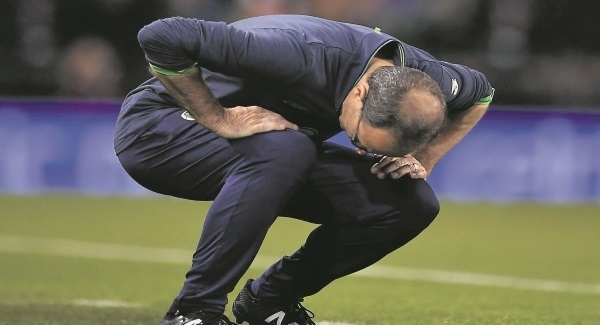
But clearly the relevant authorities in these matters have not bothered to check on Ireland’s World Cup 2018 campaign.
Back in November, a 0-1 win in Vienna saw the Irish climb to the top of Group D, two points clear of Serbia and four ahead of Wales.
That was their just reward for a positive start to the campaign which, even if the performances didn’t always match the results, saw them claim ten points from a possible 12 — seven of them earned on the road — scoring seven goals in the process.
But from that dizzying height, where the excitable were sure they could almost see Moscow, came the stomach-churning drop: three points from a possible 12 — out of three home games and one away — and a total of just two goals scored.
Now the Irish find themselves in third place, looking up at both Serbia and Wales in the table, with all those visions of entering the Russian capital in glory as group conquerors replaced by head-scratching study of the Byzantine qualification permutations which are likely to be required if we’re even to slip into the motherland through a back door.
Yet, it says something about the fine margins always separating success and failure in this tightest of groups that, before kick-off against Serbia on Tuesday night, a victory would have put Ireland back on top again.
This despite having lost so much of the momentum they had generated in 2016 with three successive draws this year, the most recent of those also the most depressing, as Martin O’Neill’s team reserved its most abject performance yet for last Saturday’s 1-1 game in Tbilisi.
Given Irish football’s unhappy history of finding a way to surrender from a position of strength, it would have been no surprise if the sight of Shane Duffy’s header nestling in the corner of the net after just four minutes had prompted George Hamilton to solemnly intone, ‘oh, danger here’.
And, indeed, it was pretty much all downhill from there as the faithful were forced to look through their fingers at the all too familiar sight of the green shirts forming a defensive line deep in their own half, the gap up to the forlorn figure of Shane Long so yawning that, in terms of what the striker could do to influence proceedings inside the Dinamo Arena, he might as well have been playing back at the Aviva.
Which he was a few nights later, and much more involved this time, as O’Neill decisively acted on the harsh lessons of Tbilisi and, in making key changes by selecting Wes Hololahan and David Meyler, brought a welcome injection of class and constructive football to the team’s approach.
Hoolahan might not be, as Robbie Savage insists, the Wessiah but it would be a very silly boy who would underestimate the almost transformative effect his willingness to get on the ball and his ability to use it creatively have on a side which is hardly renowned for its mastery of football’s finer qualities.
Fire rather than finesse has long been the Irish hallmark and, on that score too, there was much greater determination to go toe to toe against Serbia in contrast to the baffling standoffishness in Tbilisi.
The brutal irony, of course, is that Ireland came away from Georgia with a point yet departed Dublin with precisely nothing, the common denominator being an inability to land the killer blow.
The lack of a reliable successor to Robbie Keane has become almost a doleful theme tune for Martin O’Neill and, it must be conceded, with every justification.
But unless Ireland’s flat stats in 2017 are just a freakish coincidence, surely no less keenly felt since his awful leg break against Wales has been the absence of Seamus Coleman, not just for the added attacking options he provides when getting forward from the back but, perhaps even more importantly, for the skipper’s leadership qualities which, you would like to think, would have helped get the team back on the front foot in Tbilisi.
The players on the pitch simply didn’t stand up to be counted that night but, as ever in football, the buck for Ireland’s current woes stops with the manager.
It’s always the way of the game too that the most recent results dictate the popular and critical mood, which is why the ‘naysayers’ and the ‘I-told-you-sos’ are currently out in force, ganging up on Martin O’Neill.
Amid all the gloom and doom, and the concentration on where the manager has gone wrong, it’s worth remembering what Ireland have achieved under his stewardship, including such historically outstanding highlights as our best home result since Holland in 2001 (the win against Germany), our best away result since Scotland in 1987 (the win in Austria), qualification in his first campaign in charge for the European Championships via a testing play-off against Bosnia and, of course, that victory over (an admittedly second string) Italy which gave so much joy to the nation at Euro 2016.
The seemingly widespread assumption that Ireland — in the general run of things, a fairly ordinary, mid-ranking European football nation which occasionally punches gloriously above its weight — should be serial qualifiers for the big tournaments is something which, I have to confess, has always left me baffled.
Where we are now in World Cup qualifying group D, lying third behind Serbia and Wales, is hardly where we should be after the first four games but, equally, it’s not a position which most fair-minded observers of European football would regard as an affront to the natural order.
The fact is that, with two games (at least) to go we are still in the mix for qualification for the 2018 World Cup finals.
After what’s happened already in this topsy-turvy group, I wouldn’t care to predict what might happen next. But this I do know: if Ireland make it to Russia, Kingda Ka is going to have to bow down to the undisputed rollercoaster kings.