Methinks Stephen Kenny doth protest too much
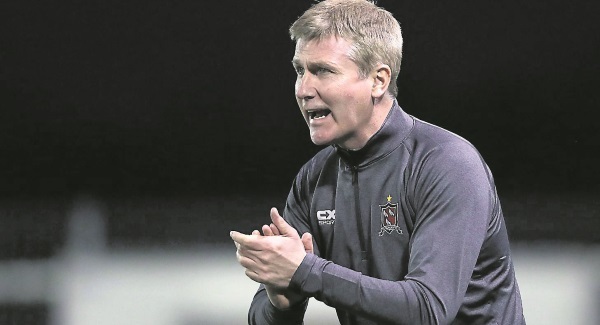

One website described his lengthy polemic as an “astonishing rant” but while you could argue the toss about “astonishing”, a rant it most definitely was not.
There was nothing spontaneous about Kenny’s combustion. These were not heat of the moment words fired off in the immediate aftermath of a match nor had he been led up the interview path by a hack with an eye for a back page splash.
Instead, 48 hours before they played at home to Bray last night, Kenny took to his own club’s website to light his big fire and he came fully prepared with the tinder of dry stats, including not only the startling revelation that his side had gone a whole calendar year without being awarded a spot-kick in the league but also that the champions’ arch-rivals Cork City had racked up 13 or - as the Dundalk website insisted on presenting it – THIRTÉEN, in the same period. “Thirteen penalties is outrageous,” added Kenny, lest anyone was in any danger of missing the point.
As I’m writing this before last night’s games, it may be that those stats have already changed: perhaps Dundalk now have a whole ONE and Cork an apocalyptic FOURTÉEN. In any event, it will be interesting as the season progresses to see if the seed Kenny has now undoubtedly planted in the minds of officialdom flowers into something rather more to his liking.
Where it all got interesting – if more than a touch holier than thou - was when Kenny portrayed his own team as saints to Cork City’s sinners “We are not going to encourage our players to go down,” he said. “We have our values. In terms of the manufacturing of penalties, the referees have to see through that. We have seen that with the penalty Cork got against Shamrock Rovers a few weeks ago where Rovers lost 2-1 in Tallaght. That sort of manufacturing of penalties has to be stopped.” Although he maintained the fig leaf of not actually naming his former player, Kenny was talking here about the incident which won the game for City late on after Sean Maguire went down under the proverbial “minimal contact” from Dave Webster in the box, and then got up to slot home the penalty.
Maguire’s reaction after the match was unapologetic: “I’ve taken a touch with my head and another with my left foot and he’s put his right foot out and he’s touched me. He’s fouled me and I went down, like anyone would in the box. It’s a clear penalty all day long. I don’t know why they were complaining.” In fact, Rovers didn’t complain anything like as much as Kenny subsequently has; at the time Hoops manager Stephen Bradley was more critical of what he called the “naivety” of his defender for making the kind of challenge which, as they say, gave the ref a decision to make.
To be absolutely fair to Maguire, in my opinion there’s a subtle but meaningful distinction to be made between a player going down under a challenge and a player taking a blatant dive.
In Tallaght, there was no doubt that Webster made contact with the man not the ball and if, let’s say, the striker had stayed on his feet but, with his progress impeded, failed to get a shot away, then what had technically been a foul would have gone unpunished. Going to ground in those circumstances is entirely different to those embarrassing dying swan acts which make all our toes curl or, more cunningly, the deliberate engineering of contact with an opponent in a bid to create something out of nothing.
But that’s the pesky detail. There’s a bigger picture here and, whether he realised it or not, Kenny’s complaints about his own side’s dearth of penalties – in particular, he referenced two Ciaran Kilduff claims, against Cork and Limerick, which he felt had unjustly got away – can be seen to contain a credible counter-argument.
Which is this: if the all too human fallibility of referees and assistant referees means that, over the course of a season, entirely legitimate penalty claims are going to be denied – among a range of other wrong calls made all around the pitch - then you can hardly be overly critical of players for trying to even things up by making the most of whatever tempting opportunities come their way in the box to ensure a spot-kick.
Only this week in the Champions League, there were two glaring miscarriages of justice based on nothing other than the limitations of the human eye: a penalty wrongly awarded to Bayern Munich for handball against Real Madrid and, of more serious consequence because it decided the final result, a penalty wrongly given to Atletico Madrid against Leicester City, after Antoine Griezmann was taken down just outside the box by Marc Albrighton.
I’ll spare my long-suffering readers yet another hydra-headed screed here on what I’ve long believed is the overwhelming case for the introduction of the video ref to football, except to note that, as evidenced by the various trials of the technology already under way, and with growing popular support reflected just this week in the RTÉ panel’s approving comments, it’s becoming increasingly clear that it’s now a matter of when, not if, the all-seeing Third Eye becomes a fixture in the elite game.
And amen to that.
Given the costs involved, the question of when, or if, the VAR percolates down to a more modest set-up like the League of Ireland is another matter and, ultimately, one which will probably depend on the willingness of FIFA and UEFA to ensure parity of esteem across the top levels of all their associate members.
In the meantime, there will continue to be plenty of fuel for fuming gaffers and everyone else to, as John Lennon had it, “keep on playing those mind games.”
Though Winston O’Boogie’s utopian dream, as stated in the song’s next line, that the same games would serve the purpose of “raising the spirit of peace and love” is, one suspects, likely to be put to the test the next time Ireland’s ‘New Firm’ lock horns, in Oriel Park in June.