Fans thinking outside the box for viewing habits
As far back as 1936, the Nazis assured us, in their promotional literature for the broadcasting of the Berlin Olympics, that televised sport would be of “unsuspected importance to the progress of mankind”.
They called that one, Hitler and the lads. Until very recently, it has not been possible to detect any stalling whatsoever in the progress of mankind in this important area. All we know is progress.
Through the 1940s and ‘50s in America — as pointed out by Martin Kelner’s book Sit Down and Cheer: A History of Sport on TV — sport was the most reliable means of shifting TVs sets.
NBC pioneer Harry Coyle did his service to mankind: “When we put on the World Series in 1947, heavyweight fights, the Army–Navy football game, the sales of television sets just spurted.”
When Sky got serious about installing satellite dishes, they too quickly earmarked sport as a more seductive prospect even than Pat Sharp’s UK Top 40.
Indeed Rupert Murdoch romantically described sport as a ‘battering ram’ for subscription television. He possibly foresaw too that The Simpsons wouldn’t be watchable beyond the nineties.
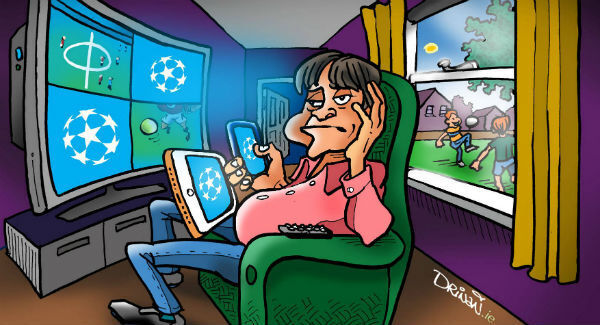
And before long we had a red button and Player Cam and then one day we found ourselves sitting in front of a television channel which asked us which of the eight Champions League matches we wanted to watch.
As giant leaps go, it was as if mankind had come back from the moon with a plan to build and sell flats.
Lately, they are still using sport to shift hardware; the Ultra HD flatscreens, as well as the broadband routers.
And maybe it is with the latter that they have complicated things. They are using sport on television to sell us the internet when it could well be the internet stopping us watching sport on television.
At least that is one of the theories doing the rounds, as the finest minds continue to wrestle with the alarming news that viewing figures of Sky Sports’ live Premier League games are down 19% on this time last year.
In a way, it is tempting to take this news as further evidence of mankind’s progress, that mankind has outdone himself by finding a way to watch all the sport he wants free of charge via illegally streaming it on the internet.
But Ken Early, in the Irish Times, had a more apocalyptic take, suggesting the mobile internet and social media has shrunk mankind’s attention span so dramatically that he no longer has the appetite for full football matches.
That he is happy enough keeping abreast of things through clips and vines and trending bantz.
Essentially, the internet is a labour-saver that is watching the football for him.
“It has become possible to watch nothing, and yet miss nothing,” wrote Ken.
Maybe those of us sticking stubbornly with the full 90 minutes are curmudgeons in the path of progress. Old ways get left behind. Just this week, the five-year-old, born into a gilded life of Sky+, offered this chilling destruction of the backward medium of cinema: “I don’t like it. It won’t stop when I want it to.”
It should be noted too that live digital television has, literally, failed to keep pace with the likes of Twitter, which brings us word of goals around three seconds before the television.
If you’re watching on both, as is the norm now, it can be baffling to hear Martin Tyler getting so excited when you’ve already scrolled past a thousand ‘GOALLL!!!! OMG!!’s.
You may as well wait another 20 seconds for the vine.
Yet, I don’t quite buy it, this idea that the internet has mushed our brains. Were we that much more sophisticated when we had to read the back of the shampoo bottle on the toilet?
Did we watch any more football when we spent the afternoon reloading Ceefax page 316? Or when we trailed around the shops hanging on text goal alerts?
Instead, I feel that football chiefs and broadcasters have made other fundamental tactical errors that have brought us to this dangerous point.
Declan Lynch of the Sunday Independent has often told us of the simple maxim he observes to keep his life in a certain order: “You should never not watch a football match.”
Long before I knew of the maxim, I remember reflecting on the essential truth of this position, possibly during Sky Sports coverage of a Victory Shield tie between Wales and Northern Ireland boys.
Sadly, it is an aspirational, idealistic outlook. And gradually it gets away from you.
You find yourself prioritising, accepting that not all football matches are equal.
In this regard, that first night of Champions League choice might just have been as provocative as it was progressive. In asking us which Champions League tie we wanted to watch, they were saying to us that it was okay not to watch the other seven. They were assuring us it would be fine if these matches were broadcast on television without us. They essentially decommissioned the Lynch maxim.
With that Rubicon crossed, they had to act swiftly. They had to give us the match we wanted to watch, all the time.
But instead they sent us to the internet. So finding streams and closing pop-ups and trying not to break the laptop when it froze every time a cross swung into the box became the new refreshing Ceefax 316.
And since they sold us high-speed broadband with our televised sport, even that’s not as painful any more.
So people tend to help themselves, rather than wait for Burnley-Watford on Monday Night Football.
Of course, all is still well when they can deliver the people what they want to see on Monday night. This week Liverpool v Manchester United brought Sky their highest ratings for three years.
There are sound reasons why they can’t bring us United and Liverpool every week, but as the music chiefs found out, it’s hard to put the internet back in its box, once it’s given any encouragement.
Rupert and the lads probably foresaw this crux too. In 1998, they tried to buy United for £625 million but were knocked back by the UK competition commission.
That would have given him a grip on both ends of the battering ram.
Heroes & Villains
Never a great leader of the line, but at a time when his nation retreats into a hard shell, he’s bravely using his profile to stand up for a bit of compassion.
No points for another mammoth effort. But word on Twitter that a barman switched over from United-Fener might be the most significant landmark yet for domestic football.
When the time finally comes, he will certainly be the first to confirm that Messi is in serious decline. It just won’t be the first time he confirms it.
The most culpable party for the weary last 20 minutes that cost Dundalk on Thursday.
The Lance Armstrong saga is a modern parable of the lying down with dogs and waking up with flees variety.