Charlie McConalogue: An investment in sport is an investment in the health of the nation
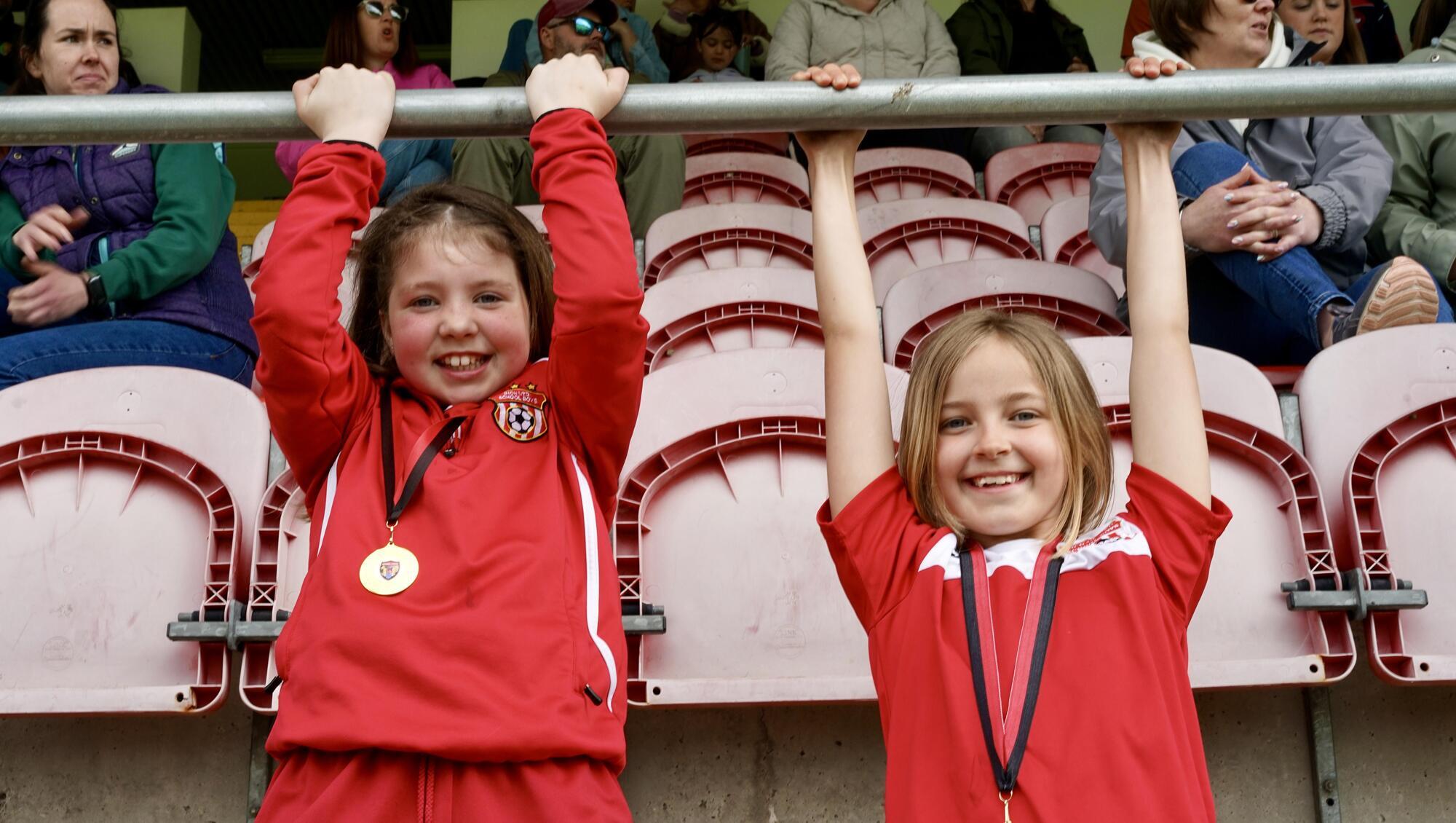
First cousins Sadie Donegan and Penny Fogarty support Killeagh at the Féile Hurling finals in MTU. Picture by Noel Sweeney
THERE is no greater unifying force in Ireland than sport. Whether it's Troy Parrott's miracle of Budapest, some David Clifford magic or a local fun run, sport has a power to bring people together like no other.
Amid the global disorder of devastating wars and the cost-of-living crisis, never has it been more important.
Today more people than ever before - some 2.16 million - are taking part in sport on a weekly basis in Ireland.
The Irish Sport Monitor (ISM) - which I launched in Dublin Wednesday, found that a third of people with a disability took part in sport on a weekly basis in 2025, the highest participation rate on record.
It is this Government's goal - and mine as Minister for Sport - to make Ireland the fittest nation in Europe by 2040. I have just returned from an EU Sports Council meeting in Brussels where we discussed active ageing through the lens of sport.
Ireland has an increasingly good story to tell on this front with the ISM noting that participation rates among middle aged and older people have increased significantly since 2017.
There are plenty of positives in the ISM report. However, it also highlights glaring pressures that are coming quickly down the track. While we are on course with our projections, a serious push is needed to reach or goal of 50% sports participation by the end of 2027.
Almost every sports club in Ireland is reaching out for help as our population grows. There were 24% more 14 and 15-year-olds in Ireland in 2025 than when the National Sport Policy started in 2017, and 40% more newborns than in 2015.
You don't need to be a statistician to realise that means a serious squeeze is coming.
As noted in the ISM report, inequalities remain a barrier to our 'Sport for All' approach.
The gender gap in sport participation is 4%, with 50% of men and 46% of women regularly playing sport.
So how do we achieve genuine gender balance? Firstly, it requires a system-wide approach to challenge some deeply ingrained and outdated perceptions, including in the media.
The argument that women’s sports lack viewership is often used to justify low coverage, when studies show that promoted properly, they can attract significant audiences.
Young girls must see it to believe it. Reading about successful sports women is a powerful tool for them. By age 14, girls drop out of sports at twice the rate of boys, often citing the lack of visible role models.
It is imperative we keep as many boys and girls as possible involved in sport as they transition from childhood into adulthood.
The benefits of lifelong sports participation are far-reaching. Studies show that consistent sports participation during teenage years boosts both cognitive function and academic performance. An investment in sport is an investment in the health of the nation.
It might surprise some people, but the Government has invested well over €1 billion in sports infrastructure and development in Ireland since 2018.
The return on this investment in terms of community participation, inclusion, integration, and physical and mental wellbeing, is substantial.
These past months I have been travelling across Ireland to inform clubs and sporting organisations about the next round of the Community Sport Facilities Fund (CSFF) - previously known as the Capital Sports Grants programme - which will open this summer.
In 2024, over a quarter of a billion euro was allocated to 3,048 community sports clubs and facilities.
This funding has facilitated improvements in the quality and quantity of sporting facilities in virtually every village, town and city.
Our next round of funding will particularly help target areas and sports - such as boxing - that have been under-invested in over the years.
I encourage all clubs and sporting organisations to prepare for this.
Now, more than ever will clubs and sporting organisations need this fund.
In the Budget, we provided €3 million to the FAI to support League of Ireland (LOI) academies to help develop the stars of the future.
Brexit has thrown up countless challenges over the past decade, including how we approach youth development.
We can no longer wave goodbye to our best and brightest, sending them to UK clubs like Liverpool or Manchester United for training.
Now we must take responsibility ourselves.
While the €3million investment in LOI academies is aimed at helping develop the next Katie McCabe, Caoimhin Kelleher or Chiedozie Ogbene, across the board we need to do more for the grassroots. We need more coaches to train the kids.
We need more Astro pitches on which they can play, especially after the dreadful winter we just experienced. And we need better facilities where boys and girls can get changed.
Swimming ranked as the second most popular sport in the ISM report among adults, trailing only personal exercise, such as going to the gym.
Yet across Ireland, our pools are either closing their doors or are beyond repair.
Swimming is more than a sport. It is an essential life skill, crucial for safety, physical health, and well-being.
Lessons - for young and old - need to happen in order for this life skill to be learned.
The data shows that demand for swimming lessons outstrips provision. Two thirds of pools report having waiting lists for lessons.
The only way to address this is to increase the supply.
One in four pools in Ireland were built before 1990 and are nearing the end of their lifecycle. Only 2.5 per cent were built in the last five years.
There is no 50m pool in Connacht or the three Ulster counties and the average distance to travel to one is 100km. Cork, the second largest city, has no 50m pool.
I would encourage also all swimming clubs and organisations interested in developing their facilities to apply for a CSFF grant.
Over the years, we have not had as many aquatic projects as we would like to see come through CSFF applications.
Local authorities too must step up to the plate on this front, not just in relation to swimming, but across the board in terms of facilities.
The challenge now is not just to grow participation, but to ensure that everyone in Ireland has the opportunity to take part and stay involved in sport for life.
CONNECT WITH US TODAY



Be the first to know the latest news and updates