Thinking outside the box for TV punditry
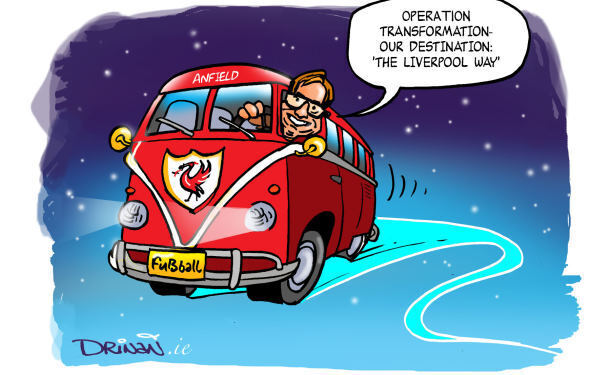

Yes, but can he do it in punditry?
We have seen many great football managers, and a handful of great pundits, yet somehow these vital professions rank far apart in esteem.
But finally, parity may been achieved. A pathway has been cleared for men at the top of the punditry game to dabble in a bit of management, if it takes their fancy.
And some day soon, this may even be possible without the right business contacts.
Of course men have graduated from punditry to management before, though largely — and we think of Alan Shearer — it has been despite their efforts in the punditry arena, rather than as a consequence of them. The career progress, to date, of Phil Neville might also fall into this category.
Others, such as Big Ron, have languished, wasted, in management, rather than dedicate themselves fully to their true calling, revamping the language of the game.
And many chancers have used the punditry chair — ideally the Goals on Sunday sofa — as a launchpad back onto the managerial merrygoround.
But now Gary Neville has been poached from punditry as Valencia have swooped.
Some hands may need holding up. Like many a top, top messiah, Gaz has climbed from modest beginnings. Who among us didn’t weigh up the heavy price of a subscription that afternoon we were forewarned that a belligerent emblem of Fergie myopia would soon be Sky’s chief analyst?
But along came that very special night three years ago, when Gaz, given the unpromising stage of a half-time interval during Stoke-West Ham, produced his first masterpiece, analysing a Jon Walters set-piece goal into a exhilarating pageant of synchronised darting and jostling by some of the game’s great jostlers; men like Robert Huth, born to jostle.
And that night, we weren’t wondering if Gaz could make it in management, rather we were thinking what hope would Arry or Pards or Big Sam have of cutting it at this level?
And even of Tony Pulis, the man behind the choreography, we thought; yes, but could he explain it in punditry?
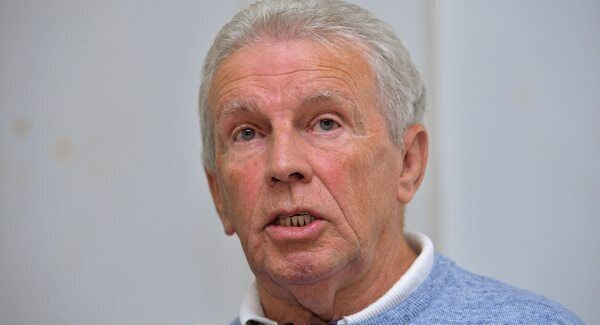
On the face of it, John Giles — one of the great pundits, though not without the odd flaw — was downplaying his own industry on Off The Ball this week, when he assured us that Neville’s work as a pundit would have no bearing on his ability as a manager.
But Gilesy quickly put things right in countering Ger Gilroy’s suggestion that a leading manager should be brought in to replace Neville, for the added insight he might bring: “I think you’d be disappointed, Ger.”
If Ger, like many others, can be forgiven for looking at this all wrong, the work of another messiah may soon change minds.
With Liverpool fans everywhere finding their current state of ecstasy undermined only by a cold, nagging terror at being dragged, once more, into that dark place where they have hope, one thing, above all, should reassure them.
Klopp has done it in punditry.
Indeed, you could argue that it was Klopp’s work in punditry that served as the surest guide to his prospects as a manager of the top, top, top, top variety.
He had made decent, if unremarkable, progress with Mainz when he took the punditry gig at ZDF TV for the 2005 Confederations Cup.
Much like Gilesy, who first persuaded RTÉ to let him scribble on the screen as he roared ‘stop it there, no, back a bit, there, no, if you could just…’ Klopp persuaded the ZDF lads — a conservative crowd — to let him draw a few circles and arrows.
He used them to get tactical points across, ZDF editor Jan Doehling assures us, “in an entertaining, funny, sexy manner”.
Doehling, talking to Raphael Honigstein, for Honigstein’s book , would go further:
“We realised that this guy knew how to put his point across and to mesmerise people. If he had started a political party, they would have voted him into government immediately.”
Klopp was back for the 2006 World Cup, flanked by Pelé and Franz Beckenbauer, with the Kaiser often nodding his agreement with Klopp’s insights. As Doehling put it: “Beckenbauer’s approval was like getting knighted for Klopp.” A world of opportunity opened.
In the political arena, we have shied away, a little bit, from the idea that a man must impress on television, before we trust him with governance. In this country, we have a twist on the idea, where a man must avoid television, lest he prove his unsuitability for governance.
But perhaps football, an insular business, is only now ready to embrace that original way of thinking. In that sense, Neville-Carragher might be our Kennedy-Nixon.
And Klopp’s proven power to mesmerise may be his most important asset.
Even amid Scouse delirium this week, you could sense two possible pitfalls ahead for Klopp’s transformative work.
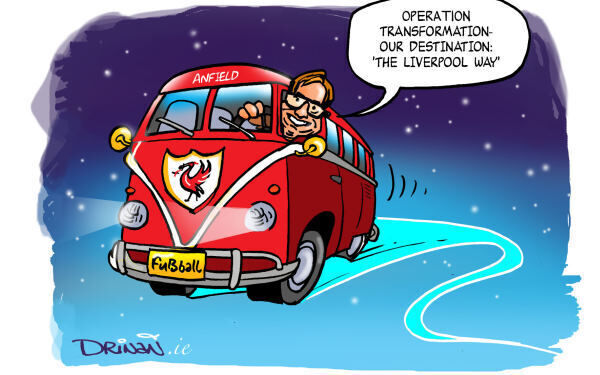
“The truth is, the training sessions are a bit boring for the players,” Alberto Moreno let slip, in praising Klopp’s tactical nous.
That notorious aversion to boredom among the footballers of the Premier League has undermined the work of many a John Foreigner with big ideas.
We have heard the occasional mutter, too, about The Liverpool Way. The odd sniff.
“There’s nothing new in football,” chuckled Graeme Souness, pointing out Liverpool tried to win the ball back long before you had to call it ‘gegenpressing’.
They will be wary too, of another philosophy, so soon after the departure of the last great philosopher. And during times of doubt that will follow inevitable setbacks, they may get flashbacks to Brendan, drawing a picture of a crown on a flipchart for Mario Balotelli, and urging him to wear the crown.
But Brendan never managed to appear on television without reminding us of television’s great comedy characters. His ability to mesmerise is unproven.
There was always the danger that a dressing room would eventually see what people at home had seen.
There is no hiding place on television.
When Gilesy returned for his second spell in management at West Brom, he admitted to having lost touch with the details of English football. He no longer knew the players well enough. A stage of affairs we may have seen repeated, now and again, in his punditry work.
Early in Klopp’s Borussia Dortmund career, the great Ulrich Hesse-Lichtenberger, writer of Tor! The Story of German Football, gave his early impressions.
“I’m aware he could be a complete charlatan who uses his brains, charisma and looks to con people into thinking he’s a good coach when in fact he might be totally useless. But I’ve come to suspect that this is the perfect job description for a football coach, anyway.”
If you can con an entire TV audience, you’re well on your way.
Heroes & Villains
“I can’t remember the last time I watched golf. I can’t stand it.”
There are times when it’s easier to warm to the man.
Superb parody of asleep at the wheel predecessors from the acting Fifa chief — dozing at a meeting to discuss reform.
A cold-eyed killer.
Listening to this lad, you can see why they put McGregor up there with Ali.