Football fans find identity in crisis

The recurring nightmare of a football fan played out for real in Bucharest last December.
Supporters of former European champions Steaua looked up at a scoreboard which read ‘Gazde’ or ‘hosts’. On the pitch, their team wore their away strip because they no longer held the rights to their colours. Club badges were taped over. The stadium announcer referred, only, to the “champions of Romania”.
Steaua, long in private ownership, had lost a case taken by the ministry of defence to reclaim all intellectual property associated with the old army team.
The matter has since been resolved, the club claims, and Steaua battle on. An identity crisis averted, the faithful allowed return to their own conflicted thoughts about the role the Ceausescus played in bringing about their finest hours — in the days when sides backed by brutal regimes were notoriously hard to beat.
In British football, meanwhile, it is identity that may be suffering an identity crisis.
Just what do we mean by identity any more?
In recent times, some supporters have had a diluted taste of the Steaua experience; the Bluebirds of Cardiff wearing the red demanded by their owner, the Tigers of Hull fighting a full rebrand, the disillusioned of Leeds exhausted at becoming a stress ball for their owner’s mood swings.
And it is 12 years since the unwanted of Wimbledon endured the full monty — a ‘disappearing’ any brutal regime would have been proud of.
They have been asking themselves searching questions up in Glasgow too, where, some say, the seemingly terminal disarray at Rangers is “an emblem of a faltering belief in Britishness in Scotland.”
A faltering belief in Britishness — and corresponding reliance on John Foreigner — is certainly at the heart of much of the identity loss epidemic.
The turgid first half between Manchester United and Liverpool in September released another hissing collective leak of identity, just as the terrible Manchester derby did last month.
“We haven’t got the Nevilles, the Carraghers anymore,” Steve McManaman moaned after the former, starved of naked hatred. Mike Phelan had confirmed it ages before: United’s identity went with the sale of Danny Welbeck.
Google fills out the pattern. “Are Watford losing their identity as part of the Premier League?”
“It is sad to see Blackburn Rovers, one of England’s most traditional clubs, lose its identity.”
“Reading FC’s identity is slowly dwindling away.”
“Club captain Russell Martin feels Norwich lost their identity.”
In these hyper-aware times, when every day requires a fresh search for meaning that can be captured in a shareable Facebook quote, every club is on the verge of some kind of identity crisis.
Last month, Swindon Town sacked Mark Cooper for misplacing the club’s identity. Just this week, Chris Ramsey became the latest to pay the price for QPR’s missing identity.
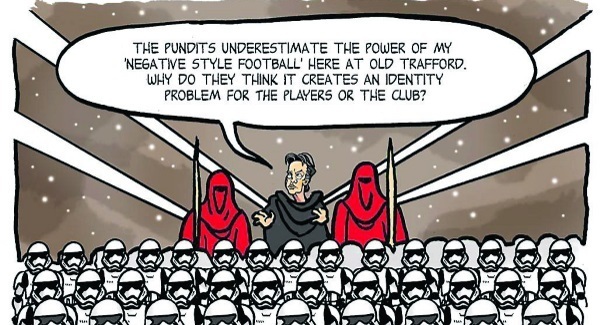
And, in a dramatic warning, Peter Schmeichel has revealed “his greatest fear” is the day Pep Guardiola becomes Manchester United manager, lest whatever shards are left of the Old Trafford identity be forever cast to the winds of possession football.
This is the intriguing modern dimension to the identity question; that supporters’ sense of self is somehow wrapped up in their team’s style of play.
In today’s equivalent of the Steaua nightmare, football fans seemingly jolt awake in a cold sweat aghast their full-backs are no longer knocking it into feet and then lie awake wondering who they really are any more.
Is identity now something that, as Brendan Rodgers seemed to think, can be fitted onto a club from a 180-page dossier?
We already see careful philosophy shopping, with PR-conscious club directors keen to matchmake the perfect marriage between a club’s identity and a manager’s philosophy; a courtship which has cost unfashionable men like Sam Allardyce.
This caper is not, admittedly, an entirely modern phenomenon. Spurs fans have always banged on about the glory game; since Bobby Moore, there has been the ‘West Ham way’; Everton have revelled in the School of Science stuff since the 1960s.
But it was generally dismissed as the kind of navel-gazing fans do when there’s nothing better to think about, such as winning.
“I hope that before I die someone can explain the ‘West Ham way’. ‘What is it? They last won a trophy in 1980, the FA Cup.”
That was Alex Ferguson’s curt dismissal. The only identity Fergie truly cared about was a winning one and you suspect that is what the United fans really miss now.
The Toffees never objected to Howard Kendall’s boys banging it up to Sharpey or Andy Gray, while the trophy cabinet was filling up again.
While Arsenal’s 21st-century identity refit as the club who play the game the right way became more cherished the longer the trophy drought went on.
So maybe identity is simply an indulgence of the bored.
And in many cases, it might be down to the sport’s summit lying so improbably out of reach, unlike in the possibility era of Steaua, Villa, Hamburg, Porto, PSV, Forest, Ipswich, Red Star and others.
In lots of places, dreams have been replaced by existentialism.Or maybe it is just that most football fans haven’t been close enough to the Steaua nightmare, haven’t looked over the precipice.
The hard-bitten fans of certain League of Ireland clubs, who have experienced rather more destabilising events than the mere rise and fall of communist dictatorships, would have assured the Steaua faithful of life after the loss of your name.
The fans of Cork City proved that. The fans of Dundalk suspect they’d survive too, having looked over that precipice and refused to let the club fall.
Amid studied national indifference, the two meet tomorrow in the FAI Cup final. The one thing we won’t be exposed to, between now and kick-off, is anyone fretting about their identity.
Dundalk attempt beautiful football, often succeed, and their fans are proud of that, but their identity isn’t wrapped up in it, nor is Cork’s in a more pragmatic approach.
It is wrapped up in place certainly, about pride in your town or city. Even more importantly, it is the fans themselves, and the knowledge they some will always be there, that preserve the clubs’ identity. Wimbledon fans know that much too.
All these people know now, that whatever they face, they can never truly lose that identity. Whatever else they don’t have, many will envy them that much.