Colin Sheridan: Is the juice for Irish golf worth the squeeze?
Doonbeg, Irish golf and Donald Trump! There's no such thing as a free lunch.
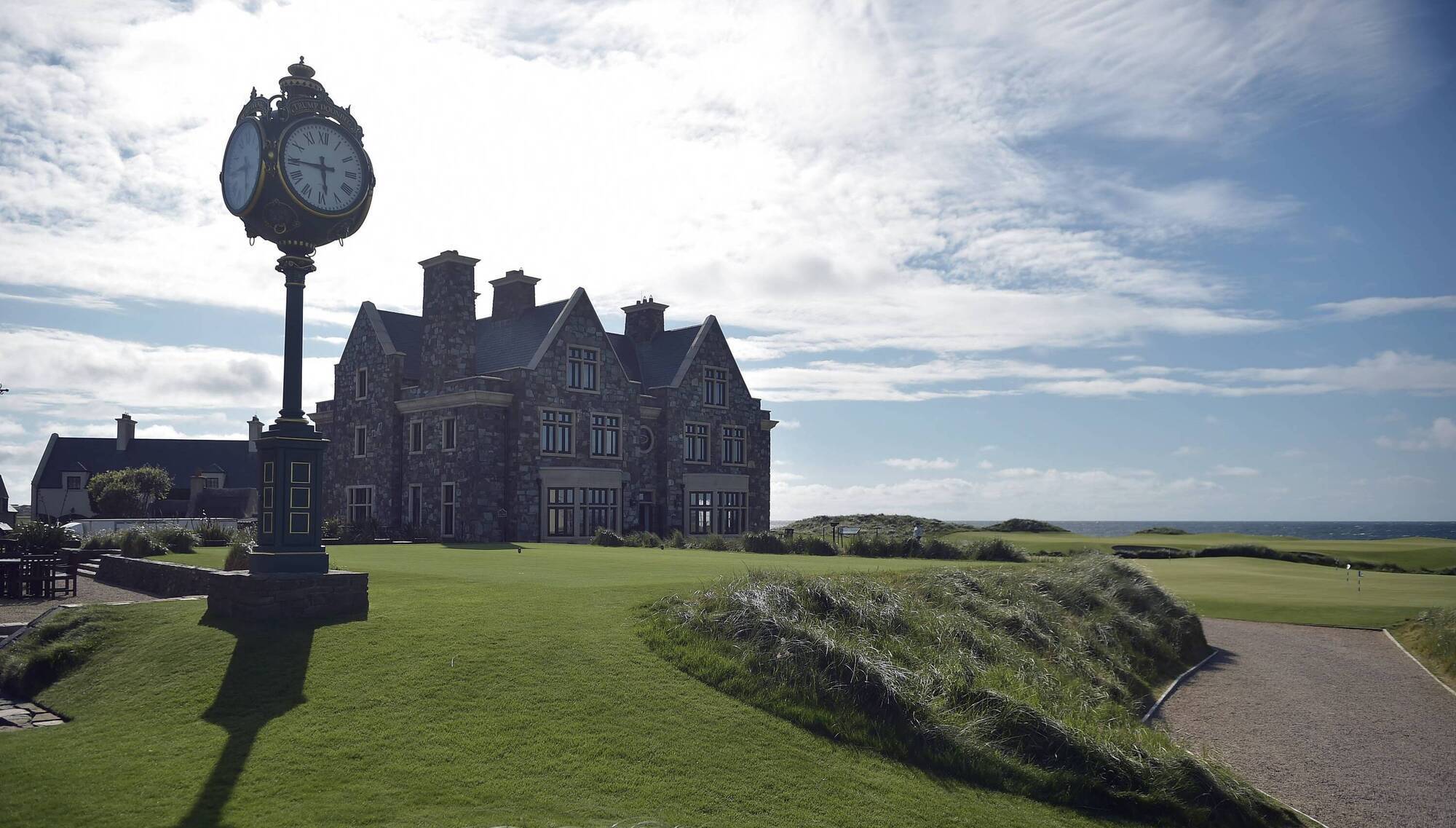
Donald Trump isn't simply coming to the Irish Open. The Irish Open is coming to Donald Trump and his Trump International Golf Club at Doonbeg. Pic: Charles McQuillan/Getty Images

Donald Trump isn't simply coming to the Irish Open. The Irish Open is coming to Donald Trump and his Trump International Golf Club at Doonbeg. Pic: Charles McQuillan/Getty Images

Ah, Doonbeg, Irish golf and Donald Trump! The unholy trinity of TANSTAAFL (There Ain't No Such Thing as a Free Lunch) theory! Irresistible in its potential for drama. Grotesque in the arrangement of its marriage. The helicopters. The motorcades. The Secret Service. The MAGA hats among the galleries and, presumably, protesters somewhere beyond them, lurking in the second cut of rough. The American president surveying the Atlantic from a links bearing his name - looking for Greenland, perhaps - while Rory McIlroy attempts to win an actual golf tournament somewhere in the foreground.

As spectacles go, Irish golf could do considerably worse. And spectacle, increasingly, is part of the gig. An international head of state attending our national open should constitute quite a coup. Except this isn't quite that. Trump isn't simply coming to the Irish Open. The Irish Open is coming to Trump.


Doonbeg is his commercial property. His name is on the gate. Every aerial shot of those magnificent links, every international news report explaining why the American president is standing beside a nine-year-old from Kilmihil eating a choc ice, inevitably advertises something he owns. Irish golf gets a presidential visit. Donald Trump gets the Irish Open. Is the (orange) juice really worth the squeeze?

Before answering, we should acknowledge that Doonbeg does not owe anybody an apology for Trump. The resort is a major local employer. The Irish Open will fill hotels, pubs and restaurants and bring tens of thousands of visitors to west Clare. For people living there, Trump is not merely an argument about American politics and moral tastes; he can also mean a job, a wage, a booking, a customer.

But Doonbeg was around before Trump and will be around long after him. He did not invent west Clare, its community, its coastline or its capacity to stage a magnificent golf tournament. The Irish Open can be wonderful for Doonbeg and bad for Irish golf while also being extremely useful to Donald Trump. All three things can be true.

Which brings us to one of modern sport's favourite expressions: "growing the game". What does that actually mean? If another 10,000 children pick up golf clubs, the game has grown. If membership becomes more affordable, public courses survive, more women and girls play, and people traditionally excluded from golf find a way into it, the game has grown.

But if the prize fund increases, has golf grown? If players already earning millions earn more millions, has golf grown? If corporate hospitality expands, media rights become more valuable and another investor discovers an asset class where a sport used to be, has the game grown?

Perhaps, but we should at least be honest about what is growing.

The phrase has become an incantation across professional sport, repeated whenever somebody arrives carrying an enormous cheque. LIV would grow the game. New markets grow the game. Bigger purses grow the game. Investment grows the game.

Football has its equivalents. Gianni Infantino's latest confrontation with Uefa over his attempt to monetise future World Cup revenues is, beneath the billions and institutional warfare, another argument about value. What is football worth? Who owns that value? Who gets to sell it? And, perhaps most importantly, does sport understand the value of what it possesses?

Because billionaires certainly do.

Private equity, sovereign wealth funds and Saudi Arabia are all hyper-aware of the emotional worth of sport to those who follow it. Donald Trump has understood it for decades. Boxing, wrestling, American football, golf: he has repeatedly placed himself alongside sport because sport offers something money and politics struggle to manufacture by themselves. Attention. Prestige. Belonging. Legitimacy. An emotional relationship with millions of people that cannot easily be bought.

Which is why Doonbeg presents Irish golf with an interesting transaction. We know what Trump brings: extraordinary attention, global headlines and the presence of the most powerful man in the world. What does golf give him? A spectacular property bearing his name, Rory McIlroy and Shane Lowry walking its fairways, enormous crowds lining its dunes and pictures broadcast around the world.

You could hardly purchase better advertising. Except he doesn't have to, as we provide it.

You can almost write the press conferences already. Somebody will ask Lowry about Trump and you can imagine the snarl before the question is finished. McIlroy will choose his words carefully until perhaps tiring of choosing them at all. Pádraig Harrington will probably try to engage with the complexity and produce something thoughtful enough to survive beyond the headline.

Their irritation would be understandable, as they are golfers, and they didn't choose the venue or invite the president. But that cannot quite be the end of it either. Professional golf cannot market its leading players as global ambassadors when it suits and then rediscover the purity of sport whenever the questions become uncomfortable.

They are enlisted to "grow the game" when that means promoting tournaments, courting sponsors and entering new markets. They cannot forever be ambassadors when ambassadorship is lucrative and merely golfers when it becomes awkward.

Nor can Irish golf run with the hare and hunt with the hound. We cannot celebrate the extraordinary exposure Trump's attendance will bring while complaining when that exposure produces questions about his toxic leadership.

You cannot have the motorcade without the microphones.

None of which requires Lowry, McIlroy or Harrington to adjudicate on gun control or the federal deficit before hitting a six-iron. But golf does need to get better at answering the question underneath all of this. What is it prepared to trade in order to grow?

Modern sport spends enormous amounts of time calculating what powerful people are worth to it, and remarkably little calculating what it is worth to powerful people.

The Irish Open at Doonbeg will probably be magnificent, and west Clare deserves its week. The hotels should fill, the pubs should prosper and the galleries should pack the dunes. Perhaps it will even grow the game.

It will certainly grow something.

We should be honest about what that is.

McKenna's glory shouldn't be in margins

There was something both magnificent and faintly tragic about Aaron McKenna becoming a world champion in Dublin on Saturday night. Magnificent because there are few harder things in sport than becoming a world champion in boxing. McKenna defeated the previously unbeaten Etinosa Oliha to claim the IBF middleweight title, at home, at 27, completing the journey from Smithborough in Monaghan to the summit of one of boxing's great traditional divisions. 

It should have felt enormous. And yet you wonder how many people even knew it was happening. That is not McKenna's failure. It is boxing's tragedy. There was a time when an Irishman fighting for a legitimate world title in Dublin would have occupied the country's sporting consciousness for days beforehand. Newspapers would have counted down to it. Radio programmes would have debated it. Casual sports followers would have known the opponent, the odds and the jeopardy. 

McKenna instead produced one of the great achievements of his life in a sport that has somehow drifted towards the margins. The irony is particularly cruel in Ireland. Boxing remains one of our most successful sports, our greatest source of Olympic medals and one of the country's deepest sporting traditions. Yet years of administrative dysfunction, controversy, fractured governance and uncertainty have damaged its visibility at precisely the moment its athletes continue to give us reasons to watch. 

Professional boxing has its own problems: competing broadcasters, paywalls, criminal promoters and an increasingly fragmented landscape in which even significant fights can disappear from the mainstream. None of that should diminish what McKenna did. It should make us appreciate it more. Ireland woke on Sunday morning with a new world champion. The shame is how many people had to wake up to discover he had even been fighting.

Femmes makes its own case

Perhaps the most significant thing about this year's Tour de France Femmes is how increasingly unnecessary it feels to describe its significance. As the peloton rolled out for yesterday's final stage, another compelling edition had already made the argument for itself. Kasia Niewiadoma attacking Mont Ventoux, Demi Vollering responding, yellow changing shoulders and seconds separating the contenders: this wasn't compelling women's cycling. It was compelling cycling. For too long, women's sport has been discussed through television audiences, attendances and worthy declarations about visibility. All important. But sometimes the sport itself is the argument. The Tour now has jeopardy, rivalry and consequence. Most importantly, we simply want to watch.

Mayo back to reality

Two weeks since Mayo’s historic All Ireland final triumph, and I announce with great authority to my children - “I shant be disturbed. It’s time I got back to my messages.” To which they bemusedly replied “You weren’t playing, dad.” If it takes me a fortnight to begin to process the magnitude of such a happening, what must it be like for the actual players, some of whom lined out this weekend for club championship matches? Kudos to one and all, as I’m barely able to type a generic thanks, never mind hit two-pointers into a gale-force in Knockmore.

x

More in this section

Sport

Newsletter

Sign up to our daily sports bulletin, delivered straight to your inbox at 5pm. Subscribers also receive an exclusive email from our sports desk editors every Friday evening looking forward to the weekend's sporting action.

Cookie Policy Privacy Policy Brand Safety FAQ Help Contact Us Terms and Conditions

© Examiner Echo Group Limited