A little bit of history repeated
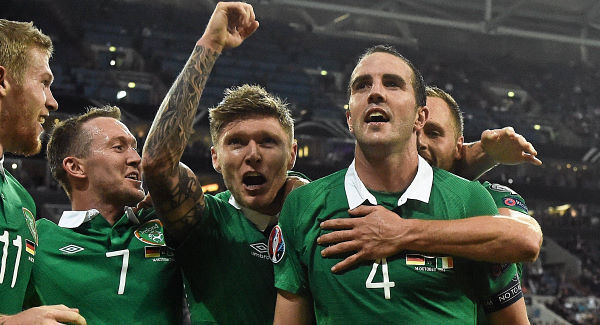
It was Darragh Maloney you felt for. I don’t know if he has the belly for it. Billo’s appetite for mischief.
“But surely... against the reigning world champions… a famous draw.”
All of this is his now. Weeks like this. He is in charge of the place where they wheel jubilation in, let the air out of its tyres and pimp it for a funeral.
The old rigmarole. Conservative selection. Spirit. Hoofing. Five minutes of football. It’s there!
Glorious parity. Jubilation. Angst. No conviction. Pass the ball. The real people. Tommy Eglington. These guys beside me. Ronnie. The martyrs. David O’Leary. John Sheridan. Mark Kennedy. Andy Reid. Wes. Football people.
The anger of the jubilant. Controversy. Relics. The riposte. We’re paid to analyse. Brian Cody. Henry Shefflin. John Oxx. Bernard Dunne. The bar is here.
Darragh’s face. Wondering how many more years. “But surely…”
We’re early in the cycle. At the stage where the five minutes of football can be taken as an indicator of rich promise, if only it can be unlocked.
And you may find yourself in a beautiful house, with a beautiful wife.
And you may ask yourself, well… how did I get here?
The argument. We have players who can play. If we play them in their right positions. If we can play like that in the last five minutes, we can play like that in the first five minutes. We know how this tends to pan out. We won’t play like that very often, not for more than five minutes at a time anyway. Even with the right players in their right positions. Instead, more conservatism, hoofing, occasional jubilation, angst, shambles, disgrace, ennui, disillusionment, consensus, exit, reboot.
And you may tell yourself.
This is not my beautiful house.
Music critic Steve Huey analysed the old Talking Heads classic. “The recited verses progress through stages of life — the first has a giddy sense of possibility stemming from newfound prosperity; the second hints at a vague dissatisfaction and sense of estrangement from the things the narrator has worked for; and the third questions the whole direction of the narrator’s life — where he had passively been ‘letting the days go by’.”
After this week, maybe Darragh is singing verse three already.
And you may say to yourself.
My God… What have I done?
Fans of Irish football have been round this course many times. Some enjoy the journey more than others. Most can relish the large automobile and the beautiful house when the major finals come round, every now and then.
Some argue for reason, accept limitations, wantDunphy and Giles to change the record.
Others can’t look beyond the hoofing. At the terror on the ball. And when they watch it, estranged, they find themselves aping Graham Taylor’s accent and muttering “Hit Les.” Or “Can we not knock it?”
For now, mid-cycle, it’s a battle for those hearts and minds. About selling other narratives. Some modern coaches might try to sell you science. They might talk about setting up an ultra-low block or the growing role verticality has to play in today’s football. Or whatever other descriptions they have for sitting deep and hoofing.
But emotion is easier to shift. An Irish bank, which played a prominent role in destroying us, is currently playing us nice music and telling us it is ‘backing brave’.
This week’s sales pitch didn’t require an act of staggering gall on that scale, but it took a little imagination, all the same, for Martin to repackage Gelsenkirchen as a night of great courage. That deciding to play, for five minutes, when defeat loomed, was an act of grand bravado. Was backing brave. “I don’t care whether we got beaten two, three, four or five. We had to go and search for something.”
There will be tougher weeks to close that sale.
There will always be tougher weeks. The cycle will repeat, with its highs and lows. Vague dissatisfaction. We will continue to ask ourselves existential questions that will annoy some. Do we not play because we can’t play or can’t we play because we don’t want to play? Unless something fundamental changes.
David Byrne had another explanation for ‘Once in a lifetime’: “We’re largely unconscious. We operate half-awake, on autopilot. And we end up with a house and family and job and we never stop and ask how did we get here.”
We’ve spent most of my lifetime, anyway, afraid of the football. Even on the good nights.
Letting the years slip by. How did we get here?
Before they left it, on Tuesday night, Dunphy remembered Hampden, 1987 and gave Darragh a history lesson. It was a glorious night, early in a cycle that offered more reason to be jubilant than most.
“Mark Lawrenson scored the goal, if you’re interested.”
“I know,” sighed Darragh, sounding a bit cheesed off by now and probably remembering how that cycle ended too.
It was a magnificent shout, all the same, by the RTÉ sports department, to play things out on Tuesday night: Bowie singing ‘Heroes’ in German.
All the more appropriate when the central figure was the strangest kind of hero.
John O’Shea, Sheasy, barely rates a mention in the spate of books released by Manchester United figures. There’s just his role as a stooge in Ronaldo’s signing or as one of the young bucks cowed by Roy Keane’s outbursts.
He might have drifted through an Ireland career too. Relied upon but largely unheralded.
A new fate awaits him now, of course. The most unsung hero since Denis Irwin.
They are fretting, stateside, at the moment, about student football players signing shirts for cash.
The NCAA are investigating these guys and banning them.
Instead of turning a blind eye and being thankful for this soft, harmless way of turning a buck while nobody else is paying them.
It was the week of the racket in racquets. Two Danish badminton players reported match-fixing approaches. Two low-ranked Italian tennis players were accused of accepting such approaches.
In all the sporting arenas where players feel under-rewarded, but there are global betting opportunities, you’d find it difficult to be 100% confident when making those bets.
The 50th-ranked badminton player in the world made less than €30,000 in prize money last year. The two Danes weren’t in that 50. The offer must have been tempting.
The college football players must get a lot of offers too.
Chips Keswick: Beautiful dismissal, from the Arsenal chairman, of the allegation that his board was too old and white: “I play bridge four nights a week and I win more than I lose.”
Mayo Mick: Mounted his defence against a one-year ban with the week’s soundest logic: “There is no way I would have been allowed anywhere near the pitch in Croke Park.”
The Gelsenkirchen ballboy: We can be thankful for the innocence of youthful German efficiency.
John Grisham: I stuck up for him with Bleachers, his foray into sport, when many hated it. Hard to make a case for him this week.