Tackling the hard questions

By their nature, such public question and answer sessions are rarely the most productive of platforms for a relaxed let alone revealing exchange of views and, even if it’s the case that Roy Keane’s utterances invariably have some meat on the bone, under the circumstances O’Donoghue played a blinder in extracting more than enough to keep everyone in the crowd — including us demanding hacks — satisfied, from his interviewee’s considered show of support for David Moyes and entertaining tales of early days on Leeside to warnings about the perils of retirement for professional footballers and that show-stopping revelation about an encounter on a plane with Stephen Ireland’s granny.
Time might have been on O’Donoghue’s side that night but, by contrast, he only had a couple of minutes in which to try to get to grips with Jose Mourinho in the bowels of the Parc des Princes following Chelsea’s 3-1 Champions League defeat to Paris Saint-Germain on Wednesday.
Barring some sensational talking point, post-match television interviews are generally notable only for their banality, a consequence of the limited time available, the practised evasion of gaffers and, too often, the timidity of the questioning, but in Paris the RTÉ man rose to the challenge of making the most out of his allotted two minutes, seeming to surprise Mourinho by first asking him if he was angry with his players and then, by way of a follow up, pointedly naming and shaming the guilty men in blue after Chelsea had contributed to their own downfall.
It meant that Mourinho could hardly duck the night’s salient issues, even if his claim that Chelsea had still been in control of the game in the second half did prompt a dismissive snort from John Giles back in the studio.
Yet, in truth, it could hardly be said that the visitors had been under the cosh all night and, but for those defensive errors, would have come away from Paris with a perfectly respectable result. Instead, the last-minute concession of a third PSG goal means it will be a steeply uphill climb back in west London.
Compounding those individual errors — most notably by the usually reliable John Terry and the always unpredictable David Luiz — Mourinho once again had cause to bemoan his team’s lack of a cutting edge.
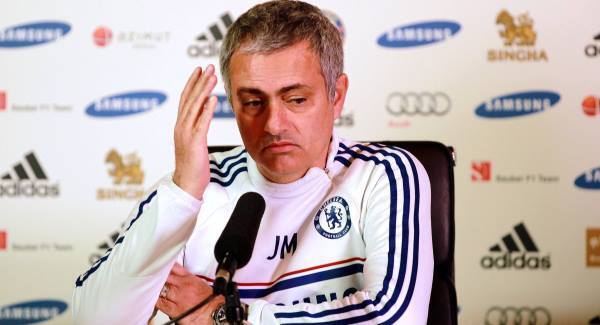
While such failings might be visible to all with eyes to see, the fact that the manager’s dismay is no less glaringly on display has got to be a worry for the Chelsea faithful who have long grown accustomed to unity of spirit — bordering on siege mentality — as the default setting at the Bridge under ‘The Special One’.
But then the bigger picture for English football after this week’s European action is hardly any more encouraging. Echoing Barcelona in their prime, possession is now nine-10ths of the law in football at the highest level, something which was evident in the way Bayern Munich against United, PSG against Chelsea and, of course, Barca themselves against Atletico Madrid were all, admittedly with varying degrees of success, happy to play out from the back, even to the extent at times of breaking one of football’s fundamental laws by passing it across their own penalty areas.
The sight of Manchester United playing like the away team at Old Trafford might have been expected given their current woes, but it was also a damage-limitation approach entirely in keeping with the Premier League’s generally inferior status — lest we forget, three of English football’s current top four are conspicuous by their absence from the Champions League shake-up.
Logic doesn’t always prevail in football, of course, which is why, on paper at least, United find themselves in a marginally better position than Chelsea going into next week’s second legs.
Credit where it’s due, David Moyes’ team answered many criticisms with the spirit and discipline of their performance against Bayern, yet it surely says something about their decline as a force in European football that we should be talking about them in much the same way as we might speak of a positive Irish performance against one of the international game’s superpowers — all that familiar stuff about guts, hard work, concentration and the importance of making the most of set-pieces. And, by the way, this isn’t only something which has manifested itself in the new era of gloom and doom at Old Trafford, as those of us who were in attendance at Wembley when Alex Ferguson’s team were blown away by Barcelona three years ago can testify.
Of course Chelsea confounded the odds to win the Champions League the following year but, unless the remaining two English clubs can surmount even greater odds this time around, all the signs are that the Premier League will once again finish the season having to content itself with the delusion that it remains “the greatest league in the world”.
But it isn’t, not when the most searching questions of all continue to be asked on the playing fields of Europe.