Mayo fans must look to future
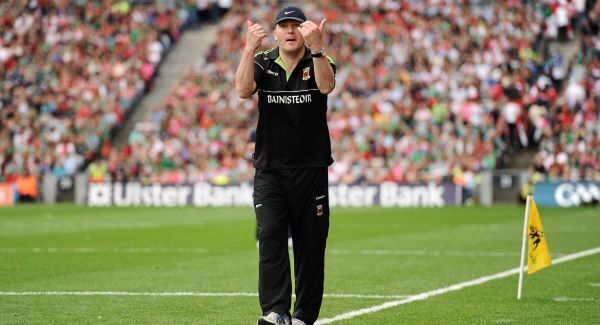

That’s what it will have to be — an assault. One from which the camp know they must come back with their shields or on them.
It’s one last tour of duty for James Horan, possibly the county’s greatest manager, as it will be for the handful of seasoned players who have decided to entwine their fates with his.
They must go it alone. Their numbers outside the circle who believe this group can win a final at the third time of asking, let alone reach another, have dwindled considerably.
If an All-Ireland title wasn’t already for themselves, it most surely is now because it is only they who are fully backing themselves to absorb the blows of the last two Septembers and repeat what Cork achieved 24 years ago.
Players in recent weeks have stated how they feel they’re getting closer to the Holy Grail but that trust isn’t so obvious in the county.
At first glance, there’s nothing necessarily wrong with that viewpoint. Back-to-back final losses throw up all sorts of negativity but Horan is inclined to think the necessary bond between the team and the fans was suspiciously weak on the day of their most recent disappointment.
In an interview with The Mayo News last week, as he rubbished the wild rumours that had spread about in-camp rows in the wake of losing to Dublin he said: “I wish there was more noise during the game than what I ever heard after it.”
His words were as much a pop at the mischief mongers as it was at supporters not finding their voice on September 22. He wasn’t questioning their presence. This, after all, was an afternoon when swathes of green and red spoilt the blue hue that usually monopolises Hill 16 for Dublin Championship games. But to him, it was all picture and no sound.
Such a dig at his own may be seen by some as a badly-advised venture. However, it’s a subject that needed bringing up.
As the team reflects on themselves, so too must their following.
To refer to their mantra first spun back in 1989, just how much faith do the Mayo following have in their team? Or, having been battered and bruised once too often, is it more in hope they make their way to Jones Road on late September Sundays? Have they become so sensitive, they are almost resigned to ritually falling at the final hurdle? Is it even a comfort for some?
In some quarters in the county, providence has been used to explain Mayo trials over these past 62 years. When that happens, sense will hardly be seen.
At the other end of the spectrum, Horan’s managerial acumen has been openly questioned. Aidan O’Shea in these pages earlier this month hit out at the extent of it: “James has taken a lot of the criticism, which is a bit unfair. Mayo people are brilliant and the best in the world but James doesn’t deserve any of it.”
His role in the game did merit detailed analysis, especially for the withdrawals of Alan Freeman and Seamus O’Shea as well as the decision not to introduce Richie Feeney. Yet a third defeat in 16 games is a Championship return many managers would envy and he retains the fulsome backing of his players, a handful of whom had privately intimated they would retire had he walked away after his third season in charge.
In taking the team’s supporters to task, Horan has diverted attention away from himself and his team, much like what he did in his attack on RTÉ after last season.
In-house, the knives will be inverted before stock is taken and everyone moves on. Among the files and folders on Saturday, Horan and his assistants plotted and schemed. A first league title since 2001 is a goal. Without three Castlebar players for the first couple of rounds at least and taking into account injuries, that will prove difficult but Mayo have a great knack of reaching semi-finals. Winning Division 1 didn’t do Dublin any harm last season or Cork, Kerry and Tyrone in recent times. He’s moving on, as his players are but just how many supporters of the team are hostages to the past?
* Email: john.fogarty@examiner.ie
Regardless of what you, dear reader, think of Owen Mulligan, , his autobiography is most surely an interesting read.
Undoubtedly, some of his views will be received poorly in Kerry but for the most part it’s an honest account of a career that sparkled on occasions and yet could have delivered so much more individually.
In some ways it’s too candid a tome. Recalling Diarmuid Marsden’s controversial sending off in Tyrone’s 2003 All-Ireland final win over Armagh, Mulligan writes:
“Philly (Jordan) got a lot of stick over that incident but he had every right to go down. Any man who says he wouldn’t have done the same thing with an All-Ireland on the line is a bullshitter”.
Jordan has long insisted he was struck by Marsden and naturally you would take him at his word.
But his old comrade recalls the incident slightly differently.
If Sunday was the last we’ll ever see of Shane Curran (pictured) on a football field then the game will be less colourful for it.
The 42-year-old’s decision to accept a recall to the St Brigid’s panel last year was one of the best choices he’s ever made. But for another generation it was an opportunity to take in the madcap brilliance of the former Roscommon star. Curran was capable of many things; he thought of himself as more than a netminder but a quarter-back and a scorer long before Stephen Cluxton arrived on the Dublin scene.
He cost St Brigid’s two points with some antics around his goalmouth in Hyde Park on Sunday and yet came out of the game in the black after a couple of fine stops.
He also succeeded in persuading the officials to cancel a Castlebar point before retiring from the game with an injury when attempting to make a save.
Would we expect anything else from Gaelic football’s René Higuita?