DONAL LENIHAN: Nuances in the contact area will be crucia
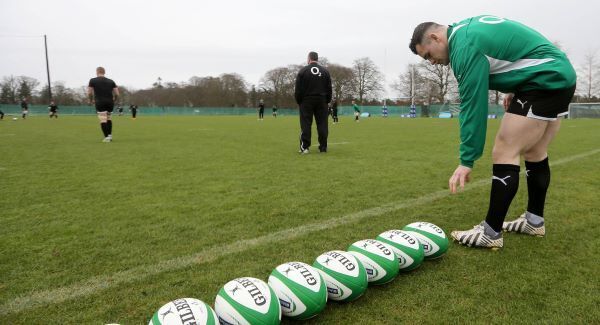
The ability of any talented back line to function and exploit deficiencies in the opposition is so often dictated by the speed and quality of ball made available to the scrum-half from broken play. That comes down to two fundamental skills, the ball presentation of the carrier in contact and the ability of the supporting players at the breakdown to get between the ball and the opposition.
The fact that England have managed to register seven tries in their last two internationals can be traced in no small measure to improved ball presentation in contact. In a game that modern coaches like to make sound complicated at times, I found a strange irony when I read during the week that England had reverted to an “old style” rucking technique, where they were getting their players to drive beyond the point of contact to produce quicker ball, hardly a Eureka moment — check out any Scottish pack from the 80s cleaning out at ruck time as a reference point. Anything that allows the No 9 to pass unimpeded with the opposition midfield on the back foot offers the advantage to the attacking side. It is not rocket science, unless you are facing Ireland, who excel at slowing down that delivery.
England have been producing quicker ball this season and reaping the benefits with an increased number of offloads and line breaks.
Ireland however have perfected the art of isolating the opposition ball carrier in their recent outings against Argentina and Wales with great reward. The effectiveness of the choke tackle has been well documented and as a result teams now choose to go to ground with the ball against Ireland to avoid that scenario. To counter that, Ireland have successfully developed a ploy where they allow the ball carrier to gain an extra yard but become isolated from his support players. Once he is on the deck, he must release or be penalised. Ireland are now generating a number of valuable turnovers by manufacturing situations like that. Will England be able to adapt? Whoever masters these basic nuances in the contact area will have a big advantagetoday.
Whenever you play against England, you know that your set piece will be put under extreme pressure. England, with massive numbers to choose from, have always produced gargantuan forwards which has meant that successive Irish packs have had to be smarter and more innovative to counter them. Today will be no different.
The scrum was the beginning and end of last season’s contest in Twickenham and so much relies on how you cope in those early engagements. Front rows are able to assess very quickly when they have an advantage over their opposite number and relay that information to the pack leader early on. That is what happened in Twickenham last year.
Mike Ross was under pressure from Alex Corbisiero even before he got injured in that game. Once he was forced off and Ireland didn’t have a natural tight head on the bench, England went for the jugular in every scrum. They will be aware that Declan Fitzpatrick, the back-up tight head for Ireland today, has had very little game time this season, which for a prop is disastrous. As a consequence they will seek to put Ross under enormous pressure in every scrum. They know how effective a scrummager the Corkman is from his days at Harlequins and will seek to physically wear him down entering the final quarter and force a change. The one plus for Ireland today is that Corbisiero, England’s first choice loose head, is out injured. He is a more destructive scrummager than Joe Marler. That said, the appalling state of the pitch won’t do either scrum any favours.
The line out is set to become a fascinating game of chess between two astute callers in Donnacha Ryan and Geoff Parling. Both are excellent in varying the delivery and recognising the opposition’s point of weakness. England will attack Ireland in the air at every opportunity and Ryan will have to be at his sharpest and not be afraid to cut the numbers in the line if necessary. England will have more options at the back now that James Haskell has replaced the injured Ben Morgan and Ireland may have to concede ball at the front to Joe Launchbury in order to mark up at the tail. Ryan has a lot of decisions to make, apart altogether from putting in his usual 80 minutes of wholehearted commitment and work around the field.
For all Ireland’s brilliance in attack in Cardiff they could well have been hauled in, despite leading by 27 points two minutes into the second half, if not for their clarity, communication and execution in defence. Leinster have won three Heineken Cups in recent years due in no small measure to their brilliance when the opposition have the ball.
With Johnny Sexton, Gordon D’Arcy and Brian O’Driscoll marshalling the midfield, Ireland have a truck load of intellectual property to lead their defence.
It helps that new defensive coach Anthony Foley has empowered the players to make decision’s in the heat of battle to shoot out of the defensive line if, in their judgment, it is on to do so. Last Saturday, rookies Craig Gilroy and Simon Zebo had the confidence and backing to make such calls. Don’t underestimate the input and leadership provided by those around them however.
Speaking to two Irish photographers on the plane home last Saturday night, both spoke in glowing terms on the direction provided by Sexton in shepherding young Gilroy through his defensive duties. Stationed behind the Irish goalposts during that frantic period in the second half, they were mesmerised by the manner with which the Irish out-half guided him through his defensive requirements.
Defence is all about communication, understanding, trust in those around you to make the right decision and execution. The fact that Ireland were forced to defend so stoutly for long periods in that second half will stand to them tomorrow. England have added subtlety to their traditional power game and with the offloading provided by Owen Farrell, Ben Youngs and Alex Goode, have the potential to unlock this Irish defence. They will take encouragement from the fact that, for all Ireland’s heroics without the ball last week, Wales still scored three tries. England will fancy their chances of emulating that effort and with Manu Tuilagi set to be sprung from the bench in the second half, have the facility to revert to type. Ireland will need to be ready to make sure they don’t.