Delivery of key infrastructure projects needed to decarbonise Ireland’s electricity system
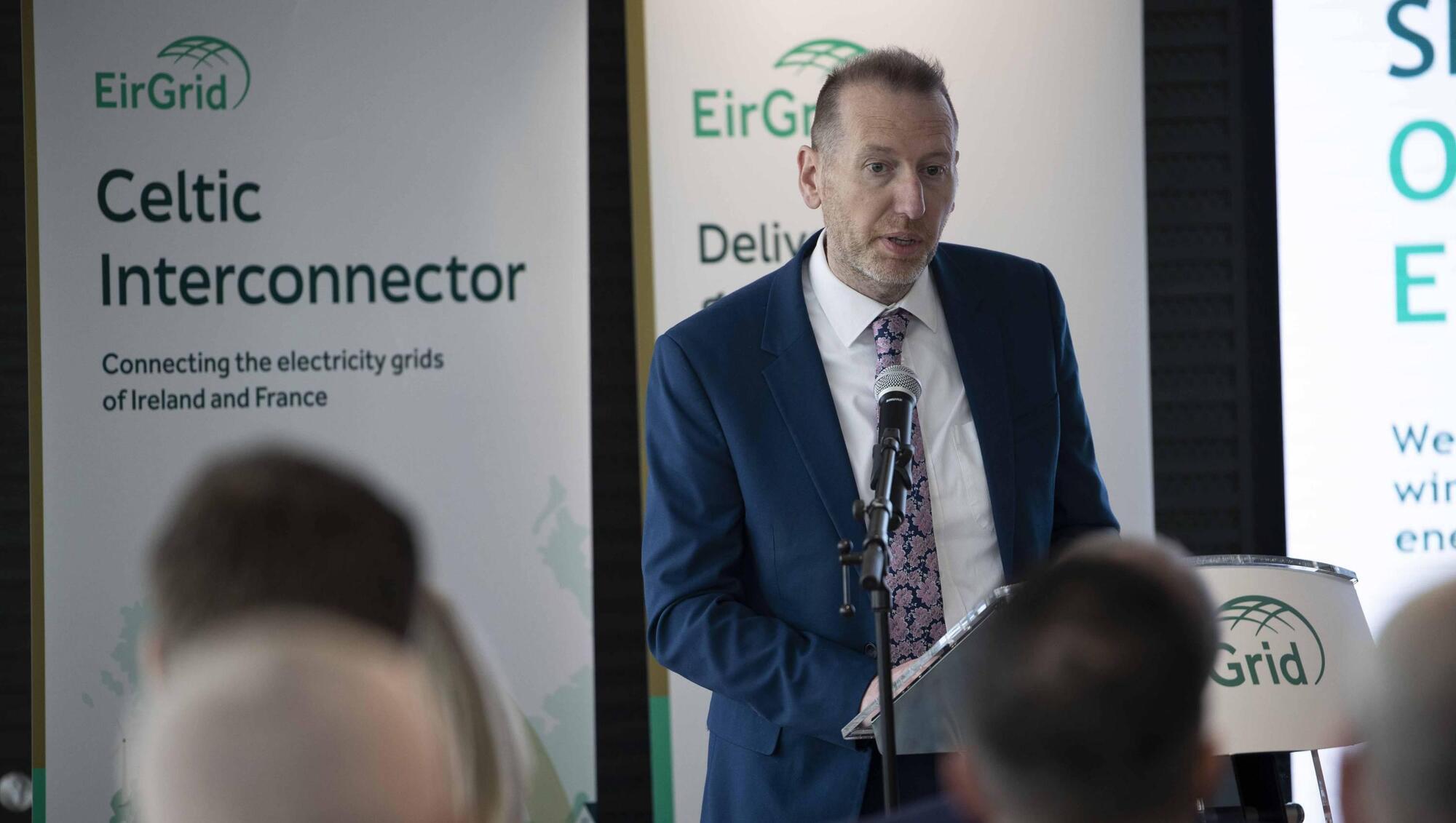
Michael Mahon, Chief Infrastructure Officer at EirGrid.
EirGrid is responsible for operating, developing and enhancing the electricity grid and market.
Over the next decade and beyond, we’ll see considerable changes to the electricity system in Ireland, in a manner none of us have seen in our lifetime.
In the past, we relied heavily on fossil-fuel burning generators, which use oil, gas and coal.
While harmful to the environment, these generators provide a comparatively reliable and consistent power source, as we balance electricity supply and demand.
Our electricity infrastructure was also developed to accommodate this type of generation, as was the supporting technology, operational solutions and markets.
Renewable energy is different. It’s less reliable and the locations with high levels of wind and solar power can often be very far away from supporting electricity infrastructure.
The manner in which this energy is managed on the grid is also very different, posing highly complex engineering and technology challenges for everyone in EirGrid and the wider energy sector.
Reinforcements, upgrades and new infrastructure are needed across the country in order to connect more renewable generators.
Much of this work is underway or planned and is outlined in our Shaping Our Electricity Future plan.
This Roadmap highlights that further interconnection with neighbouring power systems will be vital to maximise the utilisation of surplus renewable generation, accommodate variable renewable generation and shore up our security of electricity supply at times of need.
We’ll be able to export the renewable energy we don’t need and import energy at times to shore up our security of electricity supply.
One of EirGrid’s flagship projects is the Celtic Interconnector, which will connect the electricity grids of Ireland and France through a subsea cable.
This cable will link an existing electricity substation located in Knockraha, in east Cork, to a substation in La Martyre, Finistère, France.
Allowing for the exchange of electricity across 575 kilometres, the interconnector will have the capacity to power 450,000 homes.
Construction began last year, and the project is being developed by EirGrid alongside our French counterparts RTÉ (Réseau de Transport d’Électricité). It’s also partly funded from the EU Commission’s Connecting Europe Facility.
The onshore elements of the project will continue this year, with trenching and ducting works for land cables, the commencement of installation and jointing of land cables and progress in the construction of the converter station.
Marine surveys are also being conducted to prepare for the commencement of offshore marine cable installation from next year.
The project will consist of a HVAC land circuit from the network connection point at Knockraha Substation to the converter station at Ballyadam, near Carrigtwohill, a HVDC land circuit from the converter station to the landfall at Claycastle Beach in Youghal and a HVDC submarine circuit under the sea.
We estimate construction will be completed in 2026, with the Celtic Interconnector becoming our first direct energy connection to an EU member state.
The European electricity system currently has more than 400 interconnectors and is the world’s largest interconnected grid, linking nearly 600 million citizens.
With our significant wind resource on and off-shore, Ireland has the opportunity to become a major contributor in this system.
In order to support the development of the Celtic Interconnector and other strategic initiatives, we opened our Cork office last year. This year we’re looking to further build up or team in Cork to support the connection of new renewable projects in the southern region.
Beyond infrastructure changes, technology and operational solutions are needed to support our clean energy transition.
Up to 75% of Ireland's electricity generation can come from variable renewables, such as wind and solar, at any one time. This is known as the system non-synchronous penetration (SNSP) limit.
We’re exploring pathways to increase this limit.
We must be ambitious as a society and economy to implement the vast changes required.
This will help secure a low carbon future in the face of the climate crisis, so that 80% of electricity can come from renewables by 2030, as set by Government targets.