Home Q&A: Will a venting induction hob suit my kitchen?

N70 venting hob by Neff. These super-hobs can be used with an optional griddle; €2200.
No longer on the down-low, venting induction hobs are becoming standard inclusions in renovated and newly built kitchens. Despite their expense, these appliances have many breezy and unexpected talents. Let’s take a deeper dive.
First of all, what is a vented hob and its variants? As the name suggests, an extraction unit is tailored into and flush with the toughened glass surface of an electric induction hob. When the unit comes on, it pulls steam and its companion odours straight down through a filter and vent system hidden under the counter.
The stale air can either be conditioned through a charcoal filter and released back into the kitchen (recirculation system) or expelled through a duct and wall-mounted vent (exhaust system). You decide what suits your situation. Instead of two appliances (the hob and an extraction canopy), you throw the money into one piece. There’s an obvious space and sightline impact with this combination of cooking/venting — a tempting design freedom and flexibility, especially in the tighter, minimalist kitchen. Want to sear your steaks directly in front of a gorgeous view? Problem solved.
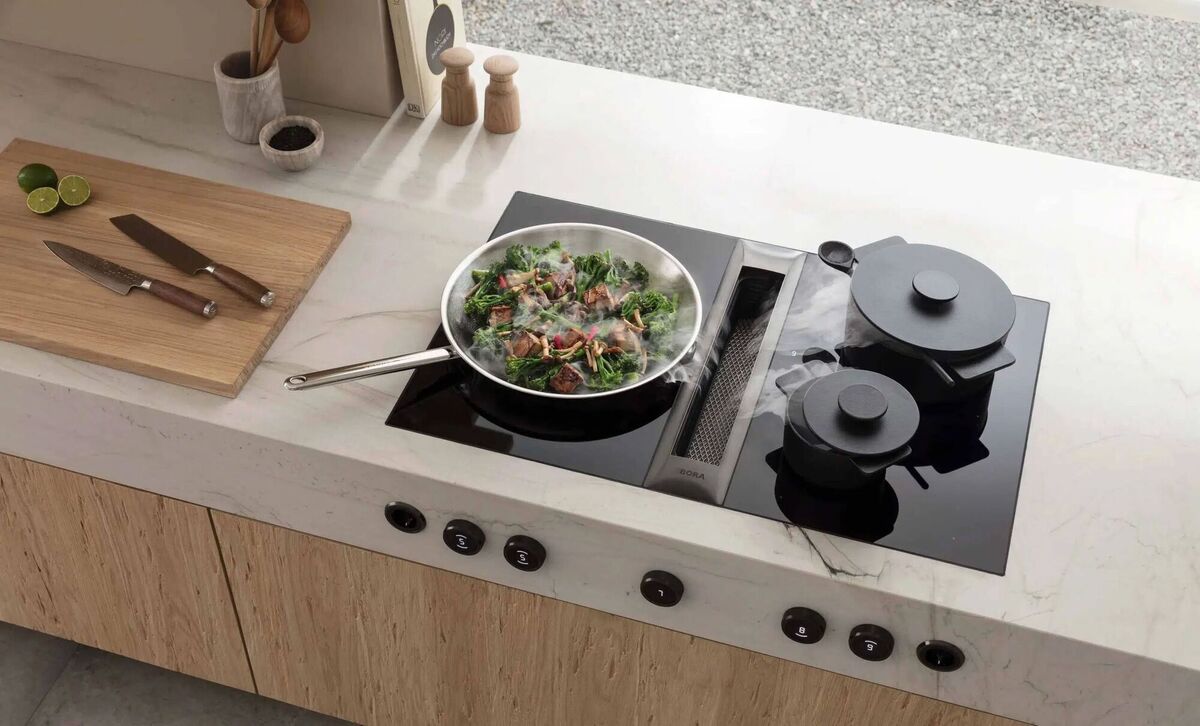
Interior designer Sara Cosgrove, who has recently become a brand ambassador for Neff appliances, says, “Integrated vented hobs are definitely the way of the future, in my opinion.
We started using them in projects about eight years ago and haven’t looked back since. Based on direct client feedback, the efficiency of newer models is fantastic and gives you huge flexibility in overall kitchen design. In terms of practicality, it really works, and I would say in 90% of projects now we tend to go for integrated extraction and avoid overhead fans in almost all cases where possible.”
Where a kitchen cannot carry a vented, integrated hob due to counter constraints, a pop-up downdraft vent can be mounted to the side or rear of the hob. These are great for smaller kitchens and perfect for a retrofit to an existing hob you’re otherwise happy with, but where an intrusive canopy extractor would date and dominate the space. Down-draft counter-mounted models must be carefully matched to the hob size/ring numbers. Prices for a pop-up downdraft vent start around €500 for an ElecriQ 60cm with an extraction rate of 603 cubic metres per hour, Buyitdirect.ie. Budget vented hobs start at €1800 for a Hotpoint 83cm induction model, rated at 405/600 cubic metres per hour, Harveynorman.ie.
All induction hobs offer instant heat, superb zoned efficiency, and easy clean-ups. It’s important to recognise that the cooking performance of a vented induction hob with zoned cooking areas is the same as that of a standard, zoned induction hob. There’s one key difference. When you’re cooking and using an updraft ventilation system (or no extractor whatsoever), steam, odours and potentially contaminated moist air are whipping past your face. There is particulate matter small enough to reach your lungs in the steam and smoke created by cooking, and recent research has indicated that the off-gassing from bringing oil to elevated temperatures can be detrimental to human health.

My asthmatic chest can sense these perceptible irritants if I even stand too close to a cheaper air fryer. With a downdraft model, including pop-up varieties matched to any hob, the steam, smells, and invisible pollutants are pulled down and away from your mouth and nose. When the air is put through an exhaust system to the outdoors, the indoor air quality is completely protected, presuming your ventilation and air exchanges are in good order, replacing what you’re losing with fresh, clean air.
In terms of ergonomics and design, with the venting job out of sight, you can lose the interrupting visual weight of that typical canopy, something that jives well with the reduction of wall cabinets — trending in kitchen flips.
When cleaning or setting the speed of extraction, a counter-mounted unit allows you to work at a comfortable worktop height, rather than thrashing around overhead.
Obviously, with a venting system right there in the centre of the action, dirt, splashes, and grease will accumulate on the components. As with an extraction unit, follow the maker’s recommended cleaning routine and filter change protocol, as this will protect the longevity of your vent and hob. Handle the showroom unit and see how easily it slips apart for routine inspections and clean-ups. Some are made with heavier materials that stand up better to the typical slings and arrows of any kitchen situation.
Vented induction hobs are significantly more expensive than similar hobs with the same bells and whistles, often 75%-100% more on the sticker price. Even Ikea’s brand-new Tacknan, 83cm hob with integrated extraction, comes in at a tasty €1,099. The sleek Ikea Langan wall-mounted extractor hood (with a rate of 322 cubic metres per hour) is just €85, with Matmassig four area hobs from €315. That said, if you’re starting out with a new kitchen or bold refresh and looking at, for instance, quality German branding, the cost of the canopy extractor has been blown away. It’s easier to throw in a venting hob if you’re redoing the cabinets and counters entirely.
Taking the role of a mechanical exhaust canopy under the counter demands room. There must be allowance made for the mechanics (the ductwork, fans, and filter housing), which will be hidden under the counter holding the hob surface.
There are highly specific clearance requirements from walls, cabinets, and particular materials for every model, so ensure you go over those details and share any concerns with your supplier/designer/electrician.
Downdraft models or pop-ups will pull back down into the base cabinet, so they need room to move over tens of thousands of uses safely and effectively. For vented hobs or downdraft extractor venting to the outside, the ductwork will be carefully designed to keep the system efficient, sealed, and safe. The price of a professional install, even where old ductwork is in place, could save future headaches here. You will need a RECI-registered electrician to put the unit in, just as you would with any venting unit, updraft, vented hob, or downdraft.

Sara Cosgrove says, “It’s important to note that most integrated vented hob models require a specialist electrical supply known as three-phase power, so they’re not suitable for every project. That said, wherever we can use them, we always try to.” Ducting from an island or peninsula can be tricky (but not impossible), so consider the added expense of not reaching up into the ceiling.
Judge the hob detailing independently of the vent and do the sums on splitting the units. In general, updraught models feature more powerful extraction rates. Consider both the assemblage and quality of the extractor element, and whether you want one set to the centre or the side of your hob. Don’t get blown away by an in-showroom demonstration of the in-hob vent.
Let’s remember, at one time, the extractor was included proudly in the cabinet work like a handsome chimney breast. Many industrial styles are zipped to the ceiling by discreet and showy housings that bounce off the other brightwork. The technology of a quality, separate modern exhaust system will deliver.
Auto vent by Smeg, for example, uses a smart infrared system which connects the hood and the hob, automatically regulating the hood extraction speed depending on the temperature and power level selected on the hob. Automated, hood-to-hob technology should always be present.
One thing you don’t get with in-hob venting is the integrated LED lighting of an overhead extractor — that focused illumination trained down on the pans. There are also some good pull-out styles of canopy, secreted behind a wall-mounted cabinet door that can be settled into the kitchen units all but unseen when off duty — a great space saver with little intrusive aesthetic impact. Going up, you are not taking cubic centimetres of storage from the base cabinets. The Elica Elica Integrated (single motor) at 60cm starts at just €120. If you don’t favour cooking on gas, and long for an anti-kitchen that flows beautifully into furnished spaces across an island or peninsula in a typical, contemporary broken-plan layout — I’m with Sarah Cosgrove. That extra investment in clean lines and discretion just as to be worth the extra spend on a good, vented hob.
- Got a question for our Home team? Email home@examiner.ie


CONNECT WITH US TODAY



Be the first to know the latest news and updates