Jennifer Sheahan: Your lighting and electrical layout can transform your home
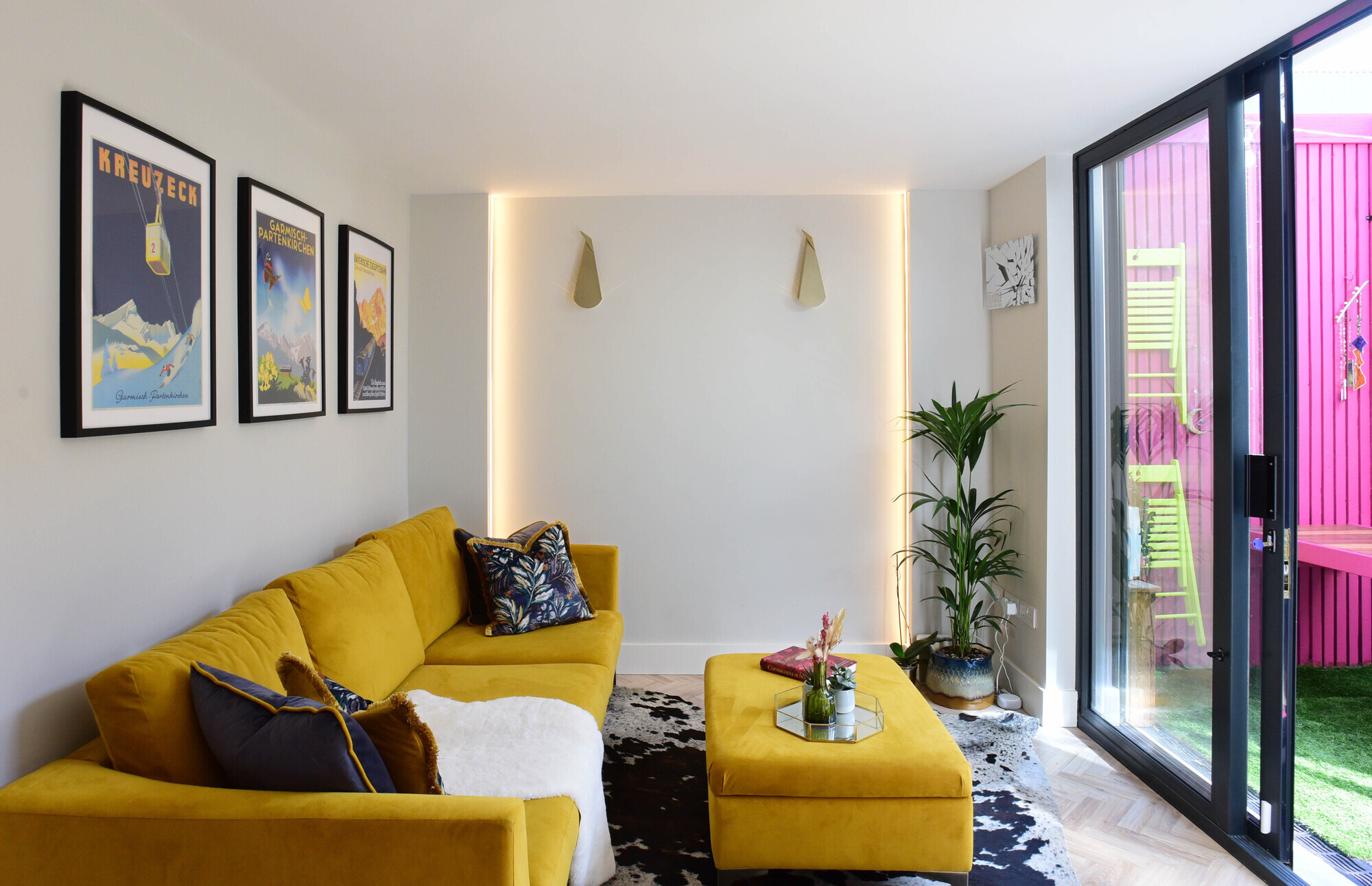
LED strips provide ambient lighting in the living room at Sheahan's home in Rathmines. Pictures: Moya Nolan
Lighting design and electrical layouts are too often left to the last minute. For first-time renovators, your contractor or electrician will probably come to you much earlier than you expect, asking you to decide roughly where you want your switches and sockets and wiring to go — a.k.a the “first fix” stage. The first fix stage of a renovation is when all the wiring goes into the walls, before the plastering goes up; so the rough positioning of your lighting, appliances, switches, sockets, and data points needs to be decided at this point. Once plaster goes up, moving anything becomes messy and expensive. That is why waiting until the decorating stage to decide on your lighting plan is often too late.
You don’t need to have final decisions made at this point — you don’t need to have chosen your fixtures and lampshades, and faceplates yet. What you do need to have decided is approximate locations, and making this decision is less about technical knowledge and more about spending some time assessing how you plan to live in the space.
I want to clarify what an electrical plan actually is first, because the term may conjure images of blueprints and circuit diagrams. It’s nothing as complicated as that. All you need to do is get a rough floor plan of your home down on paper, and then go through it, marking where you want switches, lights, sockets, appliances, and data points.
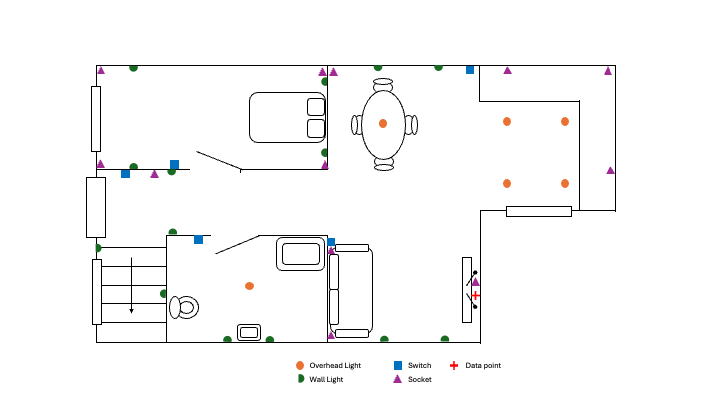
I generally do it on my laptop and use different coloured circles for each of those items, and mark those circles on the floor plan. It’s that simple. You can specify where you want wall lights or overhead lights. At the point of first fix, you don’t need anything more complicated than that.
To create the electrical plan, it would be ideal if you could physically go to your home or building site and walk through each room, but it’s also fine to do the exercise on paper if you can’t access the site (or if it doesn’t exist yet!). What you want to do is think about what your typical day will be in this home in as much detail as possible. Start first thing in the morning — can you easily reach the light switch from your bed? — and finish with the very last thing at night (perhaps getting up to use the loo at midnight!).
When you’re doing your walkthrough (virtual or in real life), be as realistic as possible. Think first about furniture placement. Where will your main items be — your couch, your bed, your dining table, your desk, etc. You don’t need to have exact measurements at first fix, but you will need a rough idea of where the main things are going.
Think about your main lights first — spotlights in the kitchen and potentially the bathroom, wall lights in the hallway, task lighting in the study. Then think about the accent lights — think about whether you’ll want a reading light beside a couch, a bedside lamp, or lighting for artwork. Think about uplighting for shelves, alcove lighting, and outdoor lights — especially at entrance points. You can consider garden lighting, too, although this is easy to retrofit later with solar lights.
Think through various scenarios — different times of year, guests in your home, and getting up in the middle of the night. Can you turn on a light as you enter a room? Can you switch it off from bed? Are you walking up stairs in the dark every evening?
Finally, think about sockets, switches, and data points. Walk through each room mentally and ask simple questions: where will you charge your phone? Can you turn on a light as you enter a room? Can you switch it off from bed? Are you walking up stairs in the dark every evening? Where will lamps sit? Where will you plug in the Hoover? Where will your TV go? Does an alarm need to be wired in?
Always err towards too much — you will never regret extra power points, but you will absolutely regret too few. If you have an older home with thick walls, factor in additional data points to ensure signal throughout your home.
If you’re unsure how to decide on your lighting, think about it in three layers. General lighting gives overall illumination; task lighting focuses on practical areas like kitchen worktops or reading corners; and ambient or mood lighting softens the room — accent lamps, uplighting an architectural feature, for example. This layered approach makes spaces feel warm and flexible. Ideally, each layer should be on a separate switch so you can change the atmosphere easily, and it’s always a good idea to put the main lights on dimmer switches.
Personally, I tend to avoid overhead lighting in living areas where possible, preferring diffused wall lighting and lamps instead. Overhead task lighting has its place, but when every light comes from the ceiling, the overall effect is like being in an interrogation room.
You do need to map out how much light you need so that you know how to space your lighting. You don’t have to get this exactly right, but a helpful rough guide is that living rooms and bedrooms generally need around 300-400 lumens per square metre for ambient light, while kitchens and bathrooms need around 500-800 lumens per square metre. Colour temperature matters too — warmer tones around 2700-3000 Kelvins feel cosy and relaxed.
LEDs remain the easiest and most energy-efficient choice.
Oh, don’t get it wrong. Just kidding — but do give yourself the best chance of getting it right by doing a full walkthrough before plastering begins, ideally at night, and imagine going through your daily routine. Are switches where you expect them to be? Is there enough power in the right places? This final check often catches small issues that would otherwise become daily annoyances.
And if you do miss something, there may be an easy solution. Technology is becoming more flexible by the day. Rechargeable lights, smart plugs and bulbs, and wireless solutions are making it easier to retrofit lighting and electrical points without ripping up the walls.
CONNECT WITH US TODAY



Be the first to know the latest news and updates