Here's how and where to get household items repaired 
Got a broken household item you don’t want to sling? We find out why mending is better for us and for the planet
Here's how and where to get household items repaired 

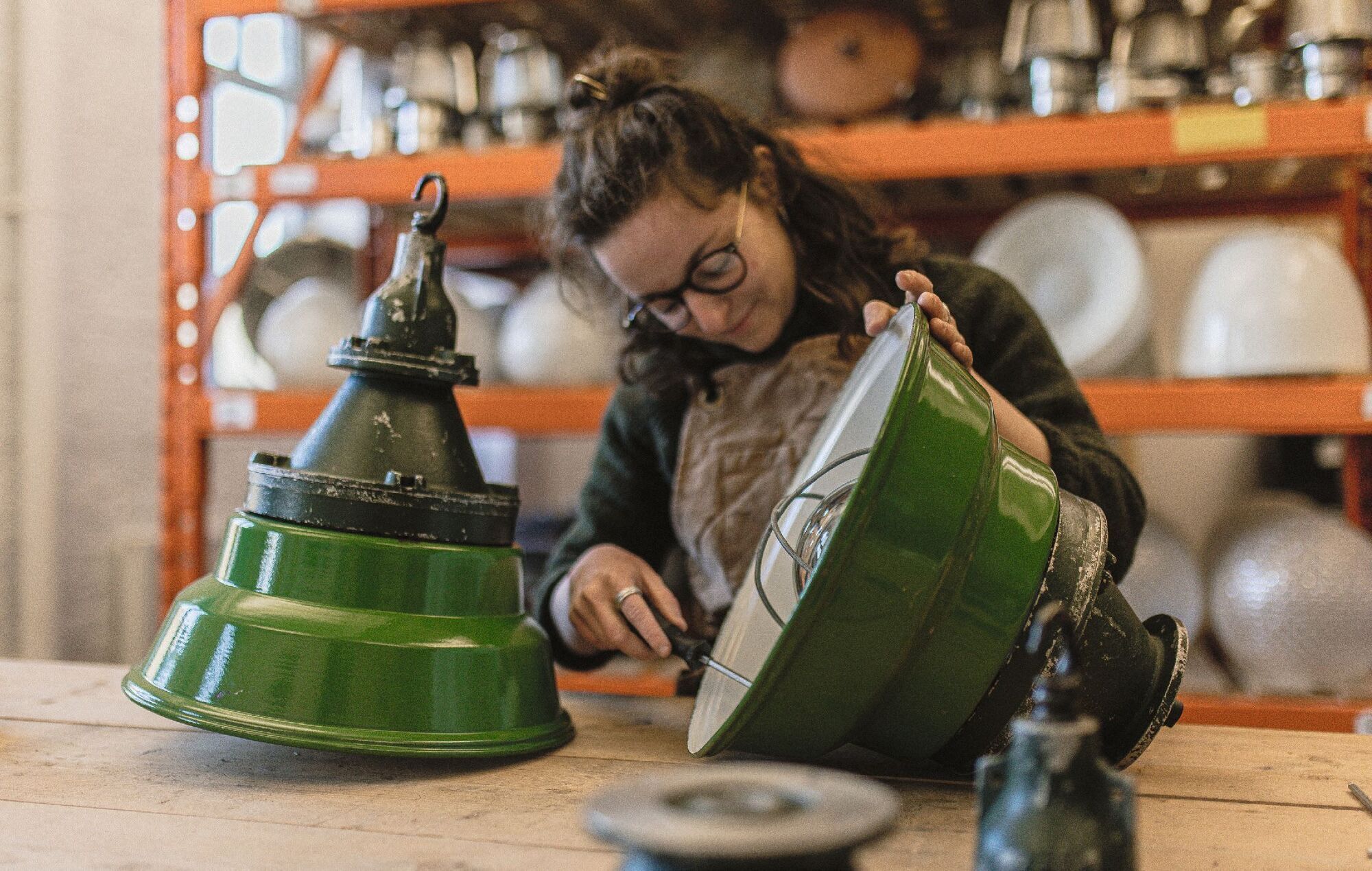
Product development engineer Rosy Seal tinkers with 1950s munitions store pendant lights in Broken: Mending and Repair in a Broken World by Kate Treggiden.

I've had four household appliances break in the last year: A two-year-old dishwasher proved uneconomical to repair; an expensive smoothie maker’s blades jammed and broke off. Its replacement, which was a gift, ground to a halt, just weeks after its warranty expired.

Recently, a third and deliberately inexpensive choice of smoothie maker lost much of its power within months and slowed to the speed of stirring a spoon, leaving an unappetising lumpy mix of spinach, cucumber, lime and mint. Welcome to the world of built-in obsolescence and the guilt of suspecting some of these broken items would end up in landfill, something which might have been assuaged had I known about the worldwide Repair Café network.

 Cane furniture restorer Rachael South in her London studio, from Broken: Mending and Repair in a Broken World by Kate Treggiden.
Cane furniture restorer Rachael South in her London studio, from Broken: Mending and Repair in a Broken World by Kate Treggiden.

Kim Eastman, co-founder of the Cork Repair Café, tells me they bring communities together to use their skills to help each other free of charge on a voluntary basis.

“It’s really very simple,” she says. “You bring in an item that needs repair. We have volunteers with some skill and knowledge of how to repair it. We talk about the different ways that the item can be repaired, and depending on what supplies we have, we go about fixing whatever it is. In the case of clothing repairs, there are opportunities to learn how to sew and use a sewing machine. Usually, it’s household items — furniture, clothing, shoes, handbags, duffle bags, backpacks, bikes, computers.”

 Take anything from a broken zipper to a lawn mower along to a Repair Café for fixing and learn about the processes involved at the same time.
Take anything from a broken zipper to a lawn mower along to a Repair Café for fixing and learn about the processes involved at the same time.

Running every few weeks, Cork Repair Café pops up on a Sunday at various locations around the city, as do Repair Cafés around the country, advertised across social media, with positive feedback from the service’s users.

“We’ve repeated attendance and many of them will spread the word and bring friends and family to the next event,” Kim adds.

But repairing or having to replace an item all starts with how we purchase in the first instance, something acknowledged by Kate Treggiden, author of Broken: Mending and Repair in a Broken World (Ludion).

She says, “The reality is that within our current systems and structures, it is often cheaper and easier to replace than to repair, especially when it comes to electrical items and white goods. The intention of the book is to show that another reality is possible and to inspire change, both at an individual level and, perhaps, more importantly, at a cultural and systemic level. I also want to show that the benefits of repair extend far beyond practicalities.

 A handmade banquette seat (upholstered by Ken Jackson Interiors) with a mid-century style table by Fergal O'Leary of Horizon Furniture.
A handmade banquette seat (upholstered by Ken Jackson Interiors) with a mid-century style table by Fergal O'Leary of Horizon Furniture.

“Mending is better for the planet, but also better for our mental health, sense of personal agency and our connection to our local communities.”

At the same time, however, she recognises that more easily repairable items can come at a cost. “The ability to purchase things wisely is a privilege,” she says. “It is often much easier to repair something that has been made to a higher quality and therefore costs more, and this is not accessible to everyone.”

It’s a point taken up by Irish furniture maker Fergal O’Leary of Horizon Furniture. “Pieces handmade by a skilled artisan can offer higher quality and more attention to detail than mass-produced goods,” he says.

 Broken: Mending and Repair in a Broken World by Kate Treggiden. Published by Ludion, €34.90.
Broken: Mending and Repair in a Broken World by Kate Treggiden. Published by Ludion, €34.90.

“They can offer surprising benefits for the environment. Handmade products are greener than products mass-produced in enormous factories. Work done by hand takes less energy than a mass production assembly line. There is less waste, a clean version of farm-to-table, if you will.”

Repairing is occasionally a feature of Fergal’s working life when a chair needs a leg or rail fixed because chairs get more use than other furniture. Similarly, a table might need refinishing after day-to-day wear and tear in the kitchen.

“Over the years we’ve restored many classic furniture designs for our good customers,” he says. “The wishbone part of Hans Wegner’s Wishbone chair is a common flaw. We’ve also repaired the extending mechanisms of classic Scandi teak tables.”

But repair isn’t necessarily an option for all furniture and it comes down to the quality of materials and workmanship, as Fergal notes.

“If there is a problem with a mass-produced product, can you easily take it back to the supplier or maker to get fixed? The nature of mass-produced furniture means that the materials used tend to be not as good or as durable as handmade. The hardware — hinges, drawer runners — can fail. Mass-produced goods tend to follow fashion and are transient.

  • Instagram.com/corkrepaircafe/
  • Instagram.com/katietreggiden.1/
  • Instagram.com/fergalhorizon/
x

More in this section

Revoiced

Newsletter

Sign up to the best reads of the week from irishexaminer.com selected just for you.

Cookie Policy Privacy Policy Brand Safety FAQ Help Contact Us Terms and Conditions

© Examiner Echo Group Limited