See the city centre green space planted in the heart of Cork
Peter Dowdall visits St Aloysius' School where young urban gardeners cultivate their creativity in their room outside
See the city centre green space planted in the heart of Cork

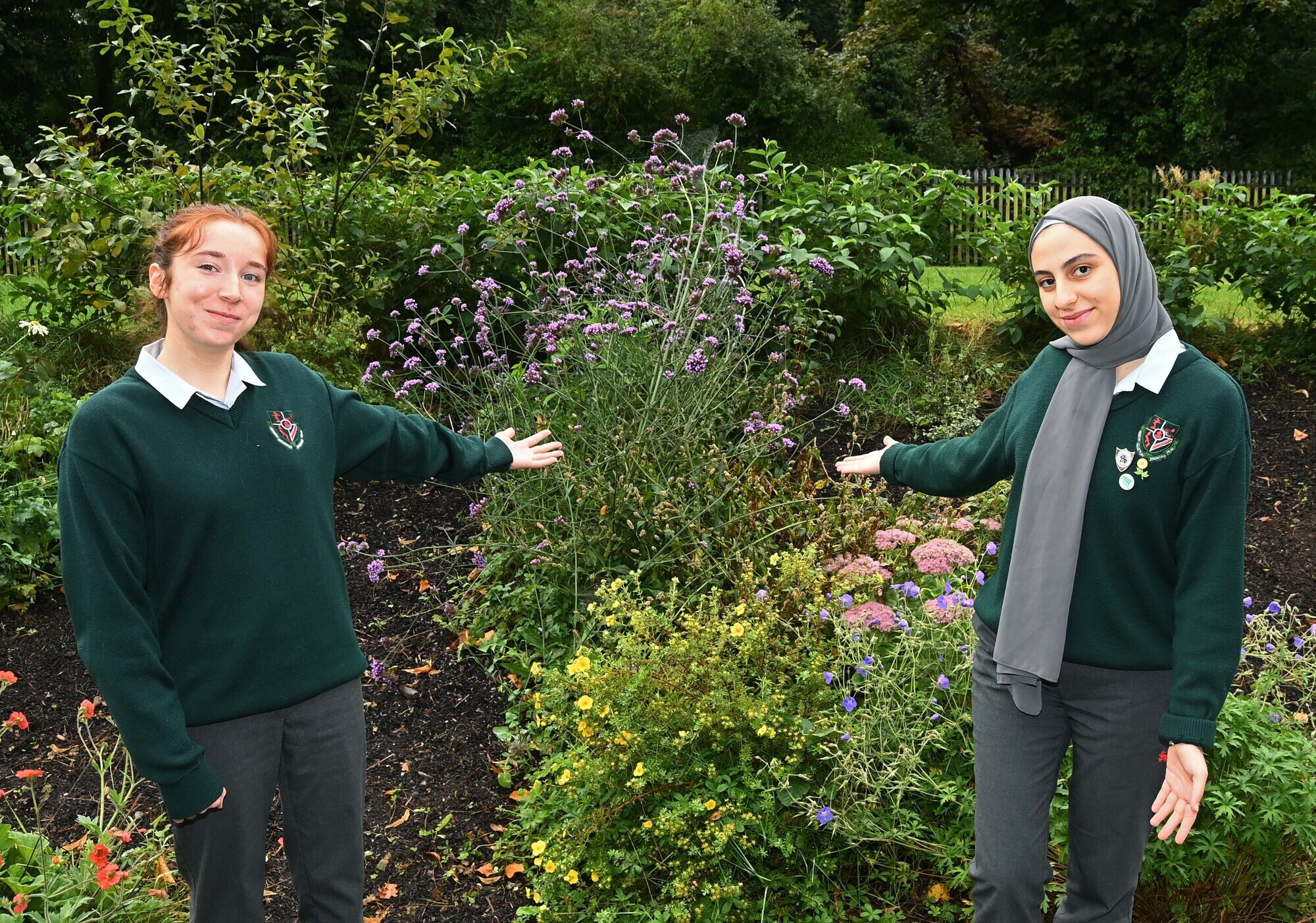
Students Maria (left) and Zinah in the sensory garden at St Aloysius' School, Cork. Pictures: Denis Minihane

During the covid-19 pandemic, our outdoor spaces became ever more important and this was particularly noticed by the students and staff of a city-centre school. 

I’m visiting St Aloysius’ School in Cork, where its students and deputy principal Kathy McGlade are showing me around their room outside.

“We all developed a deep appreciation for the outdoors and trying to cling on to part of that is one of the driving motivations of the garden here,” says Kathy.

Thanks to careful management over the years there remained a substantial green space on the grounds of this school in the middle of Cork city.

All around it is built up: a hotel, apartment blocks and the old school building itself, all surrounding this extremely valuable piece of ground.

When I talk about “value”, I mean its “green value” in terms of biodiversity, though it must be worth a lot too in monetary terms.

Immense credit is due to the current and previous management of the school to have held on to it, for the real value of this patch of ground is now being realised when you see how it is proving to be such a resource for the students.

This area was until recently just a muddy field and largely unusable for sports, as tree stumps lurked in the long grass and the dimensions didn’t allow it to be an accurately-sized sports pitch.

One student, Sofiia, travelled from Ukraine arriving at the school in April 2022, aged 15.

Fifth-year student Sofiia.

Not long before she arrived at St Al’s, the student council carried out a survey of students at the school as to how they would like to develop this area, and what they would like it to become.

In one part of the space, an all-weather Astroturf pitch has been installed and on another part, there are three tennis courts.

In the area between the tennis courts and the Astroturf pitch, the students decided that they wanted to develop a sensory garden.

So, Sofiia began helping in the school garden.

She had grown up on a potato farm in Ukraine and was able to help the other girls get started with their seed potatoes.

In this way, Sofiia found the garden absolutely invaluable in helping her to integrate into the school community.

Leaving your home at a moment’s notice and travelling thousands of kilometres to start in a brand-new school in a brand-new country with a different language at such a young age must be extremely challenging, I say.

The garden in Saint Al’s helped Sofiia to find her place and to fit in.

Transition-year and fifth-year students in the sensory garden surrounded by sports facilities.

Very soon she found other students asking her for help and advice and deferring to her on matters of horticulture.

Still now, as she moves into the senior cycle of the school, she says the garden is a place of comfort to her.

“I find it easier to concentrate with fewer distractions in the outdoors and I do my homework here most days,” she says.

Transition-year art class students and teacher Rob Lee in the sensory garden at St Aloysius' School, Cork.

After particularly challenging classes she likes to come out into the garden for some headspace, she says.

The students took ownership of this project, under the careful stewardship of teacher Lillian Lernihan, and how lucky they have been to have had her guiding hand to steer them.

Lillian is passionate about sustainability and the green environment.

Her hope is that the students will develop knowledge to bring with them when they leave.

Peter Dowdall, gardening columnist, in the sensory garden.

“This whole project has been and continues to be a learning process for all of us,” Lillian tells me.

I can only imagine the knowledge that they have already garnered from this project.

They have learned how you can so easily grow your own food from small patches of ground, and they have learned about the importance of green spaces in urban areas to local wildlife and enhancing the green tapestry, and they have learned that just being in a space such as this helps them to de-stress and wind down.

Valuable education indeed, that can never be truly learned from a book.

Speaking to several of the students who were involved since the start — Dolly, Abigail, Louise and Chloe — I consistently hear each of them repeat that they use the garden to go out with friends and just chill out after tough classes or before exams as they find it a great space to unwind.

Another shared love is the sound of the birds and the insects. Perhaps unbeknownst to themselves, or perhaps not, they are sustaining their positive mental health just by being in such spaces which are proven to have a myriad of mental health benefits.

Removing ourselves from the natural environment and surrounding ourselves with concrete and glass has a proven correlation to increases in mental health problems, drug addiction and isolation.

So, creating such an area for themselves on their school campus will benefit them in spades.

A calendula flower growing in the sensory garden.

The importance of having access to green spaces to benefit our mental health cannot be overstated and, in a way, I don’t even like using the term, ‘mental health’, in this regard as perhaps it somehow makes us think that we need to have mental health ‘issues’ to benefit from the natural world.

In fact, all that it means is that, by being out in the green environment, we feel better and this helps us to maintain positive mental health.

The garden is centred around a heart shape, representing the heart of the school. Visitors travel on a mindfulness path which brings you on a journey through the space.

I was told three times by three different teachers about counting the bees and insects feeding on the lavender growing alongside the path, illustrating that this place has captivated the staff as much as the students.

Lillian was adamant about one thing — there should be a swing in the garden, because who doesn’t love to sit on a swing?

It was an inspired idea and I would hazard a guess that it is now the most used piece of furniture in the entire school.

Having been developed by the transition-year students during the pandemic and maintained ever since by the TY group of students, one of this year’s TY students, Kaci, tells me they also have their own ideas on garden development.

One of those ideas is to assign each year group an independent space within the garden in which they can grow whatever they wish and it will be up to each group to tend this space themselves.

Outdoor bookshelves near the swing was another idea which particularly appealed to me but they are looking at any ideas which will encourage even more people to come out and use the garden and become involved.

Seating in the sensory garden at St Al's.

Speaking with Kaci, it’s clear to see that this initiative is not something which is going to peter away after the group that initiated the project moves on, as can sometimes be the case.

No, I get the feeling that, with the energy of Lillian, along with the support of the principal, Alex Savage, and deputy principal Kathy behind them, students for many years to come, will continue to develop this fabulous garden and will reap the benefits that come from being in such a space.

The garden is also a creative space.

When I visit art teacher Rob Lee is out with students Ly, Aoibh, Sara, Annya, Ellia, Genevieve, Catherine, Katie and Sofiia.

They are drawing and painting the flowers in the garden and, the resulting images would leave you speechless, such is the talent these young girls possess.

The creation of this garden couldn’t have been achieved without the generous support of the Tomar Trust, nor I suspect, the energy and enthusiasm of Lillian and the other teachers and staff in the school.

And, most of all, if those original students, inspired during covid, hadn’t wanted such a space, it would never have been created, and if the current students didn’t want to continue to maintain and enhance it, it would very quickly go back to being a muddy field as nature is quick to recolonise.

Your home for the latest news, views, sports and business reporting from Cork.

More in this section

Revoiced

Newsletter

Had a busy week? Sign up for some of the best reads from the week gone by. Selected just for you.

Cookie Policy Privacy Policy Brand Safety FAQ Help Contact Us Terms and Conditions

© Examiner Echo Group Limited