Gad about and you may miss the gadwall
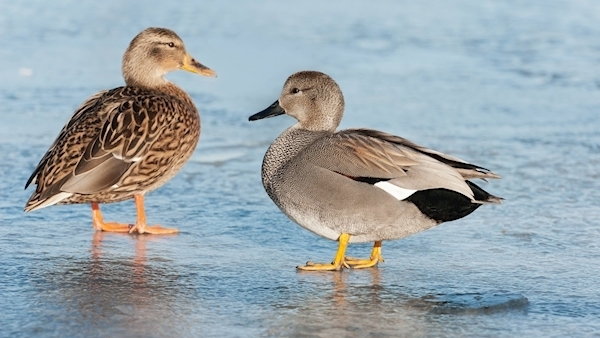
Four gadwalls, three drakes and a duck, are on a flooded pond near where Ilive. Although the gadwall is a scarce resident in Ireland, these are probably seasonal visitors from abroad.
Male ducks have colourful, even gaudy, plumages but the gadwall drake is almost an exception to the rule. The picture of sartorial elegance, his morning-suit-grey plumage has just a tinge of brown. The rump is jet black and a white ‘speculum’, the colourful ‘mirror’ on a duck’s wing, is conspicuous against the sober attire. The bird’s pale underparts aren’t visible when it is on the water.
The origin of the name is obscure.‘Gadding about’ is an old expression stillin use. ‘Gadwall’ may come from ‘gad well’, meaning ‘go about well’, although there is no obvious reason why this particular species should be so named. Females quack like mallards, while the drakes produce grunts, croaks, chatters and a flute-like whistle;perhaps the name is onomatopoeic. Lacking conspicuous plumage, must a gadwall drake vocalise to be noticed?
Rather self-effacing and easily overlooked, this mallard-sized dabbler likes freshwater locations with plenty of cover, although it will frequent more open areas also.
One can never tell where to expect it,as its visits are of a vagrant and fluctuating character
- wrote Richard Ussher and Robert Warren about the gadwall in 1900.
It was a scarce and irregular winter visitor back then. Breeding was recorded in Ireland for the first time in 1953. Pairs have nested, mainly around Lough Neagh and in CoWexford, since the 1970s. Lough Neaghremains the main breeding haunt.
Most bird populations are declining, habitat loss climate change and human encroachment being to blame.
According to the organisers of the Irish Wetland Bird Survey, water-bird numbers fell 15% between the winters of 2006/07 and 2015/16. Some of the declines may be down to fore-shortening; migrant birds find wintering haunts nearer their breeding areas in a global warming world.
Gadwall, however, are bucking the trend, here and elsewhere. Numbers increased by 17% in the short-term (2006/07 to 2010/11) and 35% since the longer-term (1994/95 to 1998/99). The count data show that there are now about 890 gadwalls in Ireland.
Dabbling ducks of differing species rub shoulders while feeding together in winter wetlands. As a result, they risk forming bonds across the species divide when courting and mating; hybrid ducks, products of such unions, turn up from time to time. Nor is the gadwall immune to such error.
“A remarkable hybrid between a gadwall and a wigeon was obtained on the MoyEstuary on 4th March 1895”, wrote Ussher and Warren.
Distinctively-marked drake plumages are thought to have evolved to help minimise the cross-breeding risk. They render ducks less likely to choose an alien drake as a breeding partner.
However, a flamboyant drake is a liability at the nest. He is likely to attract predators to it, so the egg-laying duck divorces him and bars him from visiting. The security and support he might have given her and the ducklings are lost.
This should be less of problem for gadwall, with their understated dark plumage,and there is hint that it is: according to the authoritative Birds of the Western Palearctic, gadwall pair-bonds end ‘usually before mid-incubation, but sometimes persist to hatching’.
F our gadwalls, three drakes and a duck, are on a flooded pond near where I live. Although the gadwall is a scarce resident in Ireland, these are probably seasonal visitors from abroad.