Fiann O’Nuallain discusses organic-interest research and education in Ireland
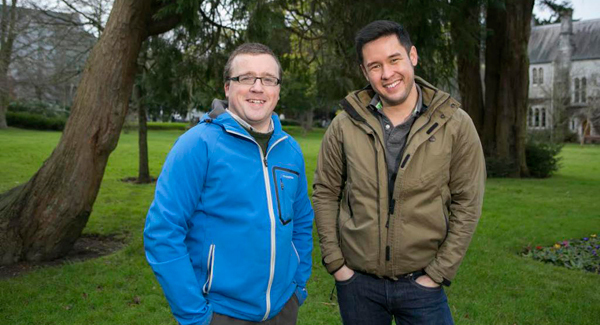
I am a GIYer — I grow a lot of my own food — I don’t use chemicals because I don’t want to eat chemicals. Instead I make my own fertilisers from comfrey and nettles. 

Fiann O’Nuallain discusses organic-interest research and education in Ireland

I used to have a horsetail problem, but over several years I harvested it out of my allotment and into my liquid feeds — as a herbalist I knew of its antifungal properties which I figured could also come over to the plant world to treat botrytis, mildews, and blackspot — and as a horticulturalist I knew for definite that its silica content would help promote strong roots and healthy stem growth, even on my ornamental plants.

I put two and two together and it did turn out to be four. But I had studied herbalism for four years and horticulture for four before that, so I had the clues to that successful mix lurking in the recesses in the first place.


Some students from the MSc Organic Horticulture at the recent conferring at University College Cork.

Nowadays you can find these sorts of recipes online and in permaculture magazines — sometimes alongside some wonderful ideas for boiled urine and seagull guano.

The big trouble is how do you really know that it works?

Which recipes came in a dream and which ones have some grounding in science?

Well the answer is in the School of BEES— no that’s not next door to Hogwarts or the episode of Thrones you missed — it’s actually the School of Biological, Earth, and Environmental Sciences at Liss Ard estate, just outside Skibbereen in West Cork, where excellence in horticulture is as ample as the fresh air.

Students within its Centre for Organic Horticulture Research (COHR) are investigating ‘the influences of aqueous extracts of comfrey (Symphytum officinale), nettle (Urtica dioica) and horsetail (Equisetum arvense) on the economic yield and composition of crops.

Best of all they are not keeping it to themselves, they are sharing their findings with local growers and avid gardeners interested in more sustainable gardening and crop production practices.

What is of real importance in the work they do is its Irishness — that doesn’t mean culture or ethnicity but the geography and climate of this Island, which is not always similar to the received wisdom of the British RHS manuals or researchers in Denmark, the Netherlands, or southern France.

How a cabbage, calendula, or rose grows in West Cork is subtly different to how the same may develop in Dublin or Antrim but the distinction grows much more in the different geology and environmental factors of other European regions.

So to know exactly what’s what for Irish gardens and farms is not just welcome, but vital to maintain our €400m-plus (farmgate value) production of fruit, vegetables, and plants in Ireland — and to the success we all personally want with plants and crops.

One of the central goals of COHR is to conduct independent, scientific research in the area of sustainable and organic horticulture. The team do it so well, but they are not just researchers — they are educators.

They run an MSc in organic horticulture, established in 2013 — the only one of its type in Europe, I might add, and which was shortlisted for two major Irish educational awards this year.

The Irish Examiner’s own Kitty Skully is a former alumni and a perfect example of the calibre of UCC’s graduates — through print, television, lectures, and her amazing work at Airfield Gardens, Kitty is flying the organic flag high.

I recently met up with course co-ordinator Dr Eoin Lettice and organic gardening guru Klaus Laitenberger, who lectures at BEES, to ask them about the MSc and the rise of interest in organic horticulture across society in general.

Dr Lettice explains that the MSc is a postgraduate qualification, generally requiring a previous horticultural degree, but that the college does recognise prior learning and experience in the field — that includes local growers, food producers, and organically-invested farmers — all of whom Klaus believes contribute a lot of really good practical knowledge.

“The great thing,” says Klaus, “is that we now get a lot of younger students in their 20s which surely is a great sign that organics is rejuvenating.”

That aspect is something we can all certainly see through the proliferation of farmers markets, artisan food producers, and the various allotment movements — notably the huge impact of GIY Ireland with whom Klaus works closely.

He expresses the view that there is a real revival in sustainable and organic food production everywhere in Ireland.

“It’s the one thing we can be really proud of… Also more and more people realise that our conventional and global food production systems are not sustainable and, as a result, produce and buy local high-quality products. It’s an amazing time we live in and we see new seeds being sown everywhere,“ he says.

I asked Eoin why he thinks this surge is happening in Ireland now and why so energetically.

“There is simply a growing interest in where food is coming from and how it is being produced. More and more people are asking questions about their food and that has got to be a good thing.

“Ultimately, the end-result of that sort of vibrant debate is people wanting to produce their own food, or at least having a real input into the decision-making about food.

“However, there is a responsibility for people to be scientifically informed about the food they eat and not to base their food choices entirely on trends, without the scientific justification for their decisions.

"Does this type of food really make me fat? Are synthetic pesticides always a bad thing? Is the food I eat sustainable on a local, national, and global scale?

“Rather than take an ideological standpoint on these issues, let’s look at the evidence and see where that takes us. Don’t eat something just because a TV chef says you should,” he concludes.

We may add the odd TV gardener to that one — or perhaps not — as gardeners are at the forefront of health awareness.

We are at the coalface of debates around GM, biodiversity loss, air pollution, and soil fertility and how all of these impact on the carrots we grow and those that are bought in supermarkets.

For myself, as a chemical-free edibles gardener, and an advocate of food-as-medicine, I welcome all the activities around food quality and sustainable growing practices.

I am impressed with Bord Bia initiatives including Bloom, Best in Season, and Origin Green, proud of the success of the organic centre in Leitrim and the GIY HQ in Waterford, and joyful that Eoin and Klaus are educating and inspiring the next generations of food growers on these shores.

If you want to play your part why not join your local GIY or check out the COHR website where you can find out the results from each year’s research projects and apply them yourself.

And if you are interested in enrolling for the next MSc in Organic Horticulture you can visit http://www.ucc.ie/en/cohr/ or contact Dr Eoin Lettice via e.lettice@ucc.ie.

Also, see bestinseason.ie, origingreen.ie, and bloominthepark.com

Fiann O Nualláin is an award-winning garden designer, botanist, broadcaster, and organic commentator.

He is the author of two books, The Holistic Gardener: First Aid from the Gardener and The Holistic Gardener: Beauty Treatments from the Garden, both published by Mercier Press and available in bookshops and online.

www.theholisticgardener.com

More in this section

Revoiced

Newsletter

Had a busy week? Sign up for some of the best reads from the week gone by. Selected just for you.

Cookie Policy Privacy Policy Brand Safety FAQ Help Contact Us Terms and Conditions

© Examiner Echo Group Limited