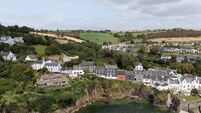
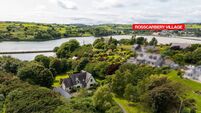
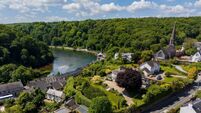
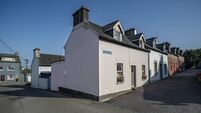
VIDEO: Refurbished Victorian home in Glanmire, Cork a precious gem
There has been a remarkable recovery in demand for high-end homes in Cork city and surrounds in 2015 – and, with a steady supply of sheer quality one-offs suddenly all hitting the market, the year isn’t over yet.
The year’s going to end with several €2m-plus house transactions: this new listing, Glanmire Rectory, may well be one of them.
After many years of declining prices and demand, low confidence levels (and, eventually, vendor expectations dipped too) the tide seems to have turned with a rush as liberated demand today chases the best of stock.
In 2014, all Cork’s €1m-plus sales were outside the city and suburbs, in places like Kinsale, although that was more or less a quirk of timing, as several city homes broke that magic mark early in the New Year, and there’s always been one or two sales over €1m, even through the worst of the slump.
Now, though, with simply top homes in the stalwart suburbs of Blackrock, Douglas, Model Farm Road, Sunday’s Well, Montenotte and West Cork, those who are keen to buy have a wide choice – and bidding competition.
When that all gets sated, or at least reaches more equilibrium, is the million dollar/euro question.
At least several of the houses now changing hands in the greater Cork city area qualify for the loose description, “one of the best in town,” and Glanmire’s former rectory certainly fits that bill. It did so back in 1994, when it last changed hands, too.
Glanmire Rectory was sold at a June auction 21 years ago, making Ir£245,000 at that time (now a €310,000 equivalent) and was sold after very competitive bidding by then-agency Hamilton Osborne King.
Now HOK, as it was, is branded as Savills, and guiding at €2.6 million, that same firm is back now looking for new owners for the rectory as its current occupants are trading down after effecting a huge but understanding transformation on the property.
Back then, it was being sold by the Church of Ireland and hadn’t been lived in for quite some time: its vendors say it was close to derelict at the time of their purchase, and at least hadn’t been lived in for some time prior to the sale, and had effectively ‘gone cold’.
It was bought in 1994 by Mitchel Barry, who set up major frozen and chilled food distribution company Allied Foods in 1989, and which counts most of the country’s major supermarkets as customers.
He admits to not really seeing its scope at the time, but to being charmed by its acres of grounds, avenue and majestic old oaks and beeches, but gives credit to his wife Betty for “for seeing the scope for the house itself.”
The couple, already living in Kilcoolishal, Glanmire (Allied Foods has long been an East Cork presence) and with three sons and a daughter, set about making the rectory a comfortably warm and liveable family home, with professional input from architect Tom Coughlan of Coughlan deKeyser, and it has continued to be so right up to today.
It’s simply pristine and, yep, one of the best again.
It dates to 1903, and fits the familiar sort of design pattern of other notable Cork rectories, designed and built by the Church of Ireland Temporalities Board.
The earlier Victorian examples are attributed to Cork architect William Henry Hill, the Church of Ireland’s Cork, Cloyne and Ross diocesan architect in the 1870s, who designed churches, glebes, rectories and residences, and although later than the 1878 Blackrock rectory/glebe, Glanmire’s could be a twin or at least a sibling, albeit younger by some 25 years.
Hill’s Blackrock rectory on 1.2 suburban acres was a Cork Sale of the Year two years ago, at €2m, changing hands after 27 years in private ownership, and Hill’s Douglas rectory is currently on the market with Savills, guiding at €1.85m.
Pitching Glanmire’s rectory at its assertive €2.6m asking price, Savills’ Catherine McAuliffe and Michael O’Donovan say it has several extra attributes to set it out on its own.
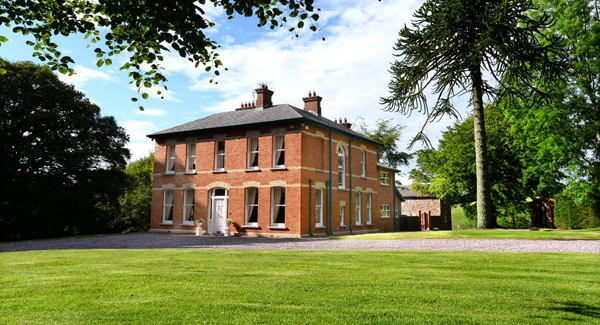
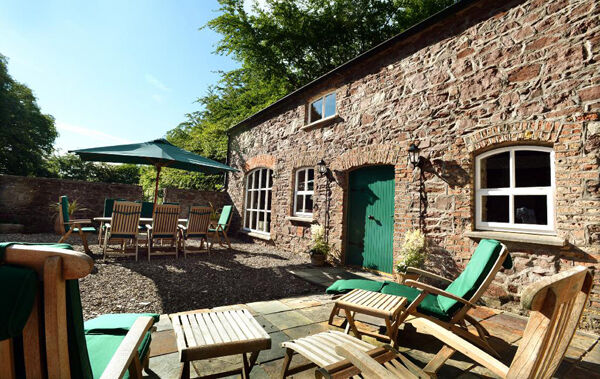
First, they note, the amount of land with this particular offer: it’s on 5.8 acres of sublime private grounds, with some exceptional specimen hardwood trees, including a variety of oaks and beeches as old as the house itself, thick of girth, luscious in leaf and soldiering up the long approach drive from the extended and improved gate lodge, right up to the main solid brick house, its adjacent coachhouse and sheltered courtyard terrace.
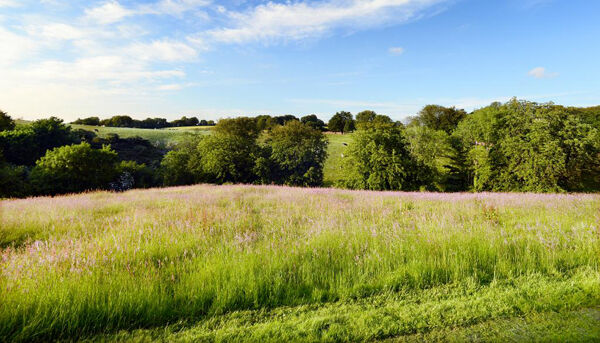
Secondly, underpinning some of the value is the fact that over half the land (a sloping 3.5 acres of wonderful meadow) is zoned for medium/high density housing, with a couple of hundred yards of road frontage to boot.
Even if a new owner isn’t interested in developing immediately or selling on, the hope is there for future needs as Cork County Council acknowledges the need for continued growth and new housing in Glanmire.
Despite sitting in the centre of land of considerable value once more, Glanmire Rectory’s 5.8 acres appears serenely removed from the all that sort of thing, and will always have huge privacy within its evergreen belt, walls and land: anything that may be built on its zoned 3.5 acres is handily out of sight, on a lower grounds portion.
Visiting Glanmire Rectory today, it’s clear money was never an object in its 1990s makeover, extension, and in its maintenance.
Even though the roof at the time was deemed perfectly fine for years yet to come, it was re-slated as the owners reckoned there was little sense in pouring in investment into the interior if the roof needed any attention in subsequent decades, so it was addressed at the same time that a new rear wing was grafted on, in sympathetic red brick.
That add-on replaced a sort of servants’/staff annex, and is now home to a new kitchen, a stepped down double aspect breakfast room/casual dining room with terrace access, as well as to a large utility room, cloak room and the second of two ground floor guest WCs.
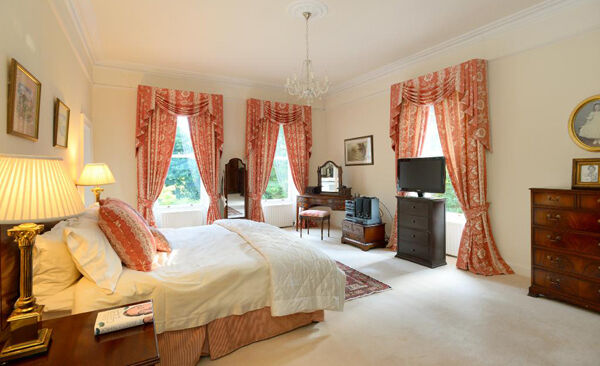
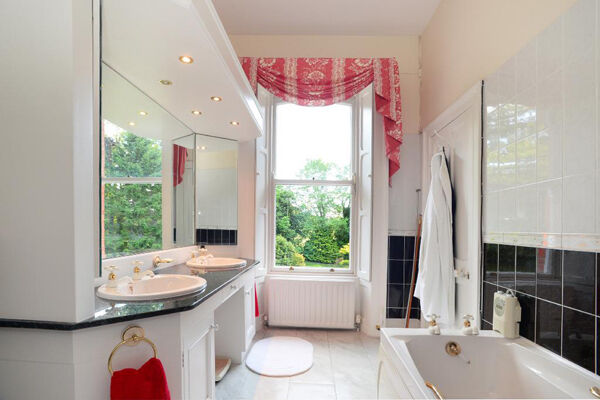
Overhead, the new addition allowed for a further en suite bedroom, a walk-in linen press, and a main family bathroom with powerful multi-jetted bath, while the main section of the quite-square red-brick home now hosts
four large double bedrooms, one of them with a double aspect and a top quality en suite, with bath, separate shower and his and hers sinks, sharing quality white ware with distinctive white Hansgrohe taps.
Both internally and externally, the rectory is top quality, with much original retained fabric enhanced and reinstated by builders Keohanes who, say the Barrys, were strongly impressed by the quality and condition of the house’s original timbers, from roof to floors.
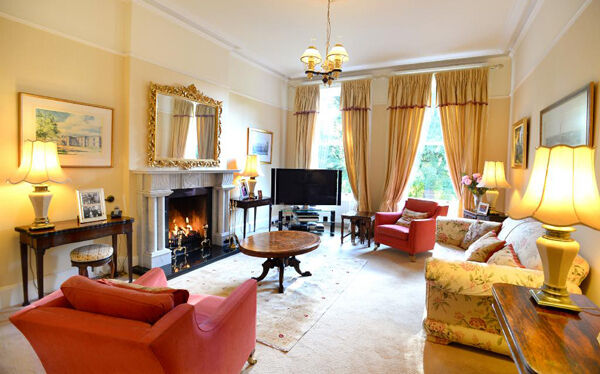
It has been decorated and furnished in an appropriate period look with requisite marble fireplaces, conserved original sash windows done by Ventrolla with old hand-rolled glass, and the tall, graceful arched stair return window is simply a gem – and an almost exact replica of that seen in Blackrock’s rectory.
“It’s like by the time they got to build Glanmire Rectory in 1903, the model was perfected,” admires Mitchel Barry.
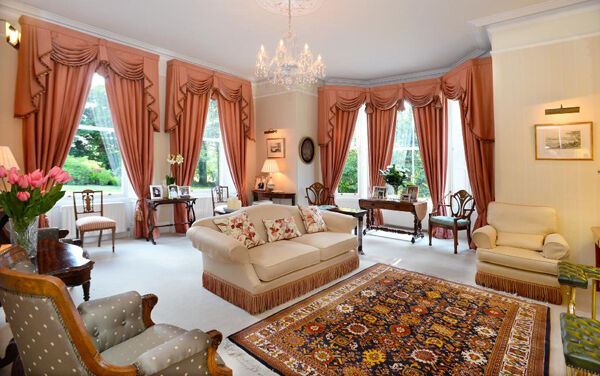
Pitch pine balusters and newels mark out the stairs and mid level, and ranged off the house’s deep inner hall are four reception rooms, one per corner, all carpeted for an underfoot hush, while all sash windows are topped and tailed with floor to ceiling drapes, appropriately headed by assorted pelmets and swags for a luxe look and added creature comforts.
The front two each have a double aspect, the right hand room being a book-lined library/study with mahogany shelves, whilst the left side’s principal and formal drawing room (almost 20’ square) has a west-facing bay window.
It has a wide marble chimneypiece, with gas fire insert, one of three gas-fed fireplaces, the others being in the family and dining rooms.
Given the abundance of timber to be harvested from maintenance of the property’s own grounds, a new owner might even like to take out one or two of convenience sake’s gas works for the scent of a real wood fire.
Should they decide to do so, there’s already a partiallyfilled log store, to the back of an adjacent restored and high-ceilinged coach-house.
Right next to the log storeroom a second equally bone-dry store room is home to the central heating boiler (surprisingly modest-sized) and a huge back-up/stand-by generator for electricity: if needed any time of winter storms, it kicks in without so much as a light flickering in the changeover, approve the owners.
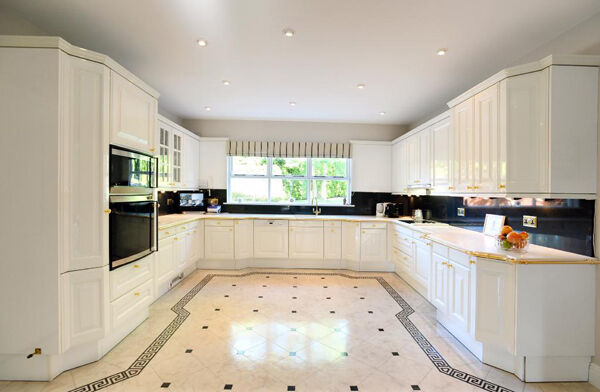
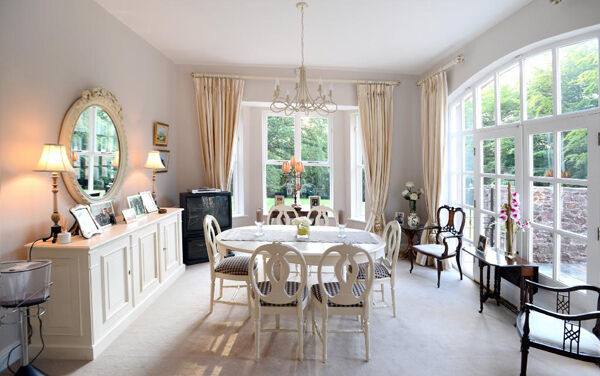
This house’s upgrade eschewed the contemporary ‘open plan’ add-on space trend, in favour of distinct rooms with distinct purposes, but the heart still naturally enough is the great kitchen, with its adjoining calm, French-style casual dining space and glazed French doors.
The kitchen itself is uber-chic with its capacious gleaming white gloss units by SieMatic, entirely ringed around its Corian worktops by gleaming brass rails. The splashback is contrasting muted black granite, and appliances including two very wide ovens are from Gaggenau.
Like the rest of the house, the kitchen’s gleaming and highly polished – as are the original Victorian tiles in the entry porch.
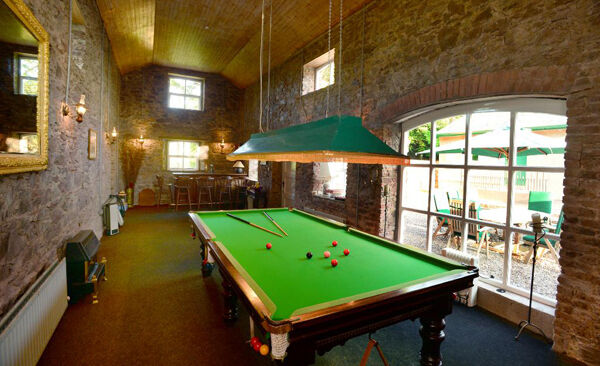
As a dwelling, the former rectory with its red brick and yellow brick stringcourse and window arches is quite a catch, but adding to its appeal for a mix of buyers (London and Sterling will come a-calling?) is the land, and the converted coach-house, almost 40’ by 13’, now a games room with full-size snooker table.
Then, discretely tucked away is a two-car garage, built for vintage motors, and, hundreds of yards back along the drive way at the curved entrance walls and gates, with limestone topped pillars, is the 850 sq ft (or 1,100 sq ft including mezzanine under three conservation-grade cast iron skylights) one-bed gate lodge, good enough to merit a page of editorial mention in its own right, after a crafty and quite seamless single story extension by architect Peter Buckley.
Surprisingly, the gate lodge was made a protected structure after its extension, while the main rectory isn’t listed.
Glanmire Rectory’s immediate grounds are in immaculate lawns, and frequent visitors are rabbits, foxes, and squirrels who seem fond of clambering the sentinel monkey puzzle tree.
: A precious gem: it made a then-record price in 1994, and looks set fair to make recovered property market headlines once more.

CONNECT WITH US TODAY



Be the first to know the latest news and updates