Letters to the Editor: Climate crisis can no longer be ignored
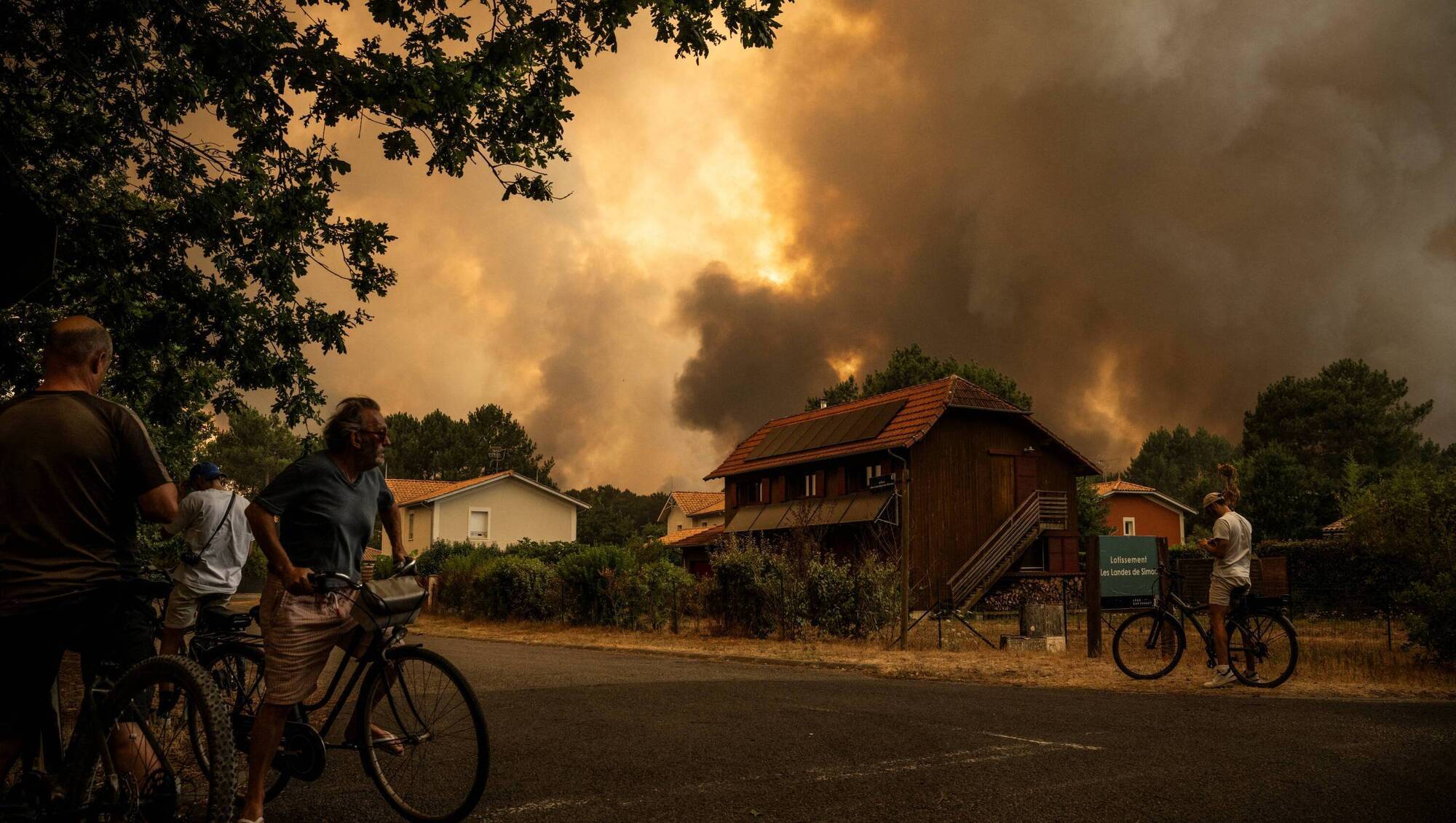
Residents on their bicycle look at smoke rising behind a residential area during a wildfire near Lege-Cap-Ferret, southwestern France this July. File picture: Julien De Rosa/Getty
Anybody following the evolution of the climate and biodiversity crisis, and the coerced political apathy to it, over the last 30 years, will certainly view this summer as a pivotal point on that journey.
There can be no doubt now that we are potentially at the beginning of an unwinding of the increasingly fragile natural and civil structures that have allowed human civilisation to flourish over millennia.
While this may appear to readers as catastrophising, it is unfortunately a reasonable observation to make when one considers the extremes we are witnessing in the natural world and their impact on the cohesiveness of society.
The prolonged global high temperatures that have driven droughts and record wildfires have significantly impacted global harvests and exposed a worrying vulnerability with an ominous El Nino appearing on the horizon.
Our extended family in Australia has read the article on Knocknagree by Sean O’Riordan on September 2 with interest. My husband Tim Herlihy sent the link to family members, and I have just finished reading the article.
We have visited Ireland twice, and each time started in Balleyvourney, and moved on to Knocknagree before visiting other parts of Ireland, since we are told that those two towns were the start of the path Tim’s antecedants from Ballyvourney took (from about 1650) to arrive in Australia via London.
While in Knocknagree we tried to get to hear music at a local pub/hotel, which was advertised, since Tim has played in bands from the age of 16, but couldn’t find anyone about to give us information, and we needed to get to our next B&B by the end of the day. I’ve always regretted that, but somewhere to sleep is important when you are travelling.
In a letter on August 27, Sineád McCarthy, having noted the building boom overseen by Cork City Council asks: “At what point do we ask what is actually going to be left for people who want to buy an apartment in Cork City?”
The focus on building for profit private developments for the debt burdened housing market is what created the current situation. Buying housing as an investment is not the same as seeking and finding a home within which a person or family might thrive, which I suggest is the very basis of a healthy society.
When a substantial supply of social housing meeting that urgent need is in place, the private housing market will likely stabilise rather than be driven by a false scarcity to ever higher purchase prices. Private purchase will assume a more realistic societal level status.
As individuals we can do relatively little meaningfully to reflect how disturbed we are by Donald Trump as president of the USA and the appalling damage he has done to international norms of democracy, diplomacy, politics and decency.
Although it would be wonderful if he could simply be ignored — by everyone and particularly every media source — what we can do is agree that none of us will ever refer to the Gulf of Mexico or Lake Ontario as he wishes; and let us also make every effort not to use Google or Apple because of their cravenness.
Ireland is facing a serious but largely unseen problem: medical neglect by omission in disability services, and its consequences are landing directly on schools.
In Munster, there are no neurodisability medical teams — no paediatric neurology, no developmental paediatrics, no clinical genetics, no paediatric rehabilitation medicine. In their absence, therapy-only CDNTs and Camhs psychiatry are being used as substitutes for paediatric medicine. Regression, dystonia, scoliosis, seizures and complex neurodevelopmental needs, frequently go uninvestigated. Adults with ADHD have no prescriber. Tier 3 autism, announced for 2026, includes no medical recruitment.
A further structural conflict of interest arises when Section 39 organisations act in loco State for AON “diagnostics” with one hand, while their funding model rewards increased social care complexity with the other. When medical needs go unrecognised or unassessed, complexity rises — and so does funding. This is not a criticism of providers, but a flaw in the system’s design.
In a society faced with graduate inability to get employment, especially faced with heartless AI, difficulties with acquiring a home and covid-prompted isolation, the state needs to think innovatively to protect our young people.
One small step, it is suggested, is to revive engagement with the Reserve Defence Forces. Organisational structures are already in place, though under-utilised. The young brainpower is patently obvious and needs to be harnessed.
The cost of a uniform and boots is inconsequential compared with tapping into the vast resources of knowledge and enthusiasm available to the Reserves.
The British prime minister’s comments on the Good Friday Agreement have caused mild consternation across a broad section of society. Andy Burnham is an experienced politician and therefore we must look beyond what seems like a rookie error and understand what drove these comments.
They betray a man who understands the political crisis the UK finds itself in and the sinister way in which its institutions are being undermined by internal and external forces, yet the man actively promotes regionalism.
There is no doubt that the UK is facing a political malaise that will prove fatal to the union and his comments on the Irish question prove it, Scottish independence and a Rump UK will bring chaos to this island.
You can’t therefore make utterances of it being off the table, it’s disappointing that the UK PM has now actually injected urgency to the question that has been meandering, at best, up to now.