Letters to the Editor: State should buy Bessborough site
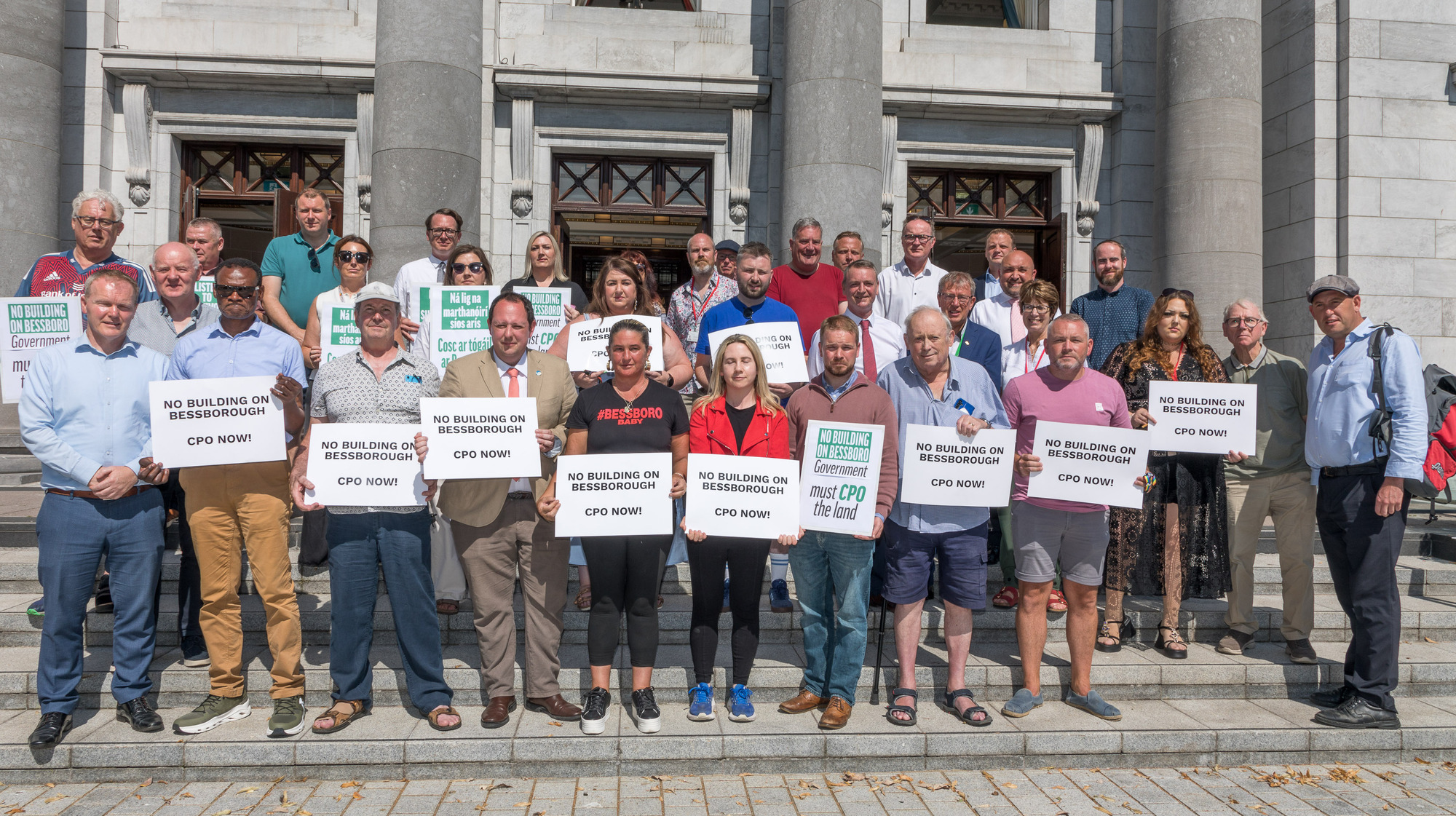
Cork Oireachtas members and councillors joined survivors on the steps of Cork City Hall this week to demand the State should buy the site of the former mother and baby institution at Bessborough. Picture: David Creedon
The front page story — ‘State urged to buy baby home lands’ (Irish Examiner, July 10) — reported the decision announced by An Coimisúin Pleanála the previous day to substantially uphold the ‘planning permission granted by Cork City Council to Estuary View Enterprises to build 140 apartments on the site’ of the former Bessborough mother and baby home in Cork City, with the only change being a reduction in the number of approved apartments to 106.
I would wholeheartedly agree with the Bessborough survivors and campaigners who have called for the Government to buy, through a compulsory purchase order (CPO), the remaining 60 acres of the Bessborough site that are the subject of this planning permission.
There are no known burial records for 859 babies who died in the ‘care’ of this mother and baby home, and, as it’s highly probable they’re buried in the Bessborough grounds, it’s simply imperative that the government must purchase the complete site and undertake a full ground survey to locate all human remains buried there. Thereafter, the site should become a memorial park to commemorate all those who both suffered and died there.
Read More
It was the Irish State that committed unmarried pregnant women to these institutions, funding the religious orders to take them in for incarceration which has been proved to be both inadequate (in terms of medical care) and cruel, and thus it’s the government’s absolute moral responsibility to right this wrong and to finally secure justice for the survivors and for the families of survivors, and for the 859 missing babies of Bessborough.
The people of Cork City and county, of the whole of Munster, and in fact the whole country, should now come out and offer support to the campaign to overturn the An Coimisúin Pleanála decision and to push for the government to compulsorily purchase the Bessborough site.
Catherine Corless, the historian who bravely exposed the scandal of hundreds of dead babies illegally buried in Tuam mother and baby home, has called for people, both in Cork and across the country, to put their shoulders to the wheel on this issue of planning permission at Bessborough, and she is right that the upholding of the original planning permission last week cannot be allowed to stand.
Will all those who know survivors of Bessborough, who know of women who spent time in there, and whose babies died or were adopted, and all those who care about the rights of women and children please now get involved in this struggle in any way that they can. Trade unions, student organisations, womens’, religious and community groups all need to offer real support to people like councillor Noelle Browne (SD), Carmel Cantwell of the Bessborough Mother and Baby Home Support Group, councillor Peter Horgan (Lab), and senator Laura Harmon (Lab), who are campaigning tirelessly along with many others for the site to be saved from development and a full investigation to be carried out on the grounds to find any human remains there.
It will be a lasting stain on the reputation of Ireland if development is allowed to go ahead at Bessborough. Let it be saved for the sake of the almost 19,000 women and children who passed through this dark institution, and the 859 babies who died there under an appallingly negligent care regime with no burial records.
What are the chances of the All-Ireland final being marred by sliotars being thrown around like confetti at a wedding.
Then you have rucks of players, bums up, all jockeying to get possession of the sliotar, like feral seagulls trying to get a morsel of food dropped on the ground, or players with the sliotar in a hand taking way more steps than the mandatory maximum of four.
The indigenous game of hurling has evolved into a hybrid game of ball throwing, rucks, arm wrestling, sliotar carrying, sliotar-pucking — almost exclusively from the hand, and physical force due to the elevated levels of the strength and conditioning of players. Sublime skills of the game like ground and overhead striking of the sliotar have been virtually abandoned.
Do we need a second meeting in Hayes’ hotel to rescue the great and once highly skilful game of hurling?
Regarding the lack of public toilets in Ireland compared to France — ‘Public toilets should never be a luxury’ (Irish Examiner, July 16) — the reasons are more historical, financial, legal, and political than cultural. France and Ireland have developed very different approaches to public amenities.
France has a stronger tradition of public infrastructure. French municipalities have long viewed public toilets as part of the basic urban environment, much like public fountains, parks, or benches.
Read More
Since the 19th century, cities such as Paris installed public urinals (“vespasiennes”) and later automated self-cleaning toilets. This reflects a broader tradition of investing in public civic infrastructure. Some urinals I have used are simply a drain surrounded by a wall giving the user privacy from passing pedestrians or motorists.
Many French towns — even relatively small ones — provide free or inexpensive public toilets because they are seen as a municipal service.
Ireland has historically relied on businesses, which is the big difference.
Ireland developed a different model. Instead of councils providing many public conveniences, people have often relied on pubs, cafés, shopping centres, petrol stations, libraries, etc.
This worked reasonably well when towns had more independent businesses and pubs were plentiful. But as retail patterns changed, the gaps became much more obvious. And indeed the retail patterns have altered significantly.
Irish local authorities often cite construction costs; staffing and cleaning costs; vandalism; antisocial behaviour, and ongoing maintenance as barriers to the provision of public toilets.
A modern accessible public toilet can cost hundreds of thousands of euro to install and tens of thousands annually to maintain. For councils with tight budgets, toilets often lose out to roads, housing, or parks.
France faces vandalism too, but many cities responded by investing in durable automated toilets rather than removing facilities altogether.
Ireland also has a fragmented system. It’s often unclear whether responsibility for the provision of public toilets lies with: the local council; transport authorities; tourism bodies, or or private businesses.
In France, municipalities generally accept that providing toilets is simply one of their responsibilities.
France welcomes around 90m to 100m international visitors annually, one of the highest figures in the world. Tourist infrastructure — including public toilets — is therefore treated as an economic necessity.
Ireland has far fewer visitors and a much smaller population, so councils sometimes perceive less demand, although many residents would disagree.
Is civic pride part of it?
Perhaps a little, but not in the way people often imagine.
Ireland actually scores highly on many measures of community engagement and volunteering.
The issue is less about whether people care and more about how public services are organised and funded.
One argument is that French citizens have higher expectations of what local government should provide.
Irish political culture has historically accepted a more limited role for local government and a greater reliance on private businesses and informal arrangements.
There has been growing recognition in Ireland that the shortage of public toilets affects: older people, families with young children, people with medical conditions, tourists, and disabled people.
Several councils have expanded facilities or introduced ‘community toilet schemes’ where participating businesses allow the public to use their toilets without requiring a purchase. However, coverage remains patchy compared with countries like France, Germany, or the Netherlands.
So while civic attitudes may play a small role, the much bigger factors are historical policy choices, local government funding, maintenance costs, and differing expectations of what municipalities should provide.
France has simply made public toilets a more integral part of its public infrastructure than Ireland has.
In relation to your article about the shortage of, or even lack of availability, of public toilets in Ireland, especially in Dublin, the capital city, I couldn’t agree more.
Even in public houses, there are signs on many front doors stating: “Toilets are for customers only.”
If the excuse for not having public toilet facilities available to the general public is that they were being used by members of the gay community, as your article suggested in recent years, when there were actually public toilets still standing in the city, and by drug addicts, using them for privacy, to get ‘a fix’.
It appears that the rest of the population are to be punished, and left without any toilet facilities, as a result.
Surely others would agree with me that it’s quite a turn off towards visiting Dublin city centre, for shopping or even sight seeing?
Whatever about the crime rate, is it not a basic human right to be able to use a toilet when necessary?
I wonder if the busloads of tourists, who visit the city, on a daily basis, from the country, for shopping, on business, or even sightseeing, are informed by the bus driver, when asked, that there are no public toilets available.
I would call this a definite turn off, for visiting any country — certainly a turnoff for myself.
People just shouldn’t have to buy a tea or coffee in a restaurant, in order to use their toilet facilities. What kind of a welcome is this for our citizens or worse still, for any tourists?
Are there plans to install public toilets around the city, or in our towns? And not just two toilets, but a sufficient amount for our ageing population too.
Surely, something will have to be done about this disgraceful problem.