Letters to the Editor: Workers can shape the future of the economy
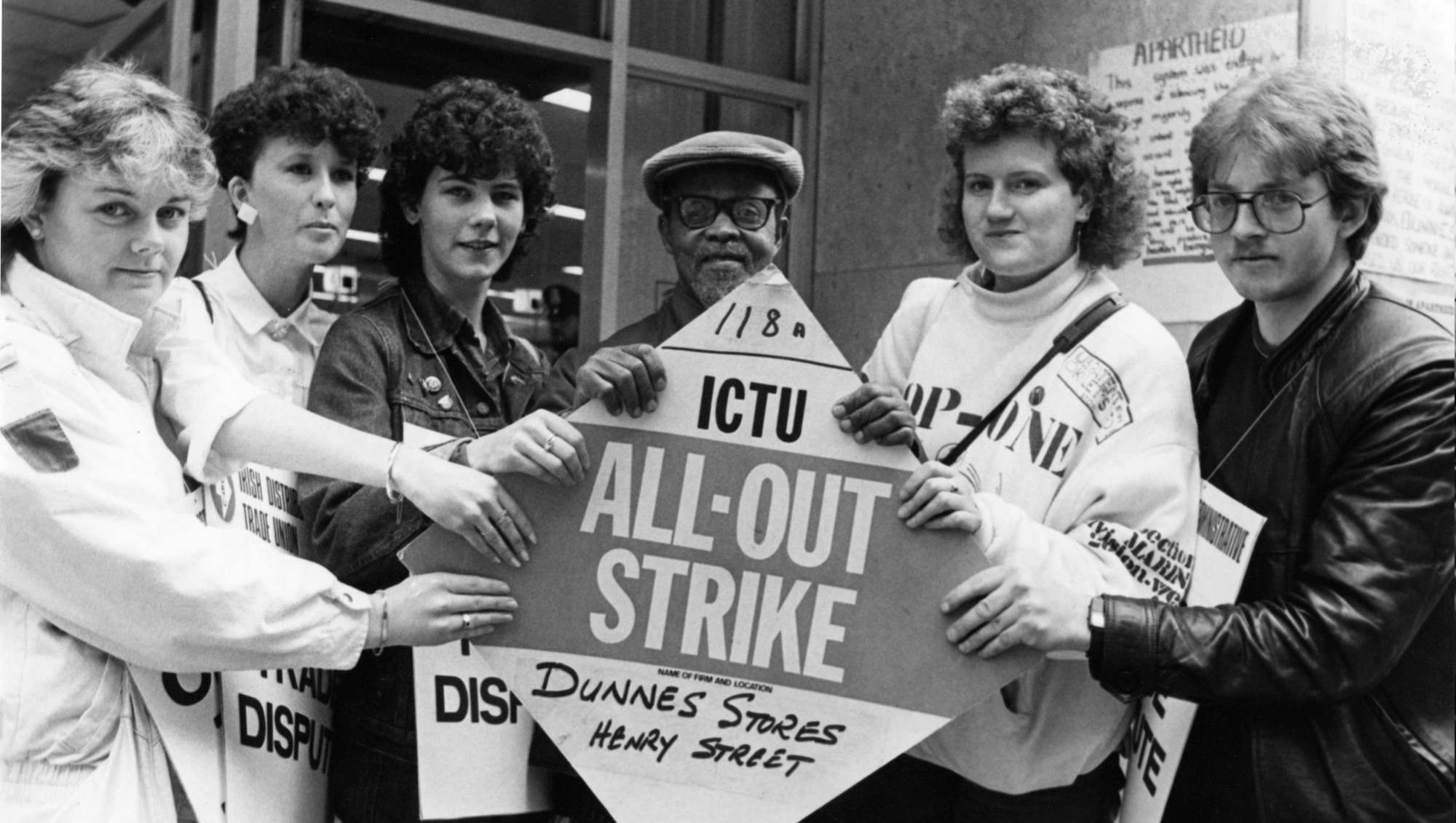
'The trade union movement is probably one of the best examples of civil society in action'
Dunnes Stores workers on strike outside Dunnes on Henry Street in 1985.'We might draw courage from the Dunnes Stores workers here in Ireland who, in 1984, refused to handle goods from then apartheid South Africa, and the huge support they received from the public.' Picture: RollingNews.ie

Dunnes Stores workers on strike outside Dunnes on Henry Street in 1985.'We might draw courage from the Dunnes Stores workers here in Ireland who, in 1984, refused to handle goods from then apartheid South Africa, and the huge support they received from the public.' Picture: RollingNews.ie

I was delighted to read the statement of the Irish Congress of Trade Unions on June 9, calling on the Government to pull back on its “blunt” and “short-sighted” decision to remove the triple lock.

This welcome statement is very much in keeping with the expressed wishes of the majority of Irish people, many of our former diplomats and veterans, and a great many of our politicians, both in Government and in the opposition.


The trade union movement is probably one of the best examples of civil society in action and is, like Irish foreign policy, based on “justice and morality”. It has been a beacon in recognising the worthiness of every human being, including the poor, the unskilled, the disenfranchised, and the worker.

Wars kill indiscriminately, and the vast majority of the victims of modern warfare are innocent civilians — the people our unions claim to represent and protect.

Needless to say, the trade union movement wants jobs for members, but it can never be jobs at any cost — and certainly never at the cost of their morality or sense of justice. With this in mind, I recall the Lucas Plan.

Even in the face of mass layoffs in the 1970s, the workers at Lucas Aerospace in the UK refused to switch to weapons manufacturing and drafted, instead, an alternative corporate plan to use their skills and knowledge to produce socially useful and peaceful technologies such as kidney dialysis machines, heat pumps, hybrid power systems, and eco-friendly vehicles. They fought for the principle that workers have a right to meaningful labour, creating items that benefit society rather than building weapons of destruction.

It is now time for an Irish Lucas Plan, and we must do all we can to make it work. In establishing this plan, we might draw courage from the Dunnes Stores workers here in Ireland who, in 1984, refused to handle goods from then apartheid South Africa, and the huge support they received from the public.

Our workers need jobs, useful, meaningful ones that do not compromise their principles and beliefs. Whether it is through direct munitions manufacturing, the production of dual-purpose goods, providing technology to be used in warfare, or facilitating foreign military traffic, Irish workers do not want to contribute to war and the destruction of the lives of their fellow human beings. Nor do they want to sell their souls, let alone their labour, to the corrupt arms industry. 

Our unions must not be seduced by the war industry, masquerading as defence and security, or by financial organisations like the Irish Defence and Security Association. The hard-fought-for and won dignity and self-respect of our workforce, and our workers’ peace of mind, must be protected. Our workers must never be sacrificed to complicity in the destruction of the lives of others, to guilt, or to moral injury.

Marian Naughton, Naas, Co Kildare

Investment in rail infrastructure vital

No train service exists between Cork and Waterford despite 100-plus years of Irish independence. Other shining examples of rail infrastructure failure also exist. Donegal, one of the biggest and most remote counties in the country, is completely cut off from rail. This is in addition to one of the worst examples connectivity in the country — no rail service between Dublin’s main rail station Heuston and Connolly station.

In colonial times, an extensive rail system existed throughout the county, while only now a skeleton remains. You won’t see any modern country in Europe that fails to have connecting rail services between major cities. Our country is flooded with cars and choking congestion. Other countries continue to invest in rail service, while this country is content to build roads to beat the band and put cars on them.

Rail should be seen as a way of getting many cars off the road and drastically reducing the time it takes people to get there without any stress. The Iron Horse could solve a lot of our congestion and health problems, and reduce fatalities and injuries. We must look at rail as vital transport infrastructure, because the country is completely saturated with cars, and no one can get anywhere without spending half the day in tailbacks with expensive delays.

Maurice Fitzgerald, Shanbally, Co Cork

Can our grid cope?

On Wednesday last, the ESB said that despite having more than 1,600 public chargers across the country, its network can only support 1,400 EVs charging at the same time.

My response to this is to say that the likelihood of everyone charging their car simultaneously is about the same as the likelihood of everyone arriving at a petrol station at the same time. However, it does suggest that our EV charging network is not up to scratch. I do think that the bigger problem here is not that the charging network isn’t up to task, it’s more that our electricity grid isn’t up to task either.

We have to electrify everything to meet our climate targets, and so that includes heating, transport, and everything else. Research has found that when strain is put on the grid, not only the public charging, but domestic charging could have issues as well, which leaves me wondering as to how good our EV charging network actually is.

John O’Brien, Clonmel, Co Tipperary

Ireland v Israel

I have a proposal for the Ireland v Israel fixture. Give the match and the rights to the GAA. Play it in Giants Stadium in New York at midday Irish time on the morning after the fireworks on Halloween. The match can be broadcast from behind the pay wall on GAA Plus. No one will get visas; they’ll all still be in bed, and no one will watch it. Irish solution to an Irish problem.

In the meantime, measured and meaningful EU-wide sanctions should be imposed on Benjamin Netanyahu’s blood-soaked coalition after multilateral negotiations at Dublin Castle during Ireland’s presidency of the EU. The nation holds its breath.

Michael Deasy, Bandon, Co Cork

EU must reconsider Taliban relations

Gender apartheid, I hope, will someday be recognised as a crime under international law. However, this will take years to implement and may only be a weak tool in supporting women who suffer atrocities in countries such as Afghanistan: Child marriage, no education, and laws that allow them to be beaten by their husbands, to name a few.

It is time for the EU to consider how it engages with Afghanistan, in particular with the Taliban. The EU should consider new laws to govern its rules of engagement with all repressive regimes. Concerning any political issues (such as the return of refugees) they could mandate that EU representatives may only meet with Afghan female representatives or males who can demonstrate they are against the gender apartheid currently enforced by the Taliban.

Alison Hackett, Dun Laoghaire, Dublin

Press must have free access to Gaza

The EU, the UK, and the US could support their media in their requests to Israel to independently enter Gaza, because it is one of the biggest man-made humanitarian disasters of our time.

Israel’s continual barring them from Gaza shows they are not comfortable with foreign media report-ing, observing, and interviewing civilians. It is believed from aerial satellite photos that Israel has cleared and is clearing areas.

On April 30, a month after a ceasefire in Gaza began, the For-eign Press Association published a joint open letter to Israel from 31 foreign news groups seeking independent access to Gaza, which was refused. They included Reuters, CNN, ABC News, NPR, The Washington Post, The New York Times, The Guardian, the Associated Press, Le Monde, Sky News, ITV, Channel 4, BBC, Agence France-Presse, and the Australian Broadcasting Corporation.

They stated: “In every conflict, journalists face limits in access to war zones. But Gaza is different. For more than 930 days, Israel has barred foreign reporters from independently entering the territory ... This has pushed the responsibility for covering this devastating war and its aftermath almost entirely on our Palestinian colleagues.”

In 2024, the Foreign Press Association had also petitioned Israel’s supreme court to be allowed enter Gaza independently — the petition was refused based on Israel’s security concerns.

Some 200 Palestinian journalists were killed in Gaza during the war, which began on October 7, 2023 to the ceasefire in March 2026. We are now in July 2026. The international media is not yet allowed independently into Gaza.

Mary Sullivan, College Rd, Cork

Pooping pooches

It appears now to be completely acceptable for dog owners to take their beloved pets to our public spaces to poo and then bend down in an effort to extract the above from the grass, the sand, or the pavement — impossible of course! Then follows the walk with the poo — bag swing, often ending with the bramble hedge or fence dangle.

These are the same beaches, parks, and promenades where people like to walk, picnic, wheel their prams, and allow their children to be barefoot. Many of whom, I hasten to add, may have no outdoor spaces of their own.

I beg the question: If it is all so grand, socially acceptable, and fine, why oh why do the beloved pets not do their private business in their own private homes? Could it be by any chance that it’s not quite that acceptable after all?

Mary Crilly, Dunleer, Co Louth

x

More in this section

Revoiced

Newsletter

Had a busy week? Sign up for some of the best reads from the week gone by. Selected just for you.

Cookie Policy Privacy Policy Brand Safety FAQ Help Contact Us Terms and Conditions

© Examiner Echo Group Limited