Letters to the Editor: Ireland should not let Israel sportswash Gaza genocide

Republic of Ireland supporters protesting against Israel during last September's Fifa World Cup 2026 Group F match against Hungary at the Aviva Stadium in Dublin. Picture: Stephen McCarthy/Sportsfile
The recent decision by the FAI and the Irish Government to support not only playing Israel, a state indicted for plausible genocide at the International Court of Justice, but to double down on playing in Dublin in September, is regrettable.
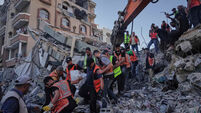
Little has changed for the better since October 2025, when a “ceasefire” came into force, except the eyes of the world’s media have turned away while over 600 Palestinians have been killed in Gaza alone, adding to the over 75,000 known dead, 56% of whom were women, children, and the elderly ( , February 2026).
It is therefore either extraordinarily naïve or politically cynical of sports minister Patrick O’Donovan to state that this country is in danger of “politicising young men who are going to turn up and play for their country”, and that the Israeli football team and the Israeli government are separate entities.
Is he not aware that all members of the Israeli football team have served in the IDF — mandatory service in Israel? Is he not aware or care that the state of Israel uses football to “sportswash” the ongoing atrocities in Gaza and ethnic cleansing in the West Bank?
Meanwhile, Israel has killed hundreds of Palestinian athletes — including members of the Palestinian football teams. In January 2024, Yarmouk Stadium in Gaza (now destroyed) was used as a temporary jail for Palestinians. The list goes on and on while the atrocities mount.
While we nonsensically debate about separating sports from politics, Fifa president Gianni Infantino “honours” Donald Trump with a fictional peace prize and endorses the equally fictional and outrageous land grab that is Trump’s board of peace.
Most Irish people and Irish athletes and footballers oppose playing Israel. Let’s stand up and be counted on the right side of history, not grovel at the greasy till of Uefa and Fifa. Surely it is the least we can do?
I noted with interest, and some irritation, the reporting from the ESRI on school attendance in secondary school, absenteeism, lower Leaving Cert points, and wellbeing of young people into their 20s.
I wonder if anyone took the time to consider the factors other than the home or illness which lead to absenteeism, poor self-worth, depression, isolation, and those lower Leaving Cert points such as school environment, understanding, acceptance and belonging, and the village that forms the community we all need as we grow.
Has anyone thought to pose questions that explore the impact of being raised in a metaphorical village that is willing to listen to be informed, and understand when we speak, and help us when we need it, values us for who we are and what we can do, or not do, and treats everyone with real dignity, decency, and respect?
Has anyone considered investigating the impact of belonging to a community that nurtures us, supports our parents, honours older people and what they contribute as they age, and refrains from judging or shaming those who are different, who show signs of struggle, cannot get in to school, object to poor care or a lack of professionalism in various settings, or don’t conform to the norms and etiquette we mistake for expressions of respect and gratitude?
Has anyone investigated the value of mentors, extended family, and friends in the lives of young adults as they step out into the world and become part of new communities, independent of the villages they grew up in?
Has there been any investigation into whether young people at third level access the disability, wellbeing, chaplaincy, and academic supports they are entitled to and may have signed up to; why they might be slow to do so; and whether or not anyone has checked in with them, or their tutors, during their time at third level?
Perhaps they have, and perhaps, instead of presenting statistics that will shame and pressure people who may be having difficulties and need a hand, these may be more valuable statistics which will give real insights into wellbeing from adolescence to one’s 20s, thriving in education and, yes, pushy person that I am, improved Leaving Cert results that reflect more of what someone is capable of.
Of course, that would mean having a society where everyone understands that professionals and State bodies have a responsibility to care and ensure people actually thrive, and we have a responsibility to have some empathy, mind each other, help each other out, not isolate families, the young, people with disabilities or older people, and be scandalised, and seek justice when the village, the State or professionals fail in their duty to care … and not tut when people “complain”.
The question is, how many are willing to do so?
And, finally — perhaps the low mood, issues around socialisation and personal development are a reflection of the reasons for the absenteeism in the first place.
So, maybe, the ESRI could investigate young people’s sense of belonging and how to support it.
I note that the Taoiseach issued an apology to the survivors of institutional abuse perpetrated upon them as children.
That is commendable. It is the fifth time such an apology has been issued in Dáil Éireann. I commend the Government on improvements announced in supporting survivors as we live out the last phase of our lives.
As a survivor, I ask: When will the Irish Government implement the judgement of the European Court of Human Rights (ECHR) of 2014 in the O’Keefe vs Ireland case?
The ECHR asserted, correctly, that the Irish State was aware of the risk to children since the Kerrigan Report of 1931, and it did not enact measures in all Irish schools, which were operating under its governance, to prevent child abuse.
This failure to act, according to the evidence it had at the time, led to decades of abuse of children, and the Irish State was culpable and liable for that harm, and is still denying survivors a legal route to seek redress for harms caused to them.
The ECHR instructed the Irish Government to correct this situation by implementing its judgement.
The Irish Human Rights and Equality Commission (IHREC) (May 31, 2024) briefed the Council of Europe on what it called the “ongoing failure by Ireland” to fully implement the judgment.
When will the current Irish Government honour that judgement, and present legislation to achieve that objective?
Regarding 'Survivors devastated by council’s permission for 140 apartments at Bessborough' (Irish Examiner, February 25): It is horrific to approve this.
First and foremost, the CSSA group does not and has never spoken for [all] survivors of Bessboro (this is the original way it was referred to) mother and baby home. But it has always been much easier for developers to deal with them than us, as we are aware of what actually happened there.
I, as a child, saw a baby being buried alone and gave depositions years ago to that which is in the area of the folly and farm. But, as always, it is so much easier to disregard survivors.
It just proves that with the provisions of this agreement, there is reason to believe there indeed are babies buried on the grounds.
Once again, greed and the ignorance of Government are more important than trying to find out the truth about those babies. You cannot believe the “nuns” that none of this happened, as it’s to their benefit to make others believe it never happened.
Shame on everyone. These babies deserve justice. But apparently, it’s not important; it’s easier to pretend it never happened
If the rail line was between Midleton and Youghal was restored, it would be a huge boon to the whole area.
Traffic would be reduced, as many who commute by train to Cork wouldn’t dream of commuting by bus.
Many new houses could be built.
Youghal would experience a much needed resurgence. Of course, this should only be the start. We should really have a rail link between the cities of Waterford and Cork.
RE: Irish people attend five funerals a year on average by Neil Michael (Irish Examiner, February 26).
Definitely an Irish custom! In fact, I think we are masters in all things death, wakes, and funerals.
After the success of Irish pubs in Germany, I am surprised no entrepreneur has started an undertaker business in the Federal Republic modelled on our customs here.
I recently attended a funeral in Germany. Well it was the most boring 40 minutes, I almost fell asleep…
I worked here in tourism as a guide for German tourists and recounted to them the stories of the many wakes I had attended plus those my seanchaí grandfather told us about. They were fascinated and often said, “that’s a business opportunity for Irish entrepreneurs”.
I note the Department of Finance has provided an analysis to the Oireachtas housing committee, indicating that Ireland is facing a pensions time bomb. Ostensibly, the ratio of workers to over 65 year olds is set to more than half by 2065 without policy reform. At present, we have four people working for every person retired.
It seems to me that we are facing into big demographic shifts which means that, in 40 years’ time, we will have two workers to every one retired.
This is down to a couple of things. One is that we have a falling birthrate. The 2022 birthrate was 1.6 children per woman, nearly five children fewer than it was about 60 years ago.
The second part of the equation is that we have a population living longer — and that’s a good thing. On average, life expectancy in Ireland is 83 years — meaning that we have more retired people.
This means that we will soon have higher health care costs, and bigger pension costs. That same report from the Department of Finance estimates that nearly half of all public expenditure in 40 years time will be age related. Despite the shift towards auto-enrolment and pressure on people to self fund their own pensions, it’s now reported that this won’t close the gap.
All this leaves me wondering: Is Ireland facing a pension time bomb?