Letters to the Editor: Israel is killing those who bear witness to genocide
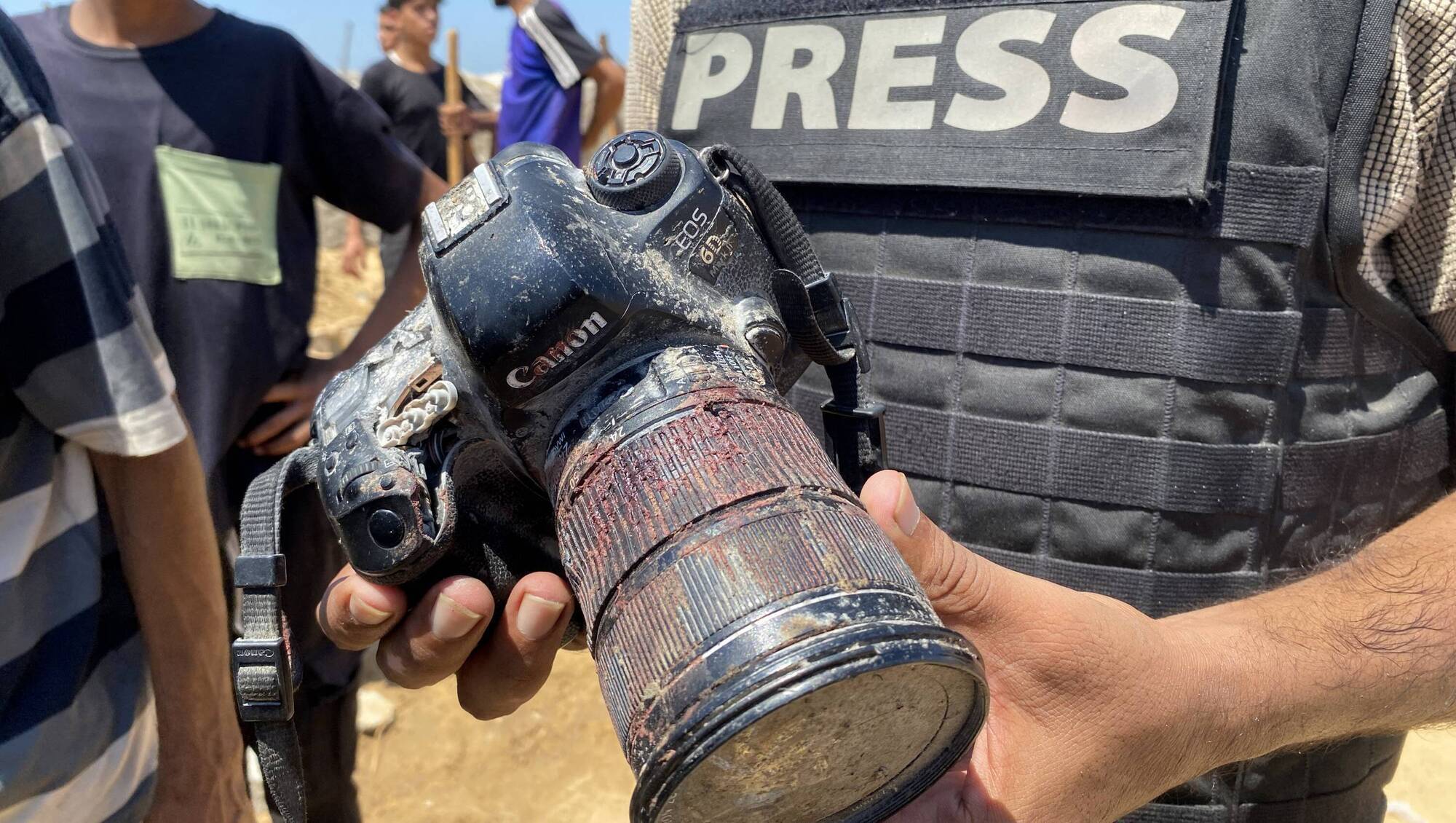
A journalist holds a blood-covered camera belonging to Palestinian photojournalist Hussam al-Masri, a Reuters contractor killed in Monday's Israeli strike on Nasser hospital in Khan Yunis, Gaza. Picture: AFP/Getty
The story from Gaza has long been horrifying beyond words and yet it continues to get worse, as Israel steps up its apparent targeting of journalists, the last line of defence for a people who have endured trauma, starvation, injuries, and death.
The ‘double-tap’ bombing of a hospital this week, in which five journalists and numerous health care workers died, was a new low.
According to Reporters Without Borders, more than 200 journalists have been killed by Israeli forces since this conflict began, including high-profile names such as Shireen Abu Akleh, who was shot by an IDF special forces sniper in May 2022.
Her death was an embarrassing episode for Israel, as forensic analysis led international observers to conclude that Shireen had been deliberately targeted.
Now, as the spectre of famine dominates headlines, Israel no longer even tries to deny its intent, instead accusing those journalists it kills of being Hamas operatives, as in the case of Anas Al-Sharif.
With no foreign media allowed into Gaza, it appears Israel finds it untenable to allow Palestinian journalists to report on what is happening there.
But the targeting of journalists is a crime under international law, and one that stacks up neatly with overwhelming evidence that has led the UN and almost every international humanitarian organisation to conclude that what Israel is perpetrating in Gaza is a genocide.
Ireland must break trade relations with this rogue state until Netanyahu’s extremist coalition has been ousted from power.
We cannot accept such behaviour from our trading partners.
I applaud Terry Prone for her brilliantly-written column — ‘There’s nothing healthy, physically or emotionally, about fat camp TV’ (Irish Examiner, August 25) — in which she poses a very pertinent question to the reader:
What is it about people’s weight that gives others the right to express vile and hurtful opinions?
It should go almost without saying that the weight loss methods used on Netflix’s new documentary which is based on obese people being put through extreme exercise, calorie restriction, and caffeine pills, is not sustainable long term. Many of the contestants and even some of the winners gained all or much of the weight back after departing the show.
As Ms Prone delineates in her piece, the conversation around is not a conversation about health and wellness, but it’s one about the way we treat people who are obese or overweight.
As a clinician, I have found that stigmatising beliefs and ideologies can lead to stigmatising acts.
These acts can manifest themselves in different ways.
Many of the people I’ve dealt with, who struggle with their weight have told me they have experienced hurtful verbal commentaries about their size. These poor souls speak of being teased and even physically assaulted.
They also mentioned the behavioural slights such as the eye rolling along with the frequent tutting by these bullies.
This Netflix documentary is more about spectacle and humiliation and not about health and sustainable habits. I have to ask, how did television ever sink so low?
Many people use food as a coping mechanism in order to deal with feelings like sadness, stress, anxiety, or loneliness, which in turn leads to overeating and weight gain. There is a very strong psychological component to overeating, so this can never be ignored.
I will conclude by asking: Why do some people think that it’s OK to make fun of overweight people?
It is ironic that the Russian veto at the UN Security Council — constantly proclaimed as a threat to Irish sovereignty by government ministers — has now been replaced by the US veto.
The Trump administration, in support of its ally, Israel, wants to prevent the extension of the Unifil mandate in which the Irish army plays a prominent role in maintaining peace in Southern Lebanon.
This is further reason why none of the veto-wielding powers at the UN can be trusted with upholding and maintaining world peace.
All future UN missions should receive their mandate not from the Security Council, which is subject to the big five veto, but from the more democratic UN General Assembly.
Your timely articles juxtaposes Tánaiste Simon Harris’ exhortations that there are “clear, concrete measures the EU can take … against the backdrop of famine”, with protests from human rights campaigners about the coalition government’s “absolute refusal to hold Israel accountable for a genocide”, particularly in the context of “the Central Bank of Ireland’s role in approving Israeli bonds for sale” (Irish Examiner, News, August 26).
There is indeed a stark contrast between the Tánaiste’s perennial demands for the EU to pull “every lever” and the government’s utter refusal to compel the Central Bank to invoke the powers at its disposal.
The joint oireachtas finance committee ’s report on the Israeli bonds programme concluded “the committee further believes that the Central Bank is vested with powers that it has not yet exercised”, that there are “areas which may provide the Central Bank with the opportunity to desist from facilitation of the prospectus”, and “the joint committee encourages the Central Bank to exercise the powers available to it in this regard”.
The Tánaiste is correct — if entities such as the EU, the Irish government, or the Central Bank refuse to take action “now against the backdrop of famine, when will we?”. Thanks to investigative journalists, opposition TDs and senators, and indefatigable human rights campaigners, the Central Bank’s role in facilitating a stream of funding for what the Tánaiste has admitted that he regards as a genocide is now well publicised.
Some day, these gruelling years will be written about in history books, and the government’s refusal to compel the Central Bank to take the “clear, concrete measures” the joint committee has identified will not be a good look.
I, for one, am tired, tired of all this loathing, fighting and hating. Do I agree that we as a people experienced extreme hardships by the hands of another? Yes. Do I agree that we as a people should continue to relive that past trauma over and over again? No.
So, imagine an Ireland that uses this absolute resentment, bitterness, and hostility and envisage instead that this energy was used to tackle its social and political issues directly, rather than directing it towards the English.
I hear stories on the radio from people pleading our Government to help. I read accounts of the hardships of our people and while talk on the streets indicates that our government has ‘checked out’, it appears that we feel almost soothed by this. This abuse of power seems to be accepted and expected.
Enticed by Colin Sheridan’s column headline — ‘Irish language shines in English courtroom’ (Irish Examiner, August 23) — I delved into what soon became a very disconcerting read. Mr Sheridan’s use of words range from crowbar, weapons, violence, vengeance, and machine gun to the condescending tones belittling a group of people is worrying. This article, is everything that Ireland should not be promoting to our youth.
As the world tears itself apart, we ought to look to our children to be the future that we wished to experience ourselves. A future where every single person deserves the right to be safe and secure, regardless of class and race. We ought to instil love and honour not hate and revenge.
Ireland is ‘knee-deep’ in its own scandals and considering everything, I believe our government has committed worse crimes to the Irish than the English ever did as they are wilfully causing harm to its own people.
I ask Mr Sheridan, is it time to start digging ourselves out of the past and focus our energy on those in power causing the Irish people harm right now? We and our language should be moving towards a more honourable future. A future that safeguards our children not jeopardises them.
Colin Sheridan’s superb piece on the Kneecap trial ends by stating that the Irish language “needs to embrace dissent”. In fact, since at least the 16th century, Irish literature and song have been at the forefront of political protest and subversion.
That this tradition is now being reclaimed and redefined is to the credit of our friends from the Belfast Gaeltacht.
As we saw in the performance of Cork’s very own Kabin Crew at the recent Fleadh Cheoil, this has resulted in the perfect marriage between the Irish-language and urban culture that has long been wished for.