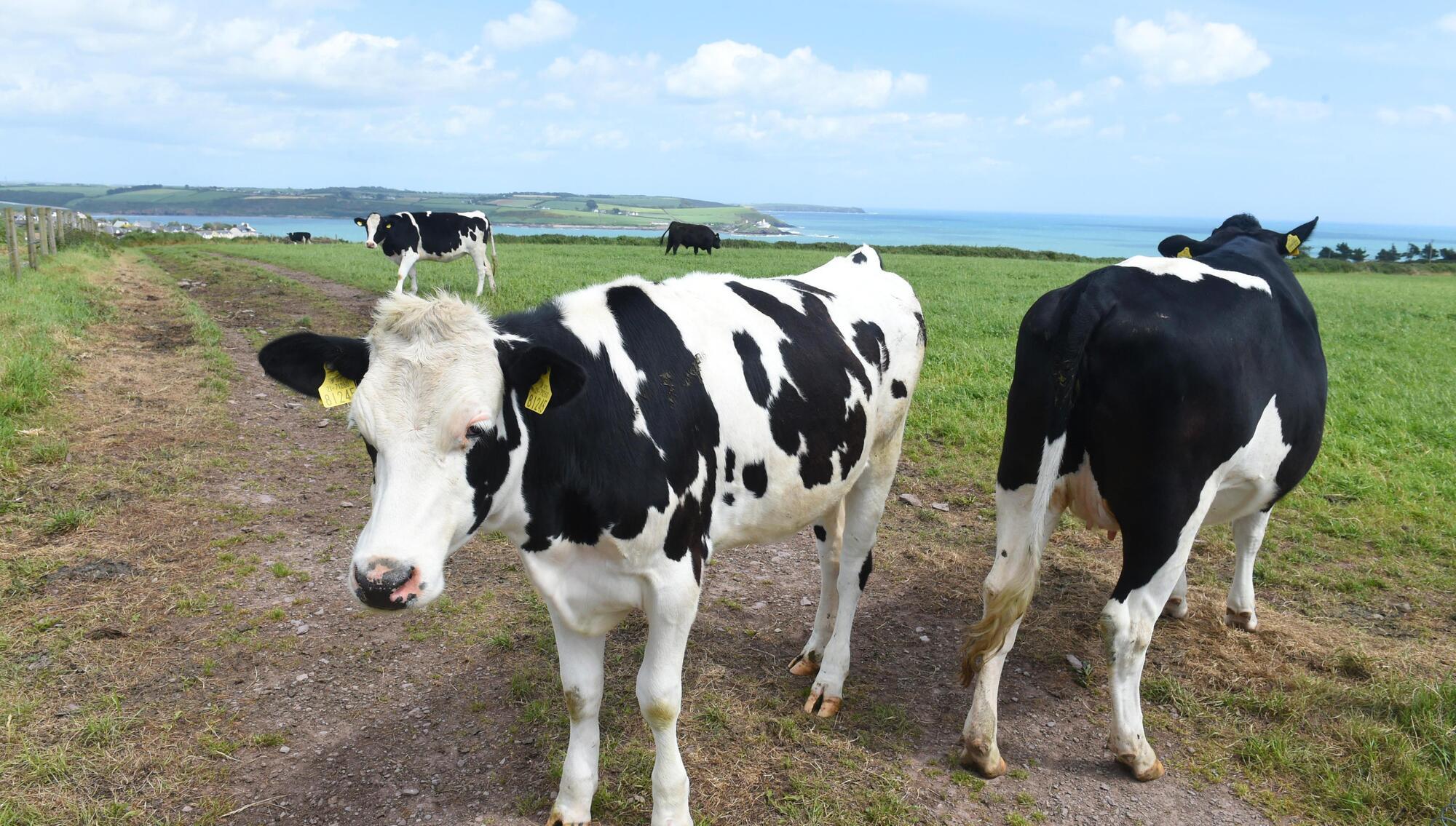
The red herrings continually trotted out by advocates for the Irish beef industry must be called out.
According to Our World in Data, beef tops the table — by a country mile — of food products for greenhouse gas emissions per kg of food product, at a massive 99.48kg. According to research published in the journal Science in 2018, avoiding meat and dairy products is the single biggest way that we as individuals can reduce our environmental impact on the planet. Author and environmental activist George Monbiot, who has written a book on our food system and who was awarded the Orwell Prize for Journalism last year, has concluded that the most damaging farm products are organic, pasture-fed beef and lamb.
The “carbon leakage” argument is another seriously flawed one. We should be aiming to reduce beef consumption globally, not entertaining the pointless (and perhaps fallacious) argument that Ireland produces an inherently environmentally-destructive product in a negligibly less destructive way than other countries.
Agriculture Minister Charlie McConalogue recently said that he actually looked forward “to seeing the value of the Chinese market grow in the time ahead to reward the efforts of everyone involved”. China has a population of over 1.4bn people.
How is increasing and subsidising the production of the most environmentally-damaging food product and exporting it over 8,000km away to the world’s most populous country, with an explicit intention to grow this market, in keeping with Micheál Martin’s “Future generations will not forgive us” clarion call at Cop27?
Unless cheerleaders for the Irish beef industry can substantiate their claims with hard scientific evidence, the “Irish beef is sustainable” slogan and its variants can be regarded with as much scientific credibility as “the luck of the Irish”.
Paul Krugman coined the term “leprechaun economics”. One must ask: Are the cheerleaders of the Irish beef industry engaging in “leprechaun science”?
Rob Sadlier
Rathfarnham
Dublin 16
How many more scandals to come?
What a week it was. It started off with overcharging medical-card holders in private nursing homes, followed by the stopping of disability payments to people entering institutions, and finally the ESB overcharging on electricity bills for more than a decade.
It seems that successive governments, institutions, and semi- state bodies will not admit, until they are exposed, to wrongful and deceitful acts against the public.
We all remember the contaminated blood transfusion debacle of the 1970/1990s, followed by the cervical cancer checks scandal of the 2000s, mother and baby homes/Magdalene laundries scandals, and a whole host of other scandals in the interim, including corruption and financial scandals.
It is an endless list that makes the mind boggle and makes one wonder about the type of country we live in.
The endless obfuscation, denial, delay, and refusal to acknowledge wrongdoing in an expedient and open manner only adds to the hurt and anger caused by delays in compensating victims by different departments and institutions who use litigation strategies and confidentiality clauses to delay the outcomes that have cost many lives.
Why is it so hard for the Government, State bodies, and institutions to admit that they get it wrong, without resorting to legal strategies that drag victims through a long, drawn-out legal process that costs everyone, primarily the vulnerable and sick, physical, mental, and financial hardship?
What has happened to transparency, openness and honesty?
How much more is hidden from public view?
Christy Galligan
Letterkenny
Co Donegal
Victorian-era ring to Martin assertion
Micheál Martin’s assertion that the Government’s approach to the revelations around non-payment of disability allowances and nursing home charges to the poorest among us was focused on protecting taxpayers’ money had a distinct Victorian-era ring to it (‘ Mick Clifford: Public purse is protected before people’, Irish Examiner, February 4). An amendment to the Poor Laws brought forward by one Sir William Gregory in 1847 sought to exclude all those who held as little as a quarter- acre — on which the holder could only grow grass due to the prevalence of blight — from receiving Famine relief in order to protect ratepayers. For what died the sons of Róisín, indeed?
Jim O’Sullivan
Rathedmond
Sligo
More authority for local government
Reading Paul Hosford’s article about the demands on ministers because of the constitutional limits of 15 ministers being allowed in Government, he did not address the issue of Ireland being governed very centrally.
This is an anomaly and orthodoxy that should be addressed.
It would address the double, triple etc jobbing of our present ministers’ oversight of multiple Government departments.
If more authority were given to local, county, and regional government it would allow the Oireachtas, Government ministers, and the increasing numbers of TDs elected to the Dáil, and their Seanad colleagues to devote their time to and concentrate on legislative issues pertaining to national needs.
We are one of the most centrally- governed countries in Europe.
A welcome change would be to give more autonomy and powers to our local, county, and our regional authorities.
This would address the anomaly of our outdated, centrally-oriented Government system and allow the central Government and departments to concentrate on national and international issues and demands.
Robert Grandon
Tullow Rd
Carlow Town
Co Carlow
Reversing society’s moral implosion
I was involved as a UN consultant in the Comprehensive Peace Agreement (CPA) in the negotiations leading eventually to the setting-up of an independent state for South Sudan.
All parties supporting the SPM were euphoric at the conclusion of many decades of struggle against the Islamist-inspired North.
This included global human rights groups, NGOs, Churches, and many governments, including that of Ireland.
But what a disappointment; with oil revenues embroiled in corrupt transactions and the two major ethnic groups in a simmering conflict leading to massive human-rights abuses against all sections of the population, but more particularly, women.
Pope Francis and the other religious leaders have their work cut out to try and reverse the moral implosion that has occurred in South Sudanese society since gaining independence... to what end?
Joseph Mullen
Rehins
Ballina
Co Mayo
Campaign needed on céad míle fáilte
Recent anti-migrant protests are challenging our traditional belief in Irish people’s céad míle fáilte welcome towards the stranger, to the extent that one feels that maybe it was all a hollow myth.
However, there is evidence that a hospitable national attitude existed in the past but it is now in a very precarious state and is in danger of disappearing.
Its growing disappearance, as shown by the opposition by local communities to asylum seekers, may be attributed not just to internal selfish attitudes but also to outside influencers who are convincing local communities that migrants, especially single men, pose a threat to those communities.
The Government should seize the initiative and launch a media campaign emphasising how Irish migrants, especially single men, have been and still are welcomed in other countries and, as has been shown by the ‘Gatherings’, very many of them have achieved positions of importance in all sectors of their adopted countries.
The same contribution can be replicated by international migrants in the future if they are welcomed and integrated into Irish society.
Brendan Butler
Homefarm Rd
Drumcondra, D9
CLIMATE & SUSTAINABILITY HUB