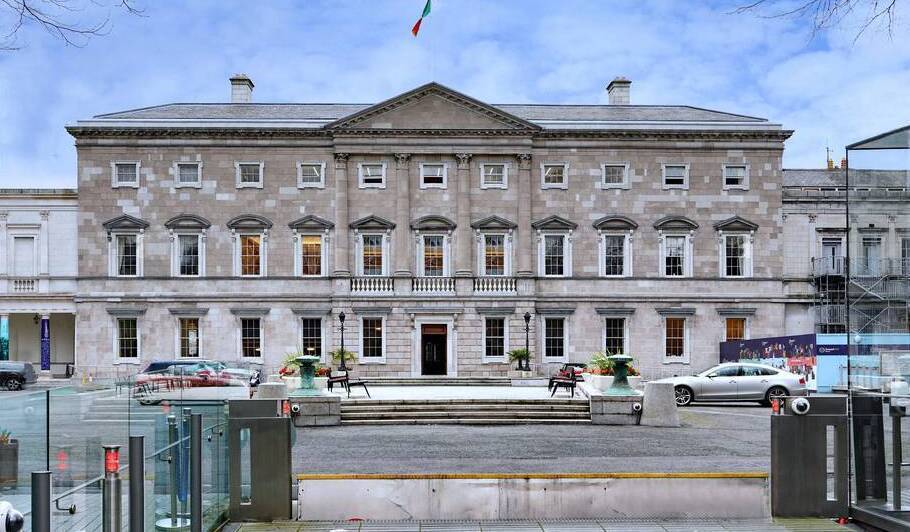
The gender distribution in the Dáil is a cause for national embarrassment. Only one in four TDs is a woman. This is obviously shameful in terms of the denied leadership opportunities for half of the country’s population but, more than that, it is impacting on issues that affect Irish people.
Last week’s vote on the Health (Regulation of Termination of Pregnancy) (Amendment) Bill 2023 perfectly embodies this point. It is undeniable that the substance of the bill addressed issues pertaining to women’s reproductive health. This goes a long way towards explaining why 64% of the women in the Dáil voted in favour of restoring the bill, while only 45% of men did so.
If these ratios were to carry through in a Dáil that had achieved gender parity, the bill would have passed by as many as 12 votes instead of falling by two.
Gender parity is frequently dismissed as an optics issue when the reality is that the gender distribution within the Dáil is demonstrably affecting outcomes for Irish people.
This is not a fringe issue, it is at the core of a democracy that is disproportionately representing the views and interests of certain demographics.
Of course, this representation goes beyond the issue of gender. If we are to look at the most pressing issue of the day — housing — there are close to 10 times more landlords in the Dáil than there are in the general population. It is ludicrous to assume that this kind of disparity is not influencing outcomes on issues surrounding housing.
We must do better by shaping a Dáil that is much more reflective of the demographics of the nation it represents. Addressing the gender divide is an excellent place to start.
By now, we all know which parties truly place their female candidates on an equal footing with their male counterparts. We also know which parties tack a woman onto the ticket at the last minute as a box-ticking exercise. We must get serious about voting accordingly.
In closing, I wish to reassure any irate male readers that I’m not advocating for anyone to overlook male candidates. The men from within the parties that truly value parity supported the bill more effectively than women from within the parties that don’t. Men are a vital aspect of building a better future. I’m not telling you to stop voting for men, I’m asking you to vote for those men who aren’t afraid of a little competition from female colleagues.
Rob O’Sullivan, Kilrush, Co Clare
Respect rule of law
During a ‘topical issues’ debate in the Dáil on November 26, Danny Healy-Rae spoke of an unnamed farmer in Kerry who he claimed had snared and killed 103 badgers in a single year to control bovine tuberculosis.
Mr Healy-Rae said he would not identify the individual, acknowledging that the actions described were illegal, given the protected status of badgers.
Parliamentary privilege exists to allow free and robust debate, not to normalise or implicitly justify serious criminal activity. Using the cover of privilege to describe unlawful acts in a favourable light, and then rely on them to argue for public policy, risks undermining both wildlife protection law and public confidence in evidence-based decision-making.
Wildlife and disease-control policy must be grounded in science, transparency, and legality, not anecdote.
When illegal actions are described without condemnation in our national Parliament, it sends a damaging signal about how such laws are valued.
At a time when trust in public institutions is already under strain, it is important that parliamentary debate strengthens, rather than weakens, respect for the rule of law.
Ruairí Ó Leocháín, Kilrickle, Co Galway
Extend Irish courses
I believe it’s important to create more further and third-level courses in Irish.
There is now an increasing number of opportunities to learn through Irish, from pre-school, primary, and secondary education. It is a shame not be be able to continue.
Miriam Gargan, Dublin
Cut waiting lists for needs assessment
Another thorny issue for the Coalition is the lengthy waiting lists for assessment of needs, the process by which children with additional needs are assigned educational supports. It would be true to say that the situation has long been untenable but the proposed solution is also controversial.
The current waiting list for an assessment of need is expected to hit 22,000 by the end of this year. So the waiting list is very, very long.
What the Government is trying to do is introduce this massive reform by October of next year for the 2027 academic year, when parents would no longer need an assessment of need to place their child in a special school or a special class.
We still don’t have the details but what we have been told is that it would be an education-led assessment where maybe somebody from the educational sector or the school would assess the child and just say what the child needs, instead of going into a massively detailed diagnosis of a specific disability.
It’s a very controversial proposal and there are lots of different views on whether it is a good thing or a bad thing. But I think the one thing that we can say for sure is that it is a tacit acceptance on the part of the State that the waiting lists for disability services and for assessment of needs are far too long.
John O’Brien, Clinical psychotherapist, Clonmel, Co Tipperary
Red-card ‘liathróid’
TG4 is to be complimented for its coverage (GAA Beo) of the club championships, which not only brightens these end-of-year ‘would be’ dreary weekends but is also analytical and engaging in its presentation.
However, I find the continued use of “an liathróid” by match commentators and panellists alike, when referring to the match ball in both codes, to be personally irritating but, more significantly, very disrespectful to the tradition of our indigenous games of football and hurling. Whatever happened to ‘an peil’ in football agus ‘an sliotar’ in hurling?
In requesting the ‘powers that be’ to correct this aberration, may I cite pages 269 and 349 respectively of De Bhaldraithe’s English-Irish Dictionary (1959), the primary go-to source for generations studying Gaeilge, as the authoritative reference.
Michael Gannon, St Thomas’ Sq, Kilkenny
Horrible history of Famine fox hunts
During the Dáil debate on Ruth Coppinger’s bill to ban fox hunting, one of the many disturbing details highlighted was that, during the Irish Famine (An Gorta Mór), it was fun and games for fox hunters.
Paul Murphy noted that “the Irish Masters of Foxhounds Association was established in 1845 during the Famine” and that “while ordinary people were starving to death, there were aristocrats in red coats riding around on horseback, torturing animals to death”.
Richard Boyd Barrett referred to the “contrast between the enforced starvation of the Irish people during the Famine and the expansion of so-called rural pursuits by the British nobility”.
Ged Nash stressed that “the historical context of fox hunting in Ireland cannot be ignored”.
Between 1845 and 1852, 1m Irish people starved to death or died of related illnesses. The unspeakable in pursuit of the uneatable did not allow this to interfere with their fun. Their bellies bloated with the finest food, they callously galloped by, showing little more sympathy than they held for the doomed foxes.
The Cork Southern Reporter of March 13, 1847, best conveyed the awful contrast: “The sound of the huntsman’s horn and the yelping pack mingle in terrible discordance with the groans of the dying parent and the cries of children perishing for lack of food.”
In A Complete History of the Westmeath Hunt, we are told that “while the rich and wealthy lived in luxurious country mansions and could indulge in feasting, sport, and leisure, their tenants lived in wretched poverty and in danger of starvation”.
The story is the same in A History of the Kildare Hunt: “There was misery everywhere. The huntsman once told me that his sufferings were great in Kilkenny during the Famine years, when he saw starving people and yet had to feed the hounds.”
Fox hunting should not have happened during our country’s darkest days and, 180 years later, it should not be happening now. The sooner this contemptible cruelty is consigned to history the better.
Philip Kiernan, Irish Council Against Blood Sports, Mullingar, Co Westmeath