Irish Examiner view: European citizens need clearer view on defence decisions
Europe’s leaders are asking citizens to take difficult decisions seriously and to support commitments that will last years
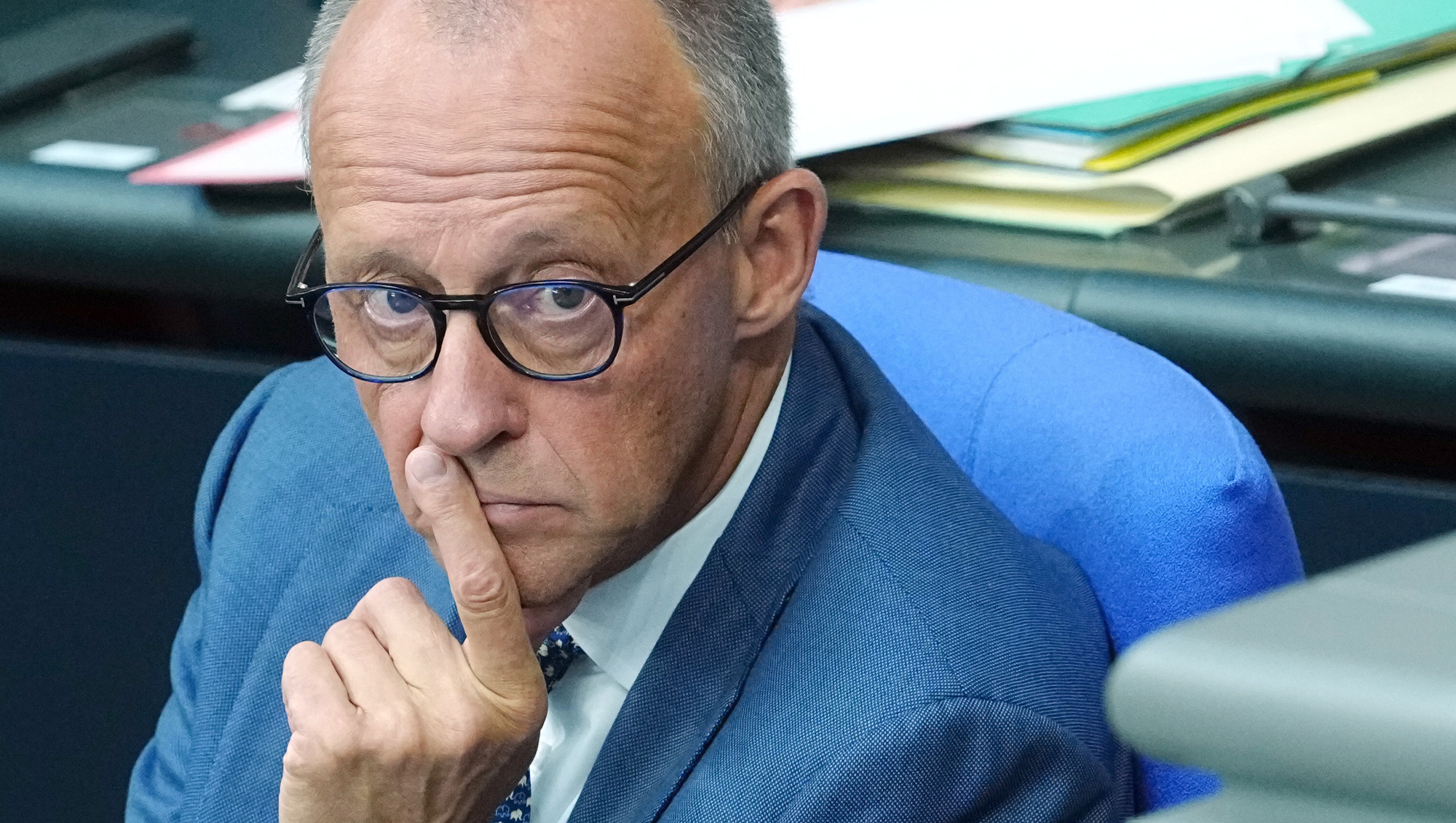
Speaking in the Bundestag during a debate on the 2027 budget, German chancellor Friedrich Merz  cited escalating Russian activity in the Baltic, in Poland, in the Black Sea, in space, and in Germany itself. File picture: Kay Nietfeld/DPA/AP)

Speaking in the Bundestag during a debate on the 2027 budget, German chancellor Friedrich Merz  cited escalating Russian activity in the Baltic, in Poland, in the Black Sea, in space, and in Germany itself. File picture: Kay Nietfeld/DPA/AP)

Russia chose to invade Ukraine and should choose to end the war it began. Europe should continue to help Ukraine defend itself.

That commitment is the starting point for judging Wednesday’s warning from the German chancellor, Friedrich Merz, that Russia wants more than Ukraine.

Speaking in the Bundestag during a debate on the 2027 budget, he cited escalating Russian activity in the Baltic, in Poland, in the Black Sea, in space, and in Germany itself. The range of that list makes it all the more important to understand what he meant. There is a considerable difference between a campaign to disrupt European infrastructure or undermine confidence in its governments and an intention to seize more territory. Both deserve serious attention.

They also demand different preparations, different expenditure, and different explanations to the public.

Earlier this month, Taoiseach Micheál Martin said Russia wanted Europe to be war-weary and attributed a substantial amount of recent hybrid activity to Moscow. That was a more specific claim about what Russia hopes to achieve.

Is Mr Merz describing the same campaign or is he warning of a further escalation? What intelligence assessments have been shared with EU member states? How far do national assessments agree about Moscow’s intentions, and how confidently can governments distinguish what Russia is doing today from what it may be prepared to do in future?

Some of the answers will properly remain confidential. No government should be expected to expose sources or disclose how it obtained sensitive information. There is ample room, however, to publish the broad judgements behind such warnings, the degree of confidence in them, and the implications for the decisions governments are asking parliaments to make.

The setting for Mr Merz’s remarks deserves attention. He was defending both aid to Kyiv and an increase in German defence spending. Across the EU, defence spending reached €418bn last year, a rise of 20%, and is projected to reach €454bn this year. At that scale, the public is entitled to ask what each major commitment will achieve, who will get the contracts, and what other priorities will have to wait.

Defence suppliers have an obvious commercial interest in how those decisions are made. Governments have an obligation to show how they arrived at them.

There is a cost to leaving a warning this broad. Each audience can hear in it the threat it already fears most, and almost any proposal can then be presented as the answer. That makes it harder to judge whether the money is going where it will do most good. It also risks wearing down public attention at a time when sustaining it matters to Ukraine.

Europe’s leaders are asking citizens to take difficult decisions seriously and to support commitments that will last years. They should trust those citizens with as much of the reasoning as can safely be shared.

If Russia wants more than Ukraine, Europeans deserve an account of what their governments believe it wants, what they know, and where they are still making judgements under uncertainty.

Highlighting a vulnerability

The first concern after Wednesday morning’s collision on Galway’s Quincentennial Bridge is for the woman who was seriously injured and for the two other people taken to hospital. For them and their families, it was a frightening day.

The bridge was closed in both directions while gardaí examined the scene, and it reopened at about 3pm. The closure exposed a problem Galway has lived with for decades. When a major crossing is out of service, there are too few dependable alternatives.

Galway City Council advised motorists to avoid coming into the city if possible. Those who had to travel were directed towards Wolfe Tone Bridge, where the council warned they would face delays too. It was sound advice in the circumstances and a dispiriting account of the options available to a city of Galway’s size.

Earlier this month, the withdrawal of a judicial review of the N6 Galway City ring road marked a welcome step forward for a project that has been debated for years. The proposed road would give traffic that needs to get around Galway another route. Many of the people caught in Wednesday’s delays, however, needed to get into or across the city itself. They will still need reliable ways to make those journeys.

The city and its transport agencies should be able to tell residents what they can expect before the ring road opens. That means a timetable for measures that can be delivered sooner, including where buses can be given priority, and where walking and cycling can become practical options for more journeys across the Corrib. People who have to drive also benefit when others have a dependable alternative.

An emergency will always disrupt a city. Galway has had ample warning of how easily a single closure can disrupt so much of it. Its residents should be able to see what is being done about that now.

Don’t phone it in this Christmas

At Phoebe Bridgers’ Dublin gigs this week, there was one less decision to make. Phones were put away for the show, and the audience got on with listening. As Tom Dunne’s account from the 3Arena makes clear, there was plenty to listen to.

In these pages, Richard Hogan has made the case for leaving a child’s first smartphone off the Christmas list. 

There is a smaller undertaking that adults might try themselves. For the length of Christmas dinner, everyone puts their phone away. The advantage of making it a rule for the table is that nobody has to be the first to stop looking at theirs, or spend the meal watching everyone else look at theirs.

Children may have their own views on whether the conversation improves. They are entitled to point out who reaches for a phone first. With luck, Christmas dinner will give them something better to talk about.

More in this section

Revoiced

Newsletter

Had a busy week? Sign up for some of the best reads from the week gone by. Selected just for you.

Cookie Policy Privacy Policy Brand Safety FAQ Help Contact Us Terms and Conditions

© Examiner Echo Group Limited