The last few days have been tumultuous in the Irish health service, which has never been a stranger to tumult.
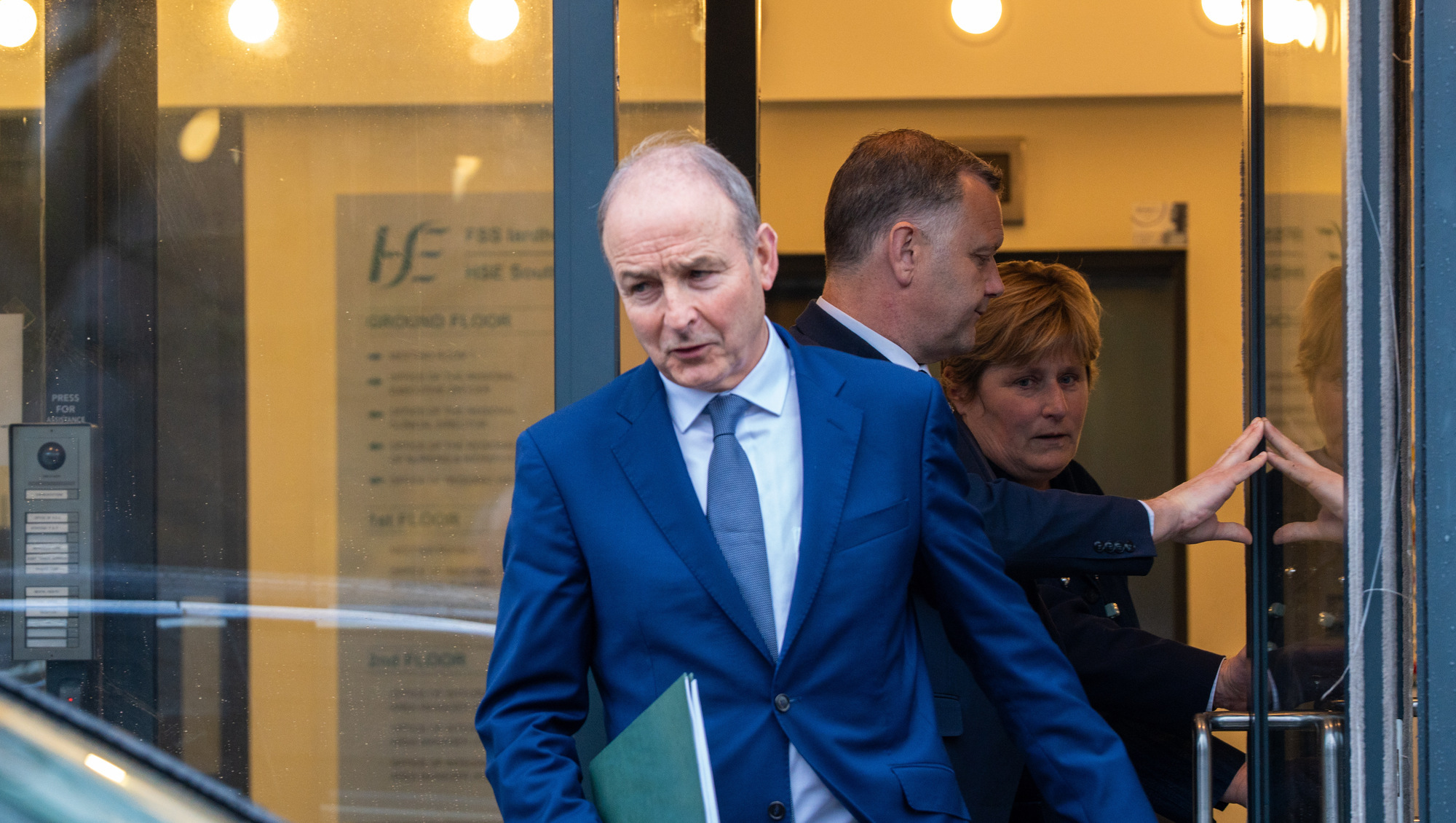
Taoiseach Micheál Martin’s meeting with Cork University Hospital (CUH) management on Monday to discuss the staffing crisis there would have been headline news any other week, but that was soon overshadowed by the departure of HSE chief Anne O’Connor less than nine months into her tenure as head of the organisation.
The HSE board stated yesterday that it had agreed unanimously to remove her based on an assessment of performance and leadership over a period of nearly eight months.
It is highly unusual for a senior public servant to be removed in this way, and there is a need for clarity on this matter.
For instance, the obvious question here is how someone can be removed based on an assessment period of less than eight months.
These events also raise questions regarding the performance of the health minister, Jennifer Carroll MacNeill. She has been sharply critical of CUH’s performance in recent weeks, for instance, but it was the Taoiseach who met CUH management on Monday, not her.
Yesterday at the Oireachtas budgetary oversight committee the minister also appeared to distance herself from the removal of Anne O’Connor, describing the HSE board as Ms O’Connor’s boss and saying she had not discussed the former CEO’s performance with anyone on the board.
Ms Carroll MacNeill was at that meeting primarily to discuss the €780m in extra money being sought by her department, and funding and staffing appear to be lurking behind those recent momentous events.
Perhaps further clarification will be forthcoming at tomorrow’s joint Oireachtas health committee meeting, though it might be difficult to top Cathal Crowe’s summary of events yesterday.
Describing the week as “a bit French Revolution-esque” in that the head of an organisation had gone, he added that what followed were “years of terror”.
Only the most adept political operators survived those years, though none had to deal with the Irish health system.
Should the AI boom depend on one man?
Just two weeks ago, there was consternation in the stock market due to the departure of a single person from one company.
Jensen Huang was ousted as chief executive of Nvidia when it emerged that he had had a relationship with a woman believed by US officials to be a Chinese intelligence asset.
The result was a dramatic fall in the value of Nvidia stock: Valued at $5.8 trillion (€5.2tn) in October, it had lost almost half its value by the end of last week.
On Monday, Mr Huang was reinstated as chief of Nvidia, and the company’s market value jumped by $1tn (€912bn) in a single trading session.
The story gains a significant and dramatic twist with the direct involvement of US president Donald Trump, who intervened with Nvidia’s board to have Mr Huang — one of his allies — reinstated.
“I just thought he should be running the company, and I didn’t know it was going to have this kind of an impact,” Mr Trump has said.
The fact that the US president is so blasé about the warnings of his own intelligence agencies regarding Mr Huang’s relationship is concerning enough, though the counter-argument is that Mr Trump’s intervention has led to a stock market recovery.
That premise is undone, however, by the strong possibility that Mr Trump benefited financially from his own intervention.
US media reports that Mr Trump owned at least $12m (€10.9m) worth of Nvidia shares at the end of last year, with The New York Times stating he “likely personally benefited” from the Nvidia surge this week.
The time lag between trading period and mandated disclosure makes it impossible to determine the extent of any gains yet.
The final complication which this saga brings into sharp focus is the perceived necessity of the AI tech boom, and of maintaining that boom no matter what the consequences — including compromising national security, if needs be.
It is hardly reassuring that this boom is so heavily reliant for survival on one individual’s involvement at all costs.
Ireland to stake a claim out West
The Irish presence in Montana is not as well-known as the outposts in places such as Boston or the Bronx, but there has long been a tradition of Irish emigrants heading to places like Butte, Montana.
Now, that tradition will form a central part of Steven Spielberg’s new movie, an adaptation of Limerick novelist Kevin Barry’s novel The Heart in Winter.
This week Spielberg has announced plans for his next project, a western scripted by Paul Thomas Anderson, himself an Oscar-winner for One Battle After Another. The novel tells the story of two fugitives on the run in the 1890s and has a strong Irish flavour.
In 2024, Barry told this newspaper that the research he drew on for The Heart In Winter helped with the novel’s verisimilitude: “So all the bars, cafes, and brothels that are named, they all existed. The Irish crowd in Butte, it was mainly Co Cork they came from — they were 10,000 of the 30,000 there until 1891.”
Accents should not be an issue for the actors tipped to star in the movie. Among those in line for the main roles are Cork man Cillian Murphy, who won an Oscar for Oppenheimer two years ago, and Kerry woman Jessie Buckley, winner of an Academy Award for Hamnet last year.
It is believed that the film is scheduled for a 2028 release.
CONNECT WITH US TODAY
Be the first to know the latest news and updates