Irish Examiner view: Let's hope we never need Nama again
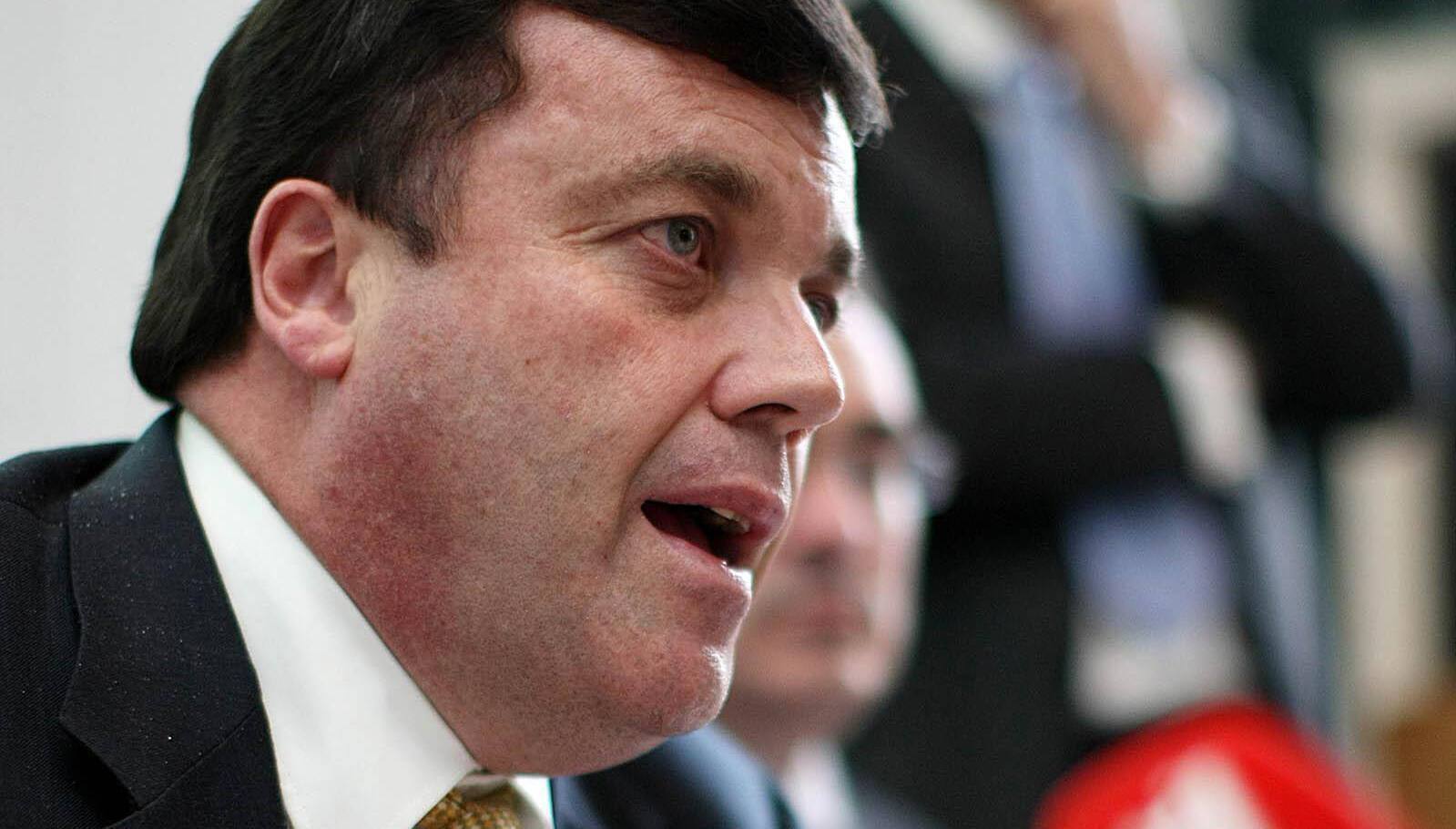
Then finance minister Brian Lenihan launching the draft legislation to set up Nama, the National Asset Management Agency, on July 30, 2009. File picture: PA
The end of an era came yesterday with news that the National Asset Management Agency (Nama) is to be wound up.
The Department of Finance announced that the organisation had fulfilled its mandate, and any remaining of its remaining activities would be taken over by the National Treasury Management Agency.
The announcement brings to a formal conclusion a particularly painful period in our recent history. Nama was established in late 2009, in the wake of the financial collapse, to manage and resolve impaired loans secured against approximately 60,000 properties across multiple jurisdictions.
The agency has returned a surplus of €5.6bn to the exchequer, while it also transferred assets to the Land Development Agency, including 1,366 social homes and land with the potential to deliver around 7,000 new homes. It also facilitated the delivery of over 44,500 homes, as well as 2,957 social housing homes.
There are alternative views of its accomplishments. Last February, it was criticised by tenants facing eviction in Dublin’s Spencer Dock and, at a Public Accounts Committee meeting last month, the agency was blamed for contributing to the housing crisis by selling parcels of land to vulture funds.
Many readers will also be familiar with the Project Eagle controversy, the proposed sale of the Northern Ireland loan book, which has led to court proceedings and fraud charges in Belfast.
Those struggling with the high cost of living may have raised their eyebrows with last week’s news that a Meath developer had a €14m debt owed to Nama written off for a €37,000 payment under a personal insolvency arrangement approved by the High Court.
It is worth pointing out the scale of the crisis facing the country when Nama was established: In 2009, it initially acquired loans with an original value of €74bn, for instance. Wrestling problems of that size into submission was never going to be a straightforward proposition, and it would have been foolish to expect consensus on the agency’s performance.
Perhaps the best we can hope for is never having to re-establish Nama, or any similar agency.
It is a depressing reality that we have now almost come to expect that women in all sorts of public positions will be targeted for abuse. It sometimes seems that the only real surprise is the endless capacity of our standing army of misogynists to find and use new forms of harassment.
Or, as reported by Louise Burne here this week, to repurpose old forms of abuse. Many female politicians have reported a similar experience in recent weeks — persistent and repeated phonecalls from a man who claims to be a paedophile who wants to “make a confession”, and who allegedly asks his listeners to “challenge” him.
The special detective unit of An Garda Síochána is investigating the matter.
At least 70 councillors from a number of political parties have reported receiving repeated calls from the man. Predictably enough, the Association of Irish Local Government said it has received no reports of male councillors receiving similar calls.
Here is a specific issue which needs to be settled as quickly as possible. Someone cannot be allowed to target public representatives in this way, and the special detective unit should leave no stone unturned in resolving this matter. Any such abuse — of any public representative — is a direct challenge to our democracy.
The broader context also needs to be considered. Given that there are 261 women among Ireland’s 949 councillors, the 70 councillors affected here are a significant proportion of the total number of women in local politics around the country.
More women are needed in such positions, but it would be a considerable understatement to say that experiences such as this are a strong disincentive to get involved in politics.
Social media is often blamed for the targeting of women in politics, and the anonymity available online certainly helps those who seek to abuse and insult others. Here we have a case where the technology being used is almost analogue — a phone — but the effect is equally chilling.
We cannot allow one in four of our female councillors to be harassed in this way, and the full rigours of the law should be applied here.
Last week, the Government announced that several significant infrastructure projects had been designated as being of critical national importance under new legislation, which will give them priority status.
Those include the Metrolink in Dublin and the Cork Commuter Rail Programme, among others.
Certainly all of the projects involved are vital to our development as a nation and should be progressed as a matter of urgency.
However, we should also bear in mind the necessity for development on a slightly smaller scale.
Sean O’Riordan reported this week that url=https://www.irishexaminer.com/news/munster/arid-41888332.html]a new traffic plan is being sought for Kinsale[/url] in Cork. While there are plans for a northern relief road to alleviate traffic in the town, that project is expected to take many years.
O’Riordan also reported that Bantry is facing a lengthy delay with a major infrastructural project: A flood relief scheme is designed to protect 200 vulnerable properties in the town but is not expected to be completed until 2031. The first stage of the project will not get underway until next year.
We cannot lose sight of the importance of smaller schemes such as these. Compressing some of these timelines would be a positive step.

CONNECT WITH US TODAY



Be the first to know the latest news and updates