Irish Examiner View: Labour start as they mean to go on
Irish Examiner View: Labour start as they mean to go on

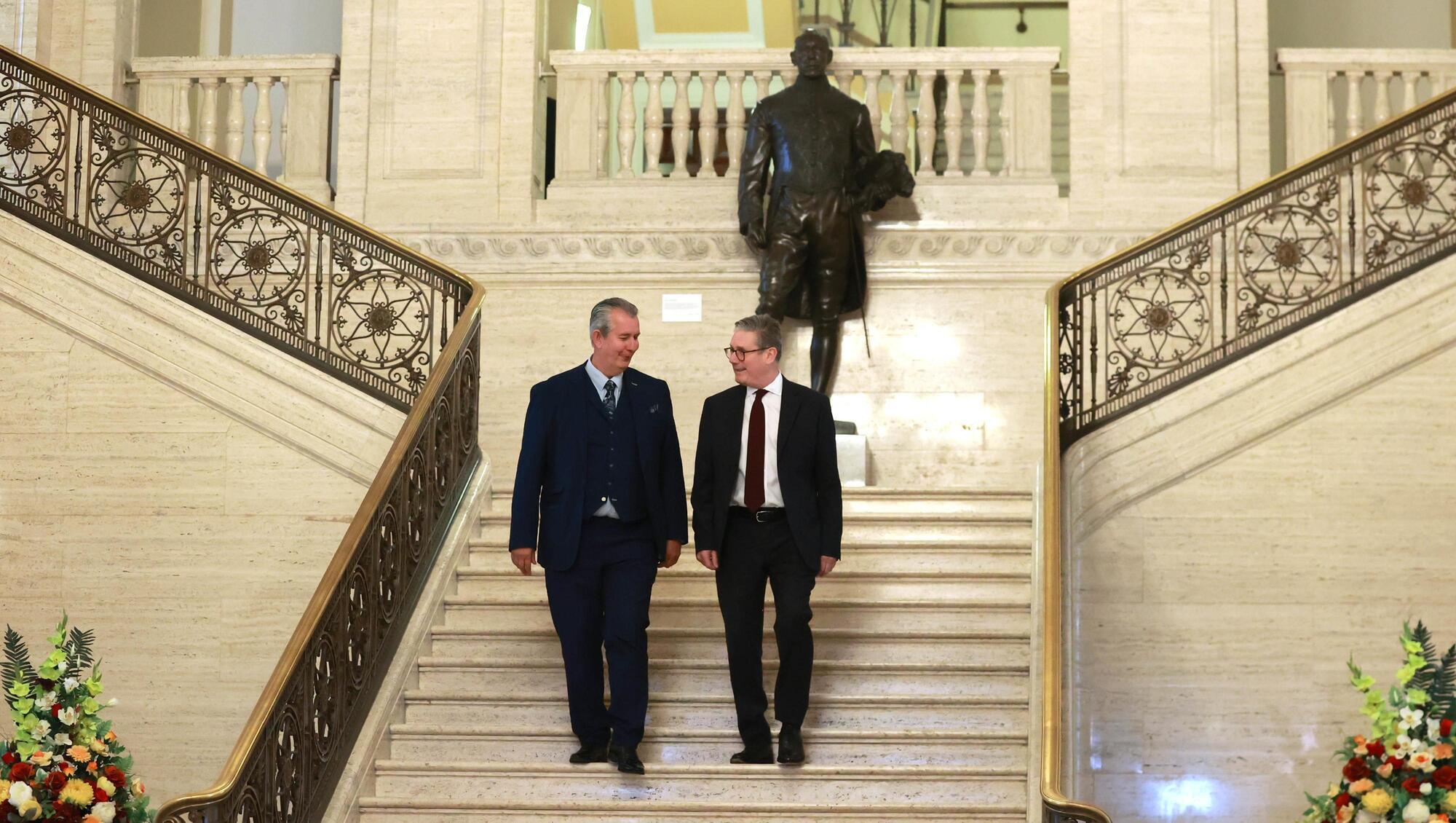
British prime minister Keir Starmer with Edwin Poots, Speaker of the Northern Ireland Assembly, at Parliament Buildings at Stormont, Belfast, on Monday. Picture: Liam McBurney/PA Wire

Britain’s new prime minister, Keir Starmer, has moved fast in his attempts to reset relations within Britain, with Ireland, and with the rest of Europe.

Mr Starmer was in Northern Ireland yesterday, a day after his new point-man in Belfast, Hillary Benn, made his presence felt there by pressing the reset button politically and announcing that the Casement Park stadium project would go ahead.

The Labour Party leader received a warm welcome at Stormont from all party leaders, and was praised for his promise to repeal the controversial Legacy Act — which offers a conditional amnesty to paramilitaries and soldiers involved in the Troubles — and also his vow to readjust relations with Dublin.

However, it has not just been Mr Starmer who’s got things up and running. The new chancellor of the exchequer, Rachel Reeves, shredded her Tory predecessors by saying the mess they’d left after them was “the worst since the Second World War”. She announced changes to the planning rules to try to spark impetus in housebuilding.

Then there was the foreign secretary, David Lammy, who engaged in a lightning European tour over the weekend — taking in Berlin, Stockholm, and Bydgoszcz — in the first steps towards reconstructing relations within Europe after the eight fractious years of Brexit.

Mr Lammy also fitted in 16 introductory phonecalls with EU and world diplomats — including US secretary of state Anthony Blinken and EU foreign affairs chief Josep Borrell.

In a few short days, the new Labour government has shown purpose and intent. It has demonstrated a willingness to actually govern — something that appeared alien to its predecessors. It has been a strong statement of intent thus far, and let us hope it continues that way.

Iran election brings hope for change

A woman casts her vote for the presidential election in a polling station at the shrine of Saint Saleh in northern Tehran, Iran, Friday, July 5. Picture: AP

The stunning victory of the reformist candidate in last week’s presidential election in Iran marks an opportunity for the country to retune its relations with the world and perhaps dampen some of the deep dissatisfaction within the country.

Masoud Pezeshkian drew nearly 3m more votes than the ultra-conservative candidate, Saeed Jalili, in a contest which, over two rounds of voting, saw him defeat three other conservative candidates on a final turnout of 49.8%, which was a huge increase on the 39% recorded in the first round.

The moderate candidate, who has proposed allowing women to choose whether they wear a hijab and ending internet restrictions, has given hope to many in Iran that reform may be at hand. His win is seen as remarkable in a country where no reform candidate was allowed to stand in the last election in 2021. It was widely considered that the chances of societal transformation had long since passed.

With many voters convinced a vote for change was pointless as a “shadow government” took all the decisions, Pezeshkian’s victory was all the more unlikely.

We do know that the new president faces a minefield in trying to bring about change in Iran, not least in trying to reduce the current 40% inflation rate, something he has said he cannot do unless international sanctions against Iran are lifted.

If he is to attempt to achieve the lifting of those sanctions, Pezeshkian will need to introduce a less confrontational approach to international relations and parlay the release of at least some of the thousands of political prisoners within Iran.

His is a victory few saw coming and particularly so as the Women, Life, Freedom movement of 2022 had been so brutally repressed and left many citizens feeling the route to reform via the ballot box had been closed off.

Pezeshkian’s win is a huge opportunity for Iran to refocus and regather not only national pride and the economy, but to restore it to something other than the pariah status it has garnered internationally.

Epic performance from hurlers

Niall O'Leary of Cork celebrates winning a free late in the All-Ireland Senior Hurling Championship semi-final against Limerick. Picture: Stephen McCarthy/Sportsfile

In a letter to the editor in this newspaper last weekend, former Kerry All-Ireland football medallist Michael Gleeson wrote emotionally about the decline — as he sees it — in the evolution of the game and what he described as the urgently needed “time for corrective action”.

The malaise which has struck the game of Gaelic football, he maintained, was being made worse by “poor sticking plaster attempted remedies” for dangerously bleeding metaphorical wounds.

Whatever the state of the “big ball” game at present, that was most certainly not the case this past weekend with its hurling counterpart — which produced two pulsating All-Ireland semi-finals, which saw Cork and Clare emerge victorious after games against Limerick and Kilkenny, respectively.

If the games themselves were wonderful exhibitions of the skills which makes hurling one of the most compulsive spectator sports in the world, the sportsmanship on display in the aftermath of both matches was an object lesson in how to comport yourself in both victory and defeat.

This was most obviously illustrated by Limerick coach John Kiely, who despite missing out on the unprecedented experience of seeing his team compete for an All-Ireland five-in-a-row, was magnanimous in defeat.

His assertion that the hurt in Limerick would be “God awful” was truthful, honest, and a welcome remove from the bickering, finger-pointing, and blame-gaming seen in so many other sports.

So too the Cork coach, Pat Ryan, who generously pointed out that Limerick had brought the game to a new level and admitted that Cork were happy to “get over the line”.

A Clare-Cork final now beckons and fans can rest assured it will be an epic one which, hopefully, will see more of the sort of sporting generosity and even-handedness missing from so many other sports, and allow the fans to bask in the purity of the game — something many feel is so obviously lacking in Gaelic football at present.

More in this section

Revoiced

Newsletter

Had a busy week? Sign up for some of the best reads from the week gone by. Selected just for you.

Cookie Policy Privacy Policy Brand Safety FAQ Help Contact Us Terms and Conditions

© Examiner Echo Group Limited