Ebola treatment trial begins in Congo at 'record pace'
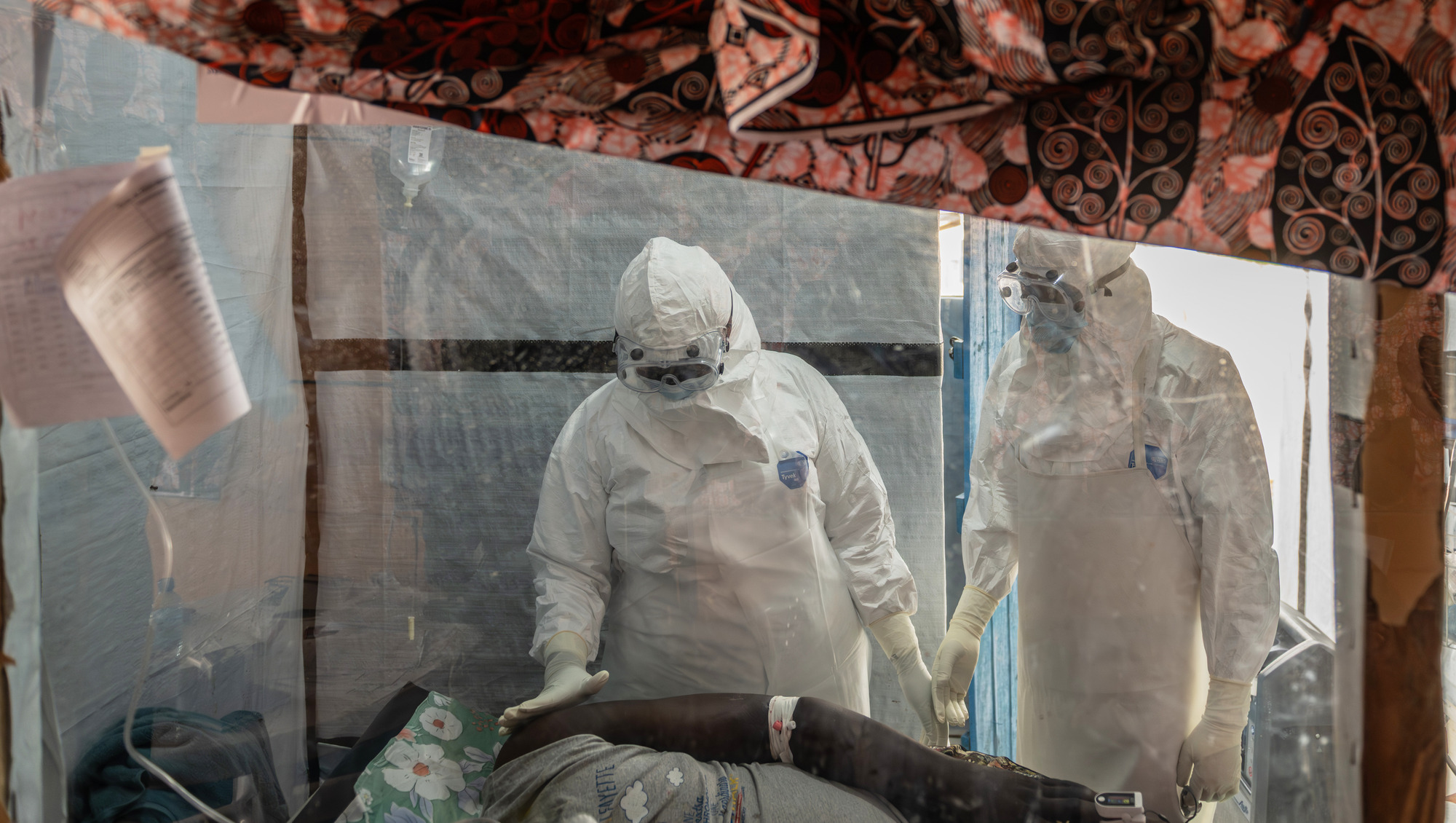
Health workers tend to an Ebola patient in Ituri, Congo. The WHO is in discussions to ensure sufficient supplies will be available after the trial, should they prove safe and effective, it said. Fille picture: Moses Sawasawa/AP
There is no approved drug to help the medical teams scrabbling to save lives in the Ebola outbreak in the Democratic Republic of the Congo — but there are hopes that could change within months as the first patients are enrolled in a treatment trial.
It is a record pace to set up and start this kind of research, scientists said, with patients enrolled just six weeks after the outbreak being declared a public health emergency of international concern by the World Health Organization (WHO) on May 17.
Nevertheless, in Bunia, the capital of Ituri province, where the virus is raging, people are impatient. “I hope these drug trials proceed quickly,” said Neema Haba, a mother of three and banana seller. “
As of July 9, there had been 1,792 confirmed cases and 625 deaths caused by the Bundibugyo strain of the virus, for which there is no vaccine and no approved treatment. It is still “in the expansion phase”, according to the WHO.
Hopes of turning the tide now rest with scientists searching for effective medicines.
The Partners treatment trial has opened with two drugs on its books – remdesivir, and MBP134. Patients will be randomly allocated to receive either drug, a combination of the two, or simply standard, supportive care.
Remdesivir is an antiviral made by pharma company Gilead Sciences, while MBP134 is a monoclonal antibody developed by Mapp Biopharmaceutical, containing two specially engineered immune proteins that recognise and neutralise the virus.
Both are given intravenously — MBP134 as a one-off infusion, and remdesivir as 10 days of intravenous therapy.
“These two drugs actually have been proven to work against the Bundibugyo virus in animal models,” said Prof Laurens Liesenborghs of the Institute of Tropical Medicine, Antwerp, who is working on the trial in Ituri.
WHO officials said enough remdesivir and MBP134 had been donated, by Gilead and the US government respectively, for 1,200 patients to be enrolled.
The WHO is in discussions to ensure sufficient supplies will be available after the trial, should they prove safe and effective, it said.
Partners is sponsored by the WHO, with funding from the Wellcome Trust, FCDO and UKRI.
Another trial is due to begin this week, looking at whether giving people who have been in contact with Bundibugyo cases a drug called obeldesivir can stop them developing the disease. Africa CDC said that trial needed around $18m to proceed, with $6m committed to date.
- Guardian
CONNECT WITH US TODAY



Be the first to know the latest news and updates