Irish Examiner view: 2008 bank collapse that changed our world
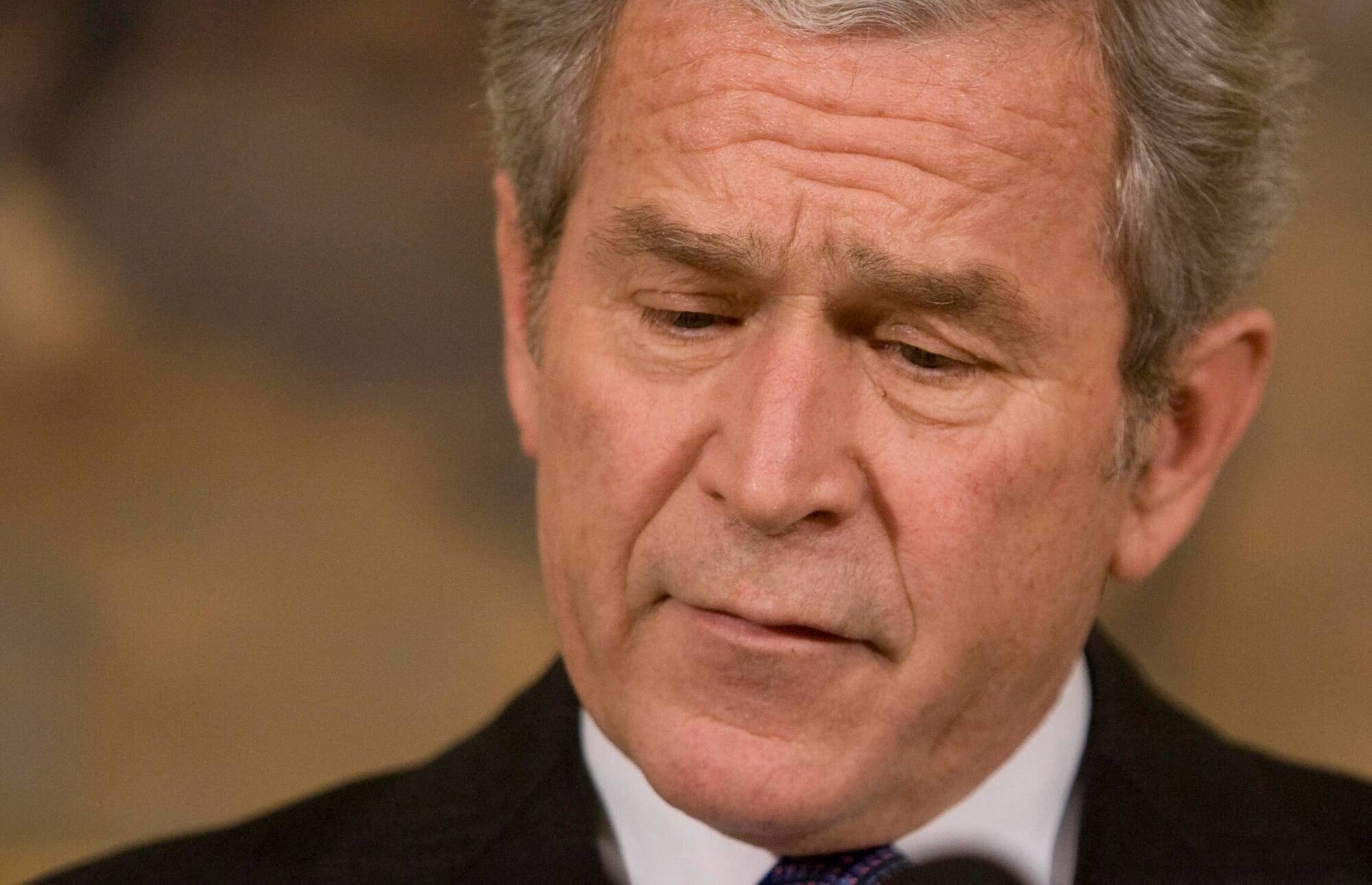
Then US president George W Bush pauses during an economic statement at the White House in 2008 as the economic crash unfolded. Picture: Evan Vucci/AP
It was 15 years ago on Friday that we learned that the decades-old accountancy aphorism ‘too big to fail’ (tbtf) does not always hold true. Not by a long way. And that chaos theory is validated most quickly in the world’s connected financial markets.
It was the week US president George W Bush took advice from the US Treasury and the US Federal Reserve, and signalled there would be no government bailout for one of the world’s largest investment banks.
The collapse of Lehman Brothers not only marked the end of an unsustainable housing bubble in the United States; it was a depth charge which brought a worldwide recession with maladies from which we still suffer today: Geopolitical uncertainty, lack of confidence in the stability or wisdom of financial markets, diminished trust in democratic leaders. And a poorer, more febrile, quality of life.
Lehman, founded by three Bavarian/Jewish immigrants, Henry, Emanuel, and Mayer, in 1850 in a real-life example of the American dream, had 25,000 employees across the globe.

It was the fourth largest investment bank in the US with an apparent expertise in trading securities, government bonds and increasingly complex instruments known as ‘derivatives’.
At the time it filed for bankruptcy on September 15, 2008, Lehman had assets of $680bn supported by only $22.5bn of firm capital, a ratio which provided a sobering lesson about terms such as leverage and gearing and why they are important.
What followed internationally is well-known. In Ireland, the Celtic Tiger was laid to rest; our own banking crisis engulfed us, requiring intervention from the International Monetary Fund and the creation of the National Assets Management Agency (Nama), a bank for bad debts underpinned by the government. Austerity and uncertainty followed, and continue until the present day, exacerbated by a pandemic and a war which has heavily disrupted trade and recovery.
One lesson that was learned, for now, is that there are financial groups which are ‘too big to fail’ because of the rapid contagion they spread. And, in the absence of any unified political or commercial will to break them up, this means the taxpayer will continue to be the lender of last resort if there is any risk of acute disorder.
Those financial behemoths are known to us, because they are identified annually in a review by the Financial Stability Board as being “systemically important”. There are 29 of them and they are required to hold higher levels of cash reserves to counterbalance their loan portfolio.
There are economics purists who chafe against this approach and worry that the numbers sheltering under this umbrella are too large. But this year we witnessed the first “tbtf” organisation to be rescued from collapse when Credit Suisse was acquired by UBS.

Since we witnessed hundreds of Lehman employees carrying their possessions in cardboard boxes through Lower Manhattan, new types of financial risk have emerged. Fintech, with its automation of investments allied to artificial intelligence, has an ever-increasing influence; crypto currency has shown several characteristics of an accident waiting to happen; three American banks serving these volatile sectors have collapsed this year.
The American philosopher George Santayana is reputed to have said: “Those who cannot learn from the past are condemned to repeat its mistakes.”
But there is a limit to that credo. The threat to all our pockets created by global financial markets may be something we have not yet experienced.
It’s a sobering thought, to touch upon the theme of her signature hit, to realise that Amy Winehouse would have been 40 this week had she not lost her life to alcohol poisoning in the small hours of a summer morning in North London 13 years ago.

One can only speculate what she would have been like at 40, this iconic symbol of modern womanhood whose empathetic music reverberated with so many in a manner similar to Edith Piaf, or Billie Holiday, or our own Sinéad O'Connor.
Her discography is remarkably short, but hugely potent. Two live albums, two studio albums, a “greatest hits” compilation and a smattering of singles, videos and TV performances.
Amy Winehouse, dead at 27, the same age as Kurt Cobain, Brian Jones, Jim Morrison, Robert Johnson, Janis Joplin, and Jimi Hendrix, had immense soul to match her vulnerabilities and her trademark red lipstick, tattoos, black eyeliner and beehive hair which referenced her ’60s heroines Ronnie Spector and Mari Wilson.
We will never know whether troubled youth would have matured into greater influence and stability. And that is the final tragedy of a voice lost to a generation.
Talking tough to the energy companies, compared to central banks, is an easy win for politicians as Taoiseach Leo Varadkar must have known when he admonished the recent round of price reductions as “not being enough” and warned companies such as SSE Airtricity, Electric Ireland, and Energia, that he wanted more.
Tucked up in the lecture about supplies being secure and the build-up of reserves was the warning that finding alternative sources may come “at a price”. In fact, nothing is more certain given a malevolent alliance between two of the world’s largest oil suppliers, Saudi Arabia and Russia.
The International Energy Agency has warned that a joint decision by Moscow and Riyadh to extend supply cuts until the end of the year will produce a “significant shortfall” and drive up prices even further. Brent crude hit $92.52 per barrel this week, more than €86, its highest level since November last year.
Forecasts say that demand will eclipse supply by one million barrels per day by year end, placing further upward pressure on buyers. Meanwhile Russia’s oil export revenues are surging.
For the Kremlin, reduced to courting North Korea dictators for company and ammunition, this is a weapon of war, and one which serves Vladimir Putin well. The Saudis are engaged in a massive expansion and infrastructure programme. The rest of us should not be hopeful of respite any time soon, if at all.