Warning signs for future of sports participation and volunteering
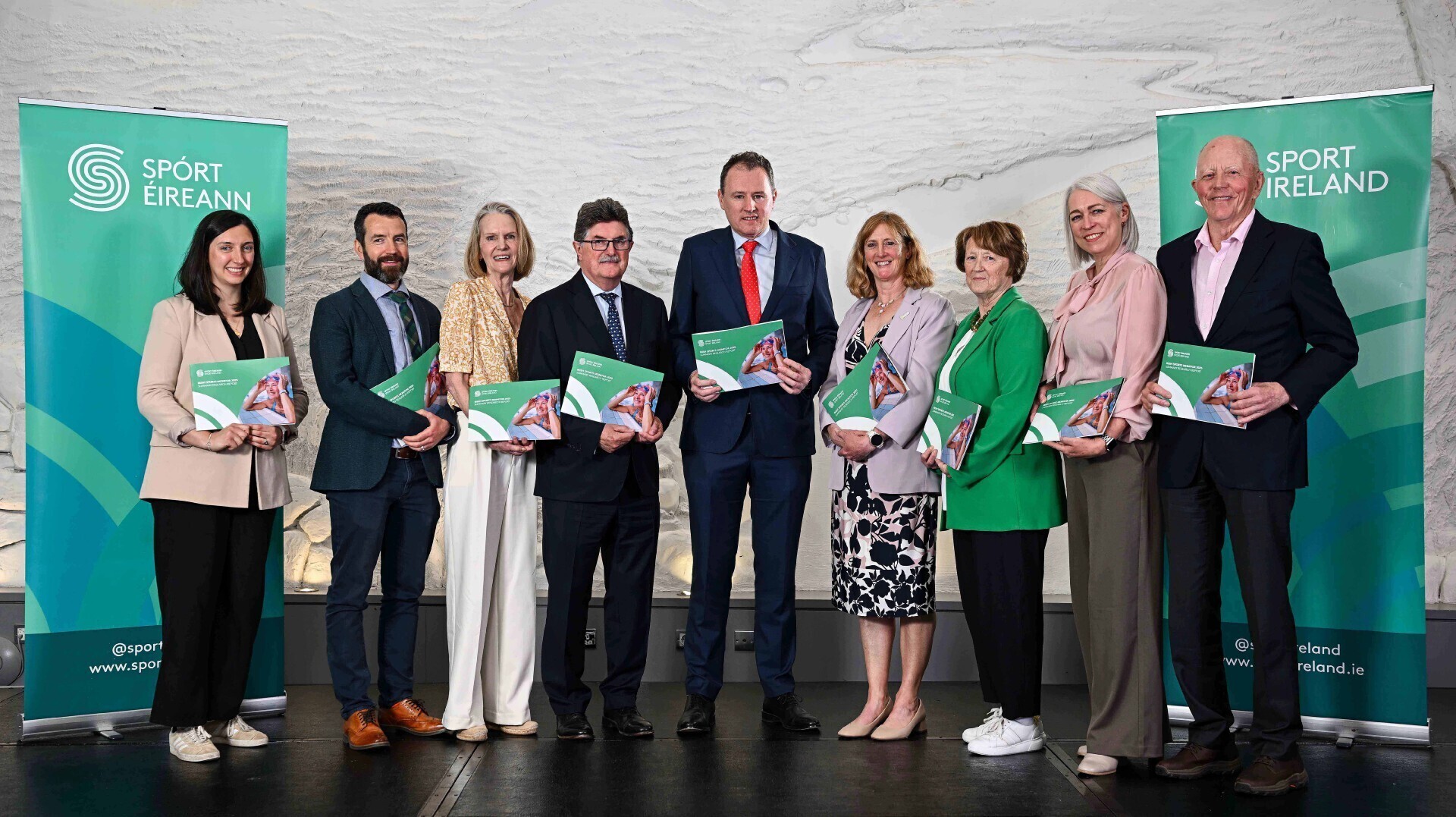
In attendance are, from left, Research and Innovation Committee member Rebecca Hope, Sport Ireland director of research and innovation Benny Cullen, Sport Ireland director of participation, ethics, integrity and research Mary Van Lieshout, Sport Ireland chairperson John Foley, Minister of State with special responsibility for Sport and Postal Policy Charlie McConalogue, Sport Ireland chief executive Dr Úna May, Research and Innovation Committee chair Miriam O'Callaghan, Research and Innovation Committee member Michelle Tanner, and Research and Innovation Committee member Iognáid Ó Muircheartaigh, during the Irish Sports Monitor 2025 launch at The Crowne Plaza Hotel in Blanchardstown, Dublin. Photo by Seb Daly/Sportsfile
Sport Ireland has warned that the current sports participation boom must not be taken for granted, with demographic trends pointing towards a potential dip in both playing numbers and volunteerism by 2035 unless action is taken now.
Speaking at the launch of the Irish Sports Monitor 2025, Sport Ireland's director of research and innovation Benny Cullen outlined how record participation figures - more than 2.1 million people active every week - mask longer-term challenges, particularly among younger age groups.
While participation has risen across most age brackets since 2017, the 16-24 cohort has remained largely static, which may be an indirect consequence of the Covid pandemic. Around 70 per cent of that group are active but Cullen argues that, in the context of wider trends, it is a warning sign.
“There are significantly more teenagers in the system now than even a few years ago,” he explained, pointing to CSO data. “With more 16-year-olds coming through - and younger people generally more active - you would expect participation rates in that cohort to be rising, not standing still.”
That matters because of what Cullen describes as the “cohort effect" - the tendency for people who are active in their youth to remain active throughout adulthood.
Much of the growth in participation over the past decade has come not from converting inactive adults, but from previously active younger cohorts simply ageing while maintaining their habits. Today’s active 40 and 50-year-olds are the same people who were playing sport in their 20s and 30s.
“If we lose them at that transition point - from teenage years into young adulthood - that drop-off carries through the rest of the system,” Cullen cautioned.
The data collected shows a sharp decline in activity levels between late teens and early adulthood, driven by factors such as exam pressure, time constraints and a loss of interest. Cullen believes the Irish sports sector must adapt to improve those figures.
“Sport has to be flexible,” he said. “It has to fit around people’s lives, and it has to stay interesting. If it doesn’t, people will drift away.”
Sport Ireland modelling suggests that overall participation numbers will continue to rise in line with population growth, potentially reaching 2.5 million by 2035.
However, Ireland’s population is ageing, with a significant increase projected in the number of over-50s. At the same time, the current “bulge” in teenage numbers will move into adulthood and be replaced by smaller cohorts, reflecting lower birth rates.
Crucially, Cullen highlighted that the 40–50 age group - those most likely to volunteer in clubs and community sport - is set to decline over time.
“These are the people who coach teams, run clubs and keep sport going at local level,” he said. “If there are fewer of them, that’s a structural challenge for the entire system.”
Cullen stressed that this is not an inevitability but it is a projection that can be addressed with the right planning. That means, he said, keeping pace with the Government's targets on housing, which amounts to building a "living city" every year.
It also includes investing in facilities - speaking at the launch, Swim Ireland's interim CEO Mary McMorrow highlighted an over-reliance on hotel pools as a barrier to growing participation levels around the country and growing club memberships.
Sport Ireland CEO Dr Úna May says the body is working closely with the Office of Planning Regulator to ensure future infrastructure keeps pace with population growth.
Sport Ireland was made a prescribed body last year under planning and development regulations, thus making it a statutory consultee on the development or variation of every county development plan and every regional spatial strategy in the country.
"If you don't look at the data, if you don't grasp what the potential risks are, you can't ever really meet those challenges," said Dr May. "The best thing we can do is identify where we can make the biggest difference."
Minister of State for Sport Charlie McConalogue, who attended the launch, stressed that studying the data and projections is vital to how the Government responds and prepares for these challenges.
“We’ve seen real progress, going from 43% of adults participating weekly to 48% now," he said. “Society is changing, but we want to make sure sport not only maintains its place, but plays an even bigger role in people’s lives."
The Minister said that volunteerism in sport must be supported and prioritised and that the Government will continue to develop facilities so people have the opportunity to take part in their own communities.
The next round of sports capital funding will be finalised in the summer, while Minister McConalogue added that while the funding that was made available via the Dormant Accounts fund will be phased out, funding for sport has doubled in recent years and that focus on spending will continue.
“There’s a greater understanding of the importance of sport," he said. "But there are also more barriers now in terms of lifestyle and increased digitisation.We have to make sure young people continue to see sport as part of their lives as they move into adulthood.
“We’ll be closely interrogating the data to understand the challenges and how best to respond from a Government point of view. We’ve doubled Government investment in sport in recent years, and we want to continue that.”

CONNECT WITH US TODAY



Be the first to know the latest news and updates