Irish Examiner view: Changes and challenges for workers
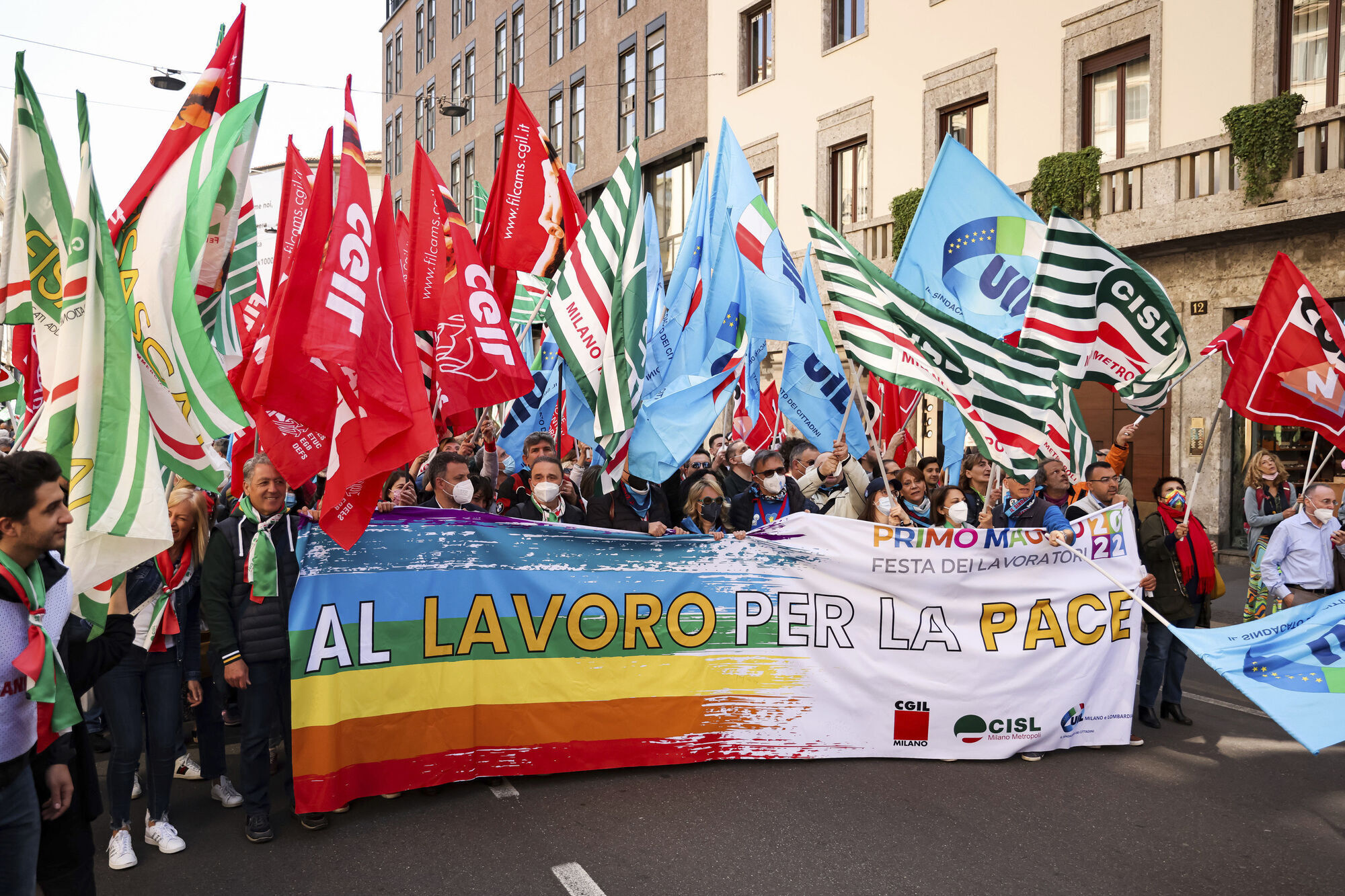
Demonstrators participate in a May Day march organised by CGIL, CISL and UIL Lombardia trade unions, in Milan, Italy, Sunday, May 1. (Picture: LaPresse via AP
The ritual of May Day as a celebration of the rights of workers everywhere has rarely been as exuberantly marked in Ireland as in some other countries.
Unlike in other European states turnouts have been limited, even 40 years ago when trade unions seemed both more vocal and more visible.
There have been some exceptions riotous: behaviour in Dublin over globalisation and capitalism in 2004 captured some fleeting headlines but the anniversary, first celebrated in Dublin in 1890, for many years was subsumed into the commemoration of the execution of James Connolly, founding father alongside Jim Larkin of the Irish labour movement.
One of the key early demands of activists was the establishment of an eight-hour day, and it is sobering to contemplate that after the passage of 100 years there will be those, particularly in what has become known as the gig economy, for which that can only be an aspiration.
Hours worked generally have been climbing since 2011.
This year the focus has been on the number of people killed in work-related incidents; there have been 481 cases in Ireland since 2012, and seven so far this year.
If we add the numbers who have died from illness after a long latency period we see that the workplace can indeed be a dangerous place.
One of the annual traditions of organised labour which has stood the test of time, and which has even bounced back after the awful restrictions of Covid-19, is that of the annual conference where union officials get together to let off steam about employers/the government/society/customers and generally put the world to rights.
In some cases, also, it allows them to signal their resistance to change. Moving on to new ways is not always popular, and in some cases not an improvement.
A recent demonstration of opposition came at the Teachers Union of Ireland (TUI) conference with particular wrath, backed up by sabre-rattling about industrial action, directed at proposals to reform the administration of the Leaving Cert and include a proportion — 40% — of teacher-based continuous assessment.
This has always been a contentious subject in the Republic with the profession fundamentally opposed to the in-house grading of students and keen to maintain a separation of powers between those responsible for delivering the learning and those who assess how well it has been grasped by those who receive it.
That argument has come under some scrutiny during the pandemic years of 2020 and 2021 when emergency measures were enabled to allow schools to provide estimated grades for their pupils.
However, the TUI is now wary that what was once an emergency will become a de facto norm.
Liz Farrell, the organisation’s vice president, told her congress that teachers must remain “advocates for our students, not arbiters” and that the new approaches proposed are “regressive” and “indicative of the disdain” that the profession is held in by the government.

Other speakers called for the existing assessment system to be protected and assurances that the “already very demanding workload of teachers” will not be increased.
There may be several reasons why teachers should not be asked to take on such duties and the allocation of scarce resources such as available timetable and the personnel to carry out these functions will surely be among them.
However, the argument is at its weakest if it maintains a philosophical or theoretical objection why such responsibilities cannot fall within their purview.
Teachers will, already, carry out their own assessments of the progress of youngsters in their care and what can be done to assist and realise individual potential.
In UK schools, which have recruited many talented staff and new entrants from the Republic, subject teachers and department heads have been required to submit course work grades, as well as a forecast, to exam boards, frequently following a collective moderation by the whole team.
Those predictions are used by the external boards to double-check against achieved grades.
If they are out of kilter with either past performance or predicted achievement then further validation is automatically initiated. If pupils are still unhappy then they have a right of appeal.
This is not to say that this should be imported into Ireland, purely to indicate that there are other ways of doing things.
All forms of work structure are under pressure. From technology, from economic forces, from the consequences of war, from skill shortages, from the impact of climate change, and from viruses.
That volatility is increasing. Whether we like it or not we must give full consideration to alternatives. Change is in the air.