Colin Sheridan: Why protest? Students at the University of Galway have shown why
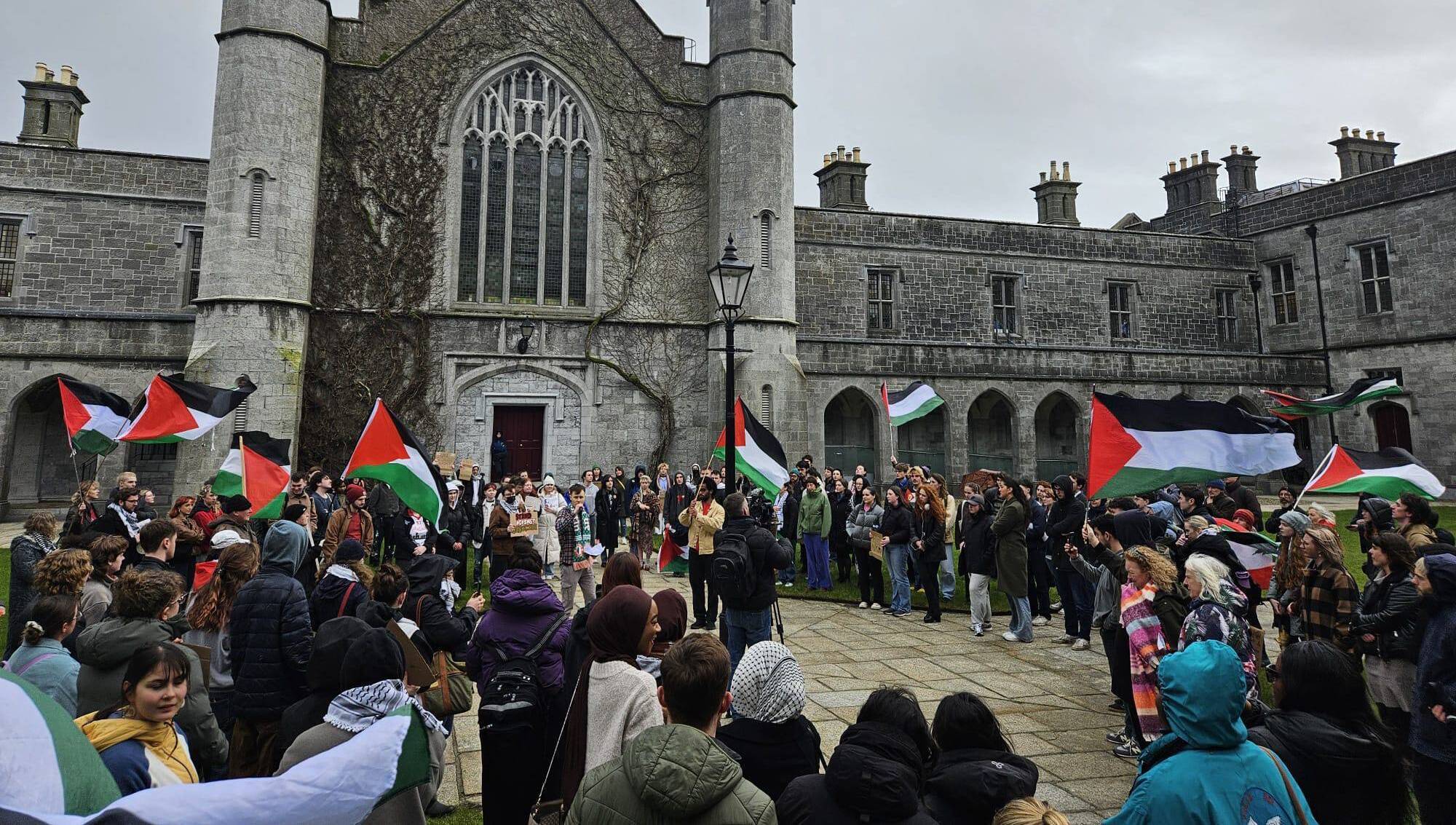
Students protesting at the University of Galway in February over a research project which is in collaboration with the Israeli institute, Technion, which has longstanding connections with Israel’s arms industry.

There is a particular kind of cynicism reserved for people who protest. What difference will it make? What will a march in Galway achieve? Why bother? On Tuesday, University of Galway supplied an answer.
Its withdrawal from ASTERISK, the European research project involving Israel’s Technion institute, is a victory for the students, staff, graduates and Palestinian solidarity campaigners who refused to let an uncomfortable relationship disappear beneath comfortable institutional language.
The university deserves credit. Doing the right thing, eventually, still matters. Announcing the withdrawal, president Professor David Burn said it reflected values “firmly grounded in respect for international human rights and humanitarian law”.
He reiterated the university’s condemnation of the genocide in Gaza and its commitment not to approve institutional research agreements involving Israeli partners.
ASTERISK researches the production of green hydrogen from seawater. Funded through Horizon Europe, it carries an EU contribution of almost €3.97m. Galway’s allocated share was approximately €706,846; Technion’s was €363,751.
Galway was the co-ordinator, making departure considerably more complicated than declining an invitation to an academic conference.
These figures require care. Galway’s allocation is not a confirmed withdrawal bill. Burn’s announcement does not specify how much funding remains unpaid, whether money must be returned, or what happens to project staff.
Read More
The university should explain those consequences and protect affected researchers. This is a funded commitment being relinquished under considerable financial pressure.
In September, Galway was reported to be forecasting a deficit of around €10m for the academic year. Its university teachers’ union warned about the vulnerability of temporary and part-time posts.
The university attributed the pressure largely to higher education underfunding and public sector pay awards. Principles are easily advertised when they cost nothing. Acting on them becomes harder when budgets are already strained.
The objection to ASTERISK was never that extracting hydrogen from seawater was inherently sinister. It concerned the partner whose institutional standing such collaboration helped sustain.
As previously reported in the , Technion has longstanding connections with Israel’s arms industry. In 2008, Elbit Systems announced a joint vision-systems research agreement with Technion, offering research grants and access to its laboratory.
Elbit manufactures the Hermes 450 and Hermes 900 drones used by Israeli forces for surveillance and strikes in Gaza. In January 2025, Israel’s defence ministry announced an agreement for Elbit to supply thousands of heavy air munitions.
That is what “military links” means here. Beyond the corporate names and research agreements lie weapons, shattered buildings and human bodies. Technion’s partnership with their manufacturer is precisely the relationship campaigners refused to sanitise.
A civilian research project does not erase those connections. Nor does its worthy scientific purpose settle the ethical question of whom a university chooses to legitimise through partnership.
Students were protesting this relationship in February 2025. Staff, students and graduates were still protesting last week. They challenged the distance between Galway’s stated commitments and its continuing participation.
Burn says withdrawal followed considerable engagement with European officials and university colleagues. He also points to the absence of a mechanism to unilaterally terminate a leadership role in a Horizon Europe project.
Campaigners were right to insist that contractual obstacles required sustained effort rather than permanent resignation.
The staff and students who persisted deserve particular recognition. Their campaigning made institutional discomfort impossible to ignore. Burn and his colleagues deserve recognition for finding a way through.
Galway cannot end the genocide by withdrawing from one consortium. It can decide which relationships it is prepared to maintain, and demonstrate to other institutions that financial pressure need not extinguish ethical responsibility.
To everyone who kept asking what difference protest makes: this is one answer.

BLACK FRIDAY
Already a subscriber? Sign in

CONNECT WITH US TODAY



Be the first to know the latest news and updates