Colin Sheridan: Ireland's credibility at Cop31 not helped by our lack of climate action at home
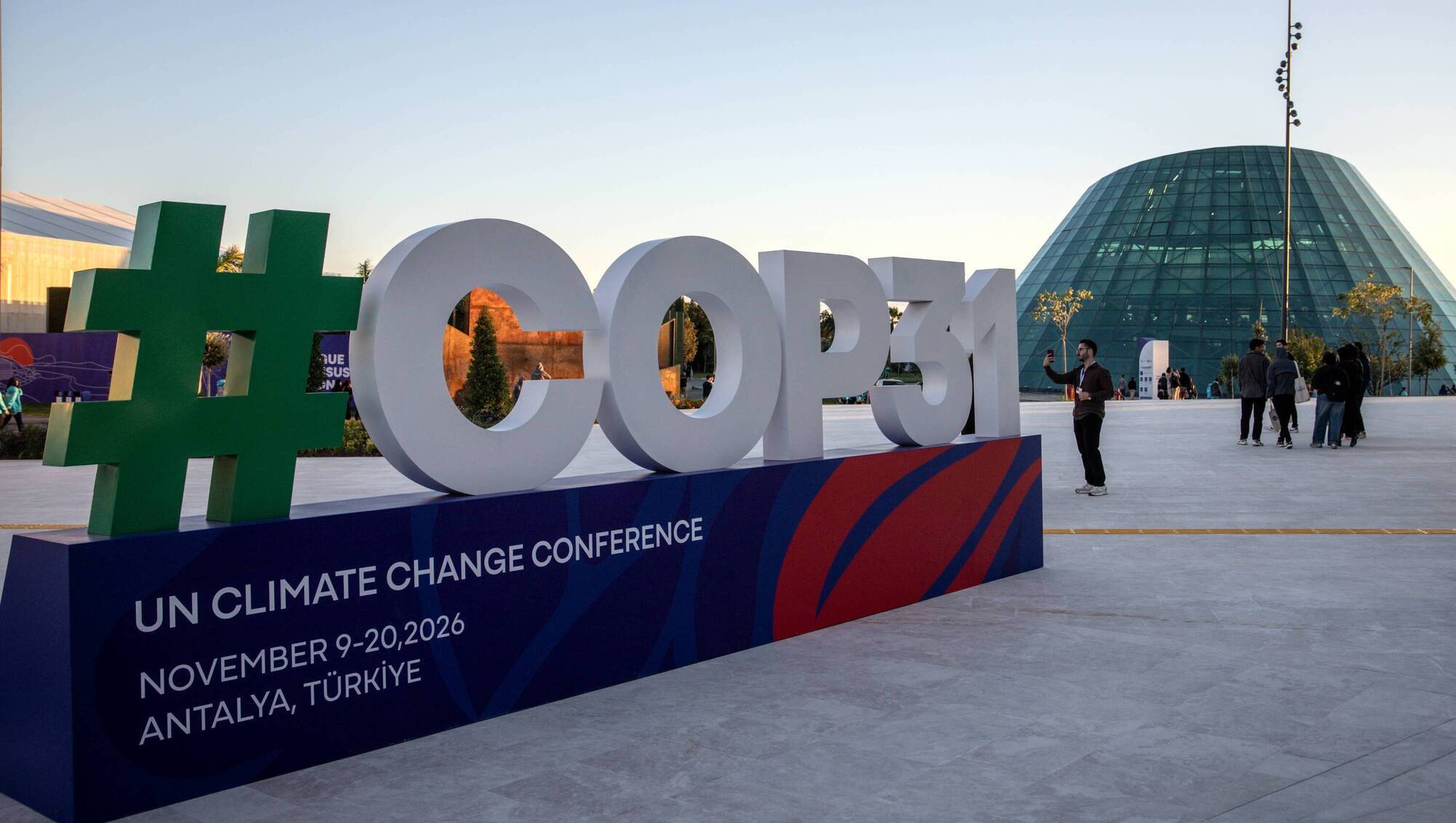
A Cop31 sign at the Antalya Expo center ahead of the climate conference in Antalya, Turkey. Ireland will help represent Europe in negotiations about delivering climate promises - though its domestic record makes that task uncomfortable. Picture: Chris McGrath/Getty
After 30 climate summits, why are we still negotiating survival?
Ireland will arrive at this week’s UN climate summit with an unusually prominent role and a familiar credibility problem. Holding the presidency of the Council of the European Union, it will help represent Europe in negotiations about delivering climate promises. At home, its own promises remain far ahead of their projected performance.
Cop31 opens in Antalya, Turkey, tomorrow, and runs until November 20. Turkey hosts and holds the conference presidency, while Australia leads the negotiations. World leaders gather on November 11 and November 12.
For Ireland, this is an opportunity to influence a global argument whose consequences are already domestic. The number attached to the summit invites weary scepticism. Some 31 meetings, and governments are still discussing how to implement commitments made at earlier gatherings. Yet the latest evidence makes disengagement a dangerous luxury. The question facing Antalya is how to accelerate action when even delivering existing pledges would leave the world facing severe warming.
The UN Environment Programme’s (UNEP) October emissions report puts projected warming under current policies at around 2.8C this century. Implementing national climate pledges would bring that to approximately 2.6C.
Both figures describe scenarios rather than predetermined outcomes. The difference between them measures the value of delivering promises; neither represents an acceptable destination. The report’s lowest-overshoot pathway envisages warming peaking at roughly 1.7C to 1.8C before returning to 1.5C or below by 2100, with a 50-50 chance. That would require steep emissions cuts and substantial carbon dioxide removal. “Overshoot” sounds temporary and technical. For people exposed to the additional damage, it offers little reassurance.
Three tests will determine whether Antalya produces more than another carefully negotiated account of insufficient progress.
First, can countries turn their national emissions plans into funded policies? These plans, known as nationally determined contributions, underpin the Paris Agreement. The EU’s negotiating position calls for their effective implementation and the urgent submission of missing plans. Governments must demonstrate how targets translate into decisions about energy, transport, industry, and land. There is a structural limitation. Paris binds countries to processes including preparing plans and reporting, but achieving each national emissions target is not itself a binding treaty obligation. Much consequently depends on scrutiny, diplomacy, and domestic political pressure. A global agreement can establish shared expectations; national governments still have to make them real.
Second, will the transition away from fossil fuels acquire practical substance? Europe’s mandate explicitly supports that transition and faster deployment of clean energy. The test is whether countries can agree on steps that change investment and energy systems, rather than language sufficiently elastic to accommodate incompatible policies. Announcing renewable capacity is easier than confronting dependence on coal, oil, and gas.
Third comes money. Cop29 established a goal of mobilising at least $300bn annually by 2035 for developing countries, with developed countries taking the lead. A wider ambition seeks at least $1.3trn annually from all sources. Antalya must help turn those figures into credible delivery, including support for adapting to damage already occurring. The distinction between loans and grants matters. So do access, timing, and whether money reaches countries already struggling with debt. A financing announcement can impress an audience while leaving a vulnerable government no closer to protecting its population. Those asking poorer countries to accelerate their transition must explain how it will be affordable.
Ireland has a diplomatic responsibility here. The rotating council presidency represents the EU alongside the European Commission, and climate minister Darragh O’Brien has helped shape the bloc’s preparations.
Europe’s negotiating position was approved under the Irish presidency in October. Ireland, therefore, has a role in reconciling European ambition with the compromises necessary to secure wider agreement.
Its domestic record makes that task uncomfortable. The Environmental Protection Agency’s projections published in May show that full implementation of planned measures could reduce Irish greenhouse gas emissions by up to 25% by 2030, when compared with 2018. The national target is 51%. Even the more ambitious policy scenario delivers only approximately half the required reduction.
That matters beyond diplomatic embarrassment. Credibility abroad rests partly on decisions at home: Delivering public transport, improving buildings, developing electricity infrastructure, and reducing emissions across agriculture and industry. The summit cannot make those choices for Ireland. Nor can Ireland’s influence in the negotiations compensate for failing to carry them through.
There are grounds for resisting despair. UNEP records that renewable energy has expanded rapidly and climate policies have reduced emissions in many places. Progress is possible and measurable. The challenge is to extend successful measures quickly enough, while supporting people and countries whose resources to respond are weakest.
The temptation after 30 previous conferences is to judge the next by its declarations. This time, Irish readers should also watch the country helping negotiate them. When Ireland asks the world to close the gap between promise and delivery, it will be asking a question of itself.

CLIMATE & SUSTAINABILITY HUB
CONNECT WITH US TODAY



Be the first to know the latest news and updates