Paul Hosford: FG’s position on political spectrum is a matter of perspective
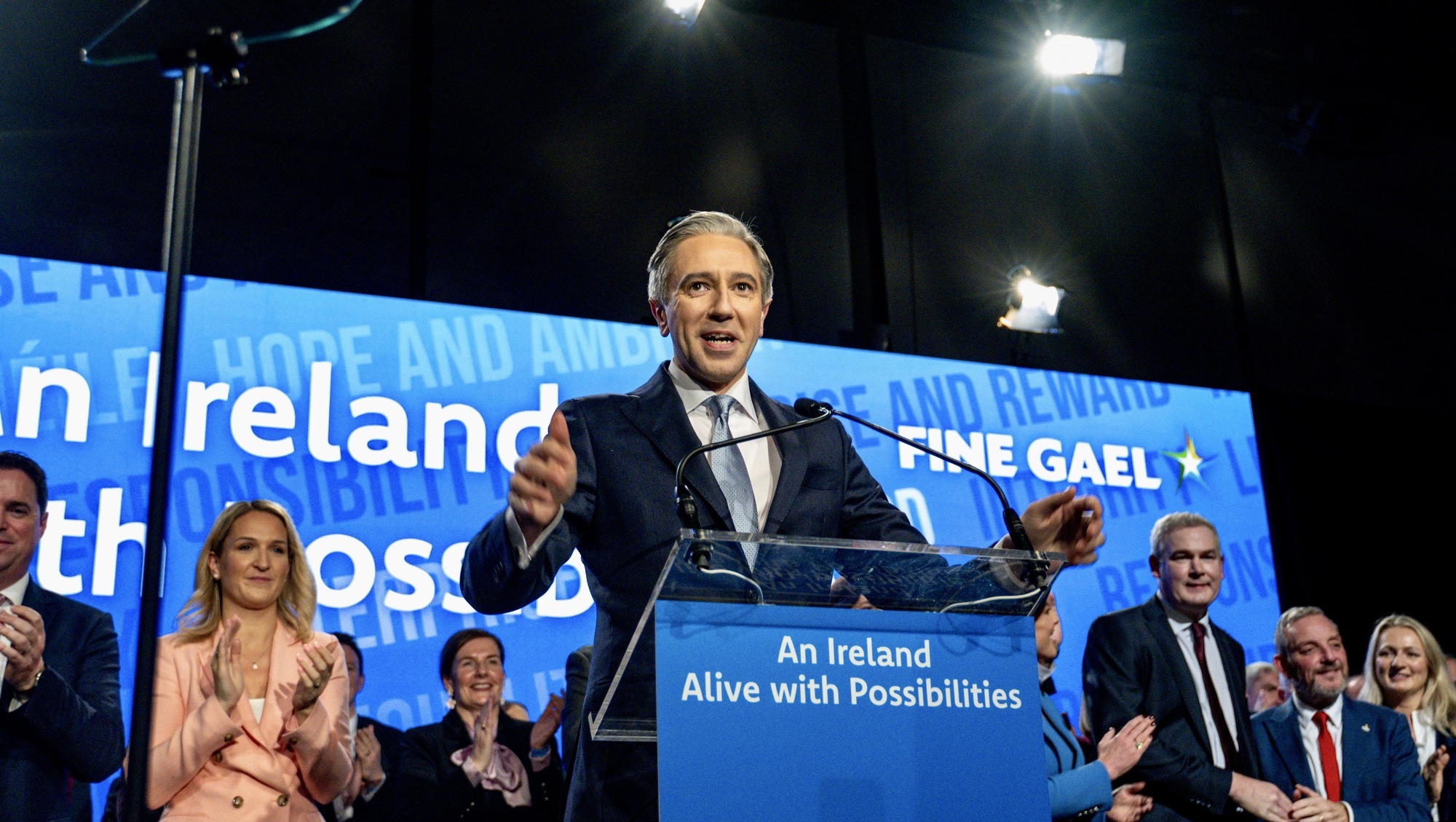
'After 15 years of compromise, Simon Harris on Saturday made a clear pitch for what he believes Fine Gael should be.' Picture: Chani Anderson
Where does Fine Gael stand on the political spectrum?
Ask its opponents, and it will paint the party as an unfeeling monster of the political right. However, ask the same question internally, and the answer can be a bit more nuanced, as evidenced by a push in the build-up to the party’s ard fheis in Cork for discussion on a motion aimed at distinguishing itself from the “woke left”.
The motion, which did not make its way onto the clár for the weekend’s event in University College Cork (UCC), asked that Fine Gael put its flag in the ground and openly call itself a “centre-right party, in the European Christian Democratic tradition”.
Whether Fine Gael is “woke” really depends on how broadly you define that phrase and just how seriously you take online culture wars.
If you’re a frontline soldier in those battles, you will see Fine Gael as woke because its leadership doesn’t openly hate minorities, but it was interesting that the party’s leader Simon Harris sought not once, but twice, to have it debated on Saturday on the banks of the Lee.
Because, as seen in his speech in the Mardyke Arena, there is some evidence that Simon Harris sees Fine Gael in at least some of the same ways as those who were pushing the motion.
Not that the Tánaiste, who played a leading role in the Repeal of the Eighth Amendment eight years ago, sees the party as necessarily “woke”, but that he is eyeing up a place on the political spectrum which is either unfilled, or could be more traditionally homed by Fine Gael.
Read More
In focusing on social welfare as “a way of life” in his keynote speech, Mr Harris harked back to his predecessor Leo Varadkar’s infamous — and calamitous — “Welfare Cheats Cheat Us All” snoopers hotline and planted that flag squarely in the centre-right of Irish politics.
Fine Gael has long seen itself as a party of law and order, of middle-class workers and of self-reliance where possible, but its place in Irish politics has been somewhat usurped by Aontú and Independent Ireland, both of whom have seen strong polling in recent times.
Fine Gael’s own internal report on its future, published in the lead-up to the Ard Fheis, suggests that the party’s identity has been somewhat lost after a decade and a half of government. Much of this is understandable - those governments have been coalition affairs or propped up by confidence and supply and required compromise.
However, after 15 years of compromise, Simon Harris on Saturday made a clear pitch for what he believes Fine Gael should be.
A knock on Mr Harris has been that he has, throughout his career, been too elastic in his politics and not moored to anything but the noble but woolly idea of “delivery”.
With a year to go until he takes up the Taoiseach’s office once more, he has laid down the clearest marker yet of what Harris 2.0 might look like.
Just how woke that version is will depend on your outlook.

CONNECT WITH US TODAY



Be the first to know the latest news and updates