Colin Sheridan: What ‘East of Eden’ teaches us about allowing adaptations make their own choices
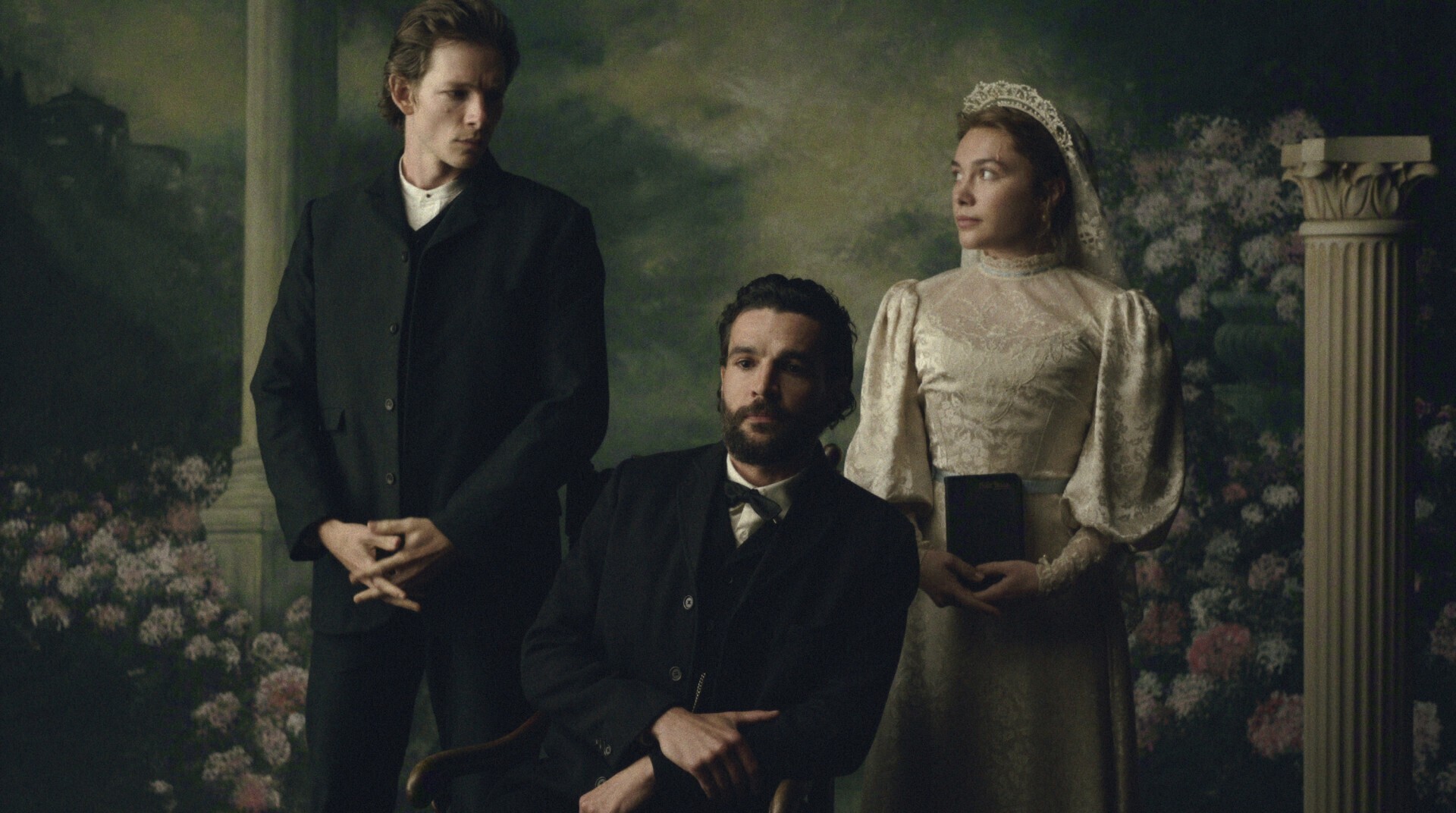
Mike Faist as Charles Trask, Christopher Abbott as Adam Trask and Florence Pugh as Cathy Ame in ‘East of Eden’. Picture: Netflix

Some years ago, hoping to impress somebody I knew to be a considerably better reader than me, I arranged a selection of heavyweight novels on my bedside locker.
Spines battered, pages thumbed and sun-bleached, this was literary curation undertaken with all the subtlety of a man leaving his own press clippings on the kitchen table. Steinbeck, I figured in my hubris, was a decent enough hill to die on.
“Have you ever read Sanora Babb?” came the question.
I had not.
There are few more efficient ways of dismantling a man’s intellectual credentials than introducing him to a woman he has never heard of. Babb, I came to learn, wrote , about the Dust Bowl migrants whose suffering Steinbeck immortalised in .
Accepted for publication in 1939, it was shelved after Steinbeck’s book appeared, on the basis that the market could not accommodate both. It eventually appeared in 2004, acclaimed as a worthy rival.
Ever since, I have found it difficult to think of Steinbeck without thinking of Babb. Which is probably a good thing. The bedside locker could accommodate them both.
I thought about that encounter while watching Netflix’s adaptation of , a novel I have loved at different times, in different places, alongside different people. A book you return to accumulates these associations. You remember where you read it, who recommended it, whom you subsequently pressed it upon.
Then there are the passages you underlined. A small mark left by somebody you used to be. Why those words, then? What were you hoping they explained? Sometimes the sentence retains its significance. Sometimes you find yourself reading it for clues about the person holding the pen.
Watching somebody else adapt such a book can feel surprisingly intrusive. I approached with the proprietary suspicion familiar to anyone who has loved a book and discovered that somebody intends to put actors in it.
The casting is questioned. The omissions are anticipated. A quiet prosecution begins before the opening credits. Then, rather counterintuitively, I gave it time.
Across seven episodes, Zoe Kazan’s adaptation drew me into the story again. I returned to the book and the memories attached to it.
I wanted to savour the television as I watched, conscious that the pleasure would eventually end.
Against the wearying spectacle of CGI catastrophe, disposable storytelling and the prospect of AI manufacturing more of everything, here was a series that seemed to unfold in perpetual golden hour.
Faces, landscapes, silences worth attending to. Its beauty made room for the ugliness of human behaviour without ever surrendering to it. It was, ever so briefly, life-affirming.
Steinbeck’s novel is vast, biblical in its architecture, concerned with inheritance, jealousy, cruelty and the freedom to choose what kind of person we become.
Bringing it to the screen requires decisions that will inevitably distress somebody.
Kazan, whose grandfather Elia directed the 1955 film starring James Dean, places Florence Pugh’s Cathy Ames at the centre of her interpretation.
That choice gives the series much of its force. It also changes the distribution of light.
Cathy occupies more space. Other lives occupy less. Much of the Hamilton family’s story disappointingly falls away. The adult sons arrive late.
These are meaningful losses, and we are all entitled to mourn them.
Yet watching a familiar character receive a different kind of attention is compelling.
Kazan gives Cathy context without removing her capacity for appalling cruelty. Understanding how somebody became monstrous does not require us to forgive what they do.
One revealing choice involves words about monsters that Steinbeck gives his narrator. In the series, Cathy speaks them. The language travels from one voice to another, and the meaning shifts.
Anyone who has moved a sentence around a paragraph will recognise the principle. Anyone who has spent 40 minutes doing so will recognise the need for professional help.
I have no intention of comparing this column with . There are differences of scale, achievement and, presumably, talent. But writers’ attachment to their own sentences can be hilariously disproportionate to their merit.
You labour over a paragraph. You recite it in the shower. You adjust its rhythm. You remove a word, restore it, then congratulate yourself on removing it again. Eventually, you produce something you privately suspect might redefine literature. Your editor deletes it.
There is no ceremony. No acknowledgement of the dependents it leaves behind. A sentence you regarded as a living organism is removed with the brisk efficiency of someone clearing dirt from a fingernail. Occasionally, the worst thing happens: you read the piece again and realise it is better.
“Kill your darlings” is sound advice, considerably easier to administer when the darlings belong to somebody else. Steinbeck’s account of writing offers consolation. In his notebook, he wrote letters to his editor, Pascal Covici, on the left-hand pages, with the manuscript opposite. The finished work had its doubts sitting beside it.
“Whether I am good enough or gifted enough remains to be seen,” he wrote as he began. Later, he anticipated that the completed manuscript would be “overhauled very very deeply”.
Kazan consulted those letters while making the series. I like the thought of her encountering the uncertainty behind a book readers now approach with such certainty about how it should be treated.
We know what must remain. We know which character matters most. The writer was wondering whether he could manage it at all.
Kazan and her collaborator Jeb Stuart are now adapting Larry McMurtry’s , another book I love, another landscape and collection of lives I can already see when I close my eyes.
My newfound generosity towards adaptation may soon face further examination. For now, I am grateful that Kazan made her choices, and that I eventually stopped supervising them.
They brought me back to Steinbeck, to the book, the underlined sentences, the people I shared it with. To rooms I have long since left.
Years ago, I arranged those novels hoping somebody would see me differently. This time, I let somebody else show me something I thought I already knew.

BOOKS & MORE
Check out our Books Hub where you will find the latest news, reviews, features, opinions and analysis on all things books from the Irish Examiner's team of specialist writers, columnists and contributors.
CONNECT WITH US TODAY



Be the first to know the latest news and updates