Denying visas to Palestinians in the midst of genocide is immoral and cruel
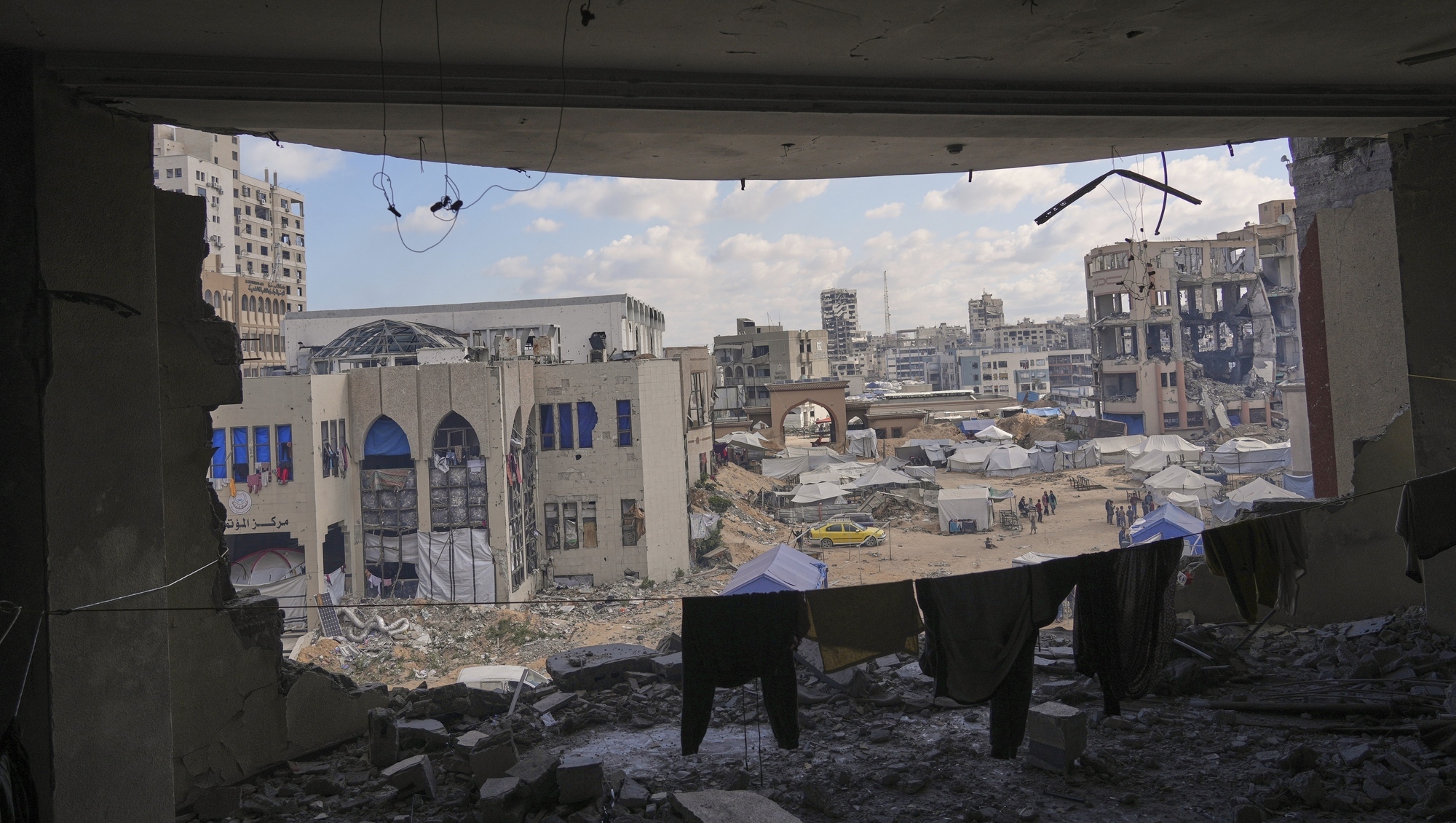
The Islamic University in Gaza City, partially damaged by an Israeli bombardment in April 2025. 'The destruction of education is not collateral damage. It is part of Israel’s targeted and express genocide of Palestinian intellectuals, culture, and education.' File photo: AP/Jehad Alshrafi
The third year of Israel's ongoing genocide in Gaza has just passed. As the daily toll continues to mount, approaching 75,000 recorded deaths, Israel's onslaught has brought a new word into wider circulation: scholasticide, the wholesale annihilation of the Palestinian capacity to educate its youth.
Within weeks of October 7, 2023, Israel had systematically destroyed or irreparably damaged all of Gaza's 19 universities and colleges as well as most of its schools. According to a recent report on scholasticide, some 1,400 students and 250 academics and staff members have been killed, including university presidents and senior administrators.
The destruction of education is not collateral damage. It is part of Israel’s targeted and express genocide of Palestinian intellectuals, culture, and education.
Under such circumstances, compounded by the almost total destruction of Gaza's buildings and by mass displacement, it is extraordinary that students of medicine, engineering, English, the arts, have continued to study, huddled in tents and with rare access to the internet. They have persisted in working for exams and diplomas, despite spending hours securing the basic necessities of life, seeking wifi connections, or caring for traumatised families.
Their persistence is not simply a story of resilience. It is a refusal to surrender intellectual life itself: a refusal to abandon their dreams or give up the commitment to learning that has always characterised Palestinian society and that will be crucial to Gaza's rebuilding and eventual liberation.
Given such atrocious circumstances in Gaza, it is an unthinkable act on the part of the Irish minister of justice to deny visas to Gazan students who had been accepted and offered places for further study by Irish universities and, in some case, were to have been supported by Irish government scholarships.
Read More
More than half of Palestinian applicants have now been denied visas, despite having the promise of scholarships and admission. They have been denied not only the freedom to travel, making the Irish government complicit with Israel's crimes against humanity, but the opportunity to pursue their educational ambitions at precisely the moment when education has become most urgent — for themselves and for a society whose institutions and infrastructure are being systematically destroyed.
Though many of their cases are still on appeal, that they have had to endure that further hurdle only adds the vicissitudes of judicial review to the torturous process they have been forced to undergo.
Some of the rationales for the refusals add an extraordinary degree of petty cruelty to the process, such as asking for copies of academic credentials or bank statements to be mailed by individuals living under the conditions of Israel’s genocide where there is no functioning infrastructure, including schools and universities, let alone a postal or banking service.
Likewise, demanding proof of a stable address or continuous education and transcripts turns a routine bureaucratic practice into a sophisticated form of mockery.
To bar an individual whose intellectual achievements and promise have already been vetted by an Irish university because they have been obliged by Israel’s three years of unrelenting destruction to live in a displacement camp, with neither documents nor regular access to a functioning educational institution, adds an unconscionable insult to the disappointment of legitimate hopes.
Even the suspicion that such students might seek asylum after arrival shows an extraordinary ignorance of the Palestinian commitment to their land.
While they desperately need temporary refuge, the vast majority of such students seek to study further in their fields, whether in the arts, in engineering, or in medical professions, because they know well that Gaza will need educated personnel to reconstruct what Israel has so wantonly destroyed.
For the past year, we have been preparing with colleagues at Maynooth University for an international conference on Palestine that was to be held in late October.
Given the long historical overlaps between Ireland and Palestine as sites of British colonialism and our understanding that the Irish people and its government were committed to supporting the Palestinian pursuit of liberation and peace, we all believed that it would be appropriate and productive to hold this conference in Ireland.
The conference had invited scholars from throughout historic Palestine, including several originally from Gaza already living in exile, and others from throughout Europe. It is an alarming prospect that they too might be denied entry and that the whole rationale of the conference, to bring Palestinian scholars, artists and intellectuals together with others from Ireland and the global south, would be undermined.
Given that possibility, it would be an act of bad faith to proceed with this conference at this time and, to our great regret, the decision has had to be made to postpone the conference till such times as the Irish government rescinds this inhuman policy.
That Great Britain and the United States denied entry to hundreds of European Jews fleeing Nazi Europe in the 1930s and 1940s is an indelible and notorious stain on their moral record. Visa denial during an ongoing genocide is no less evidently racist and no less unconscionable.
Ireland has benefitted globally from the reputation it has earned for supporting the Palestinian cause. That reputation risks being wiped away in the light of a policy that so blatantly contradicts both the Government's stated positions on Palestinian rights and the sentiments of its own people.
Visa denial in the midst of genocide is both immoral and cruel and will be an enduring cause of shame to the government and the individuals that impose it.
- Professor Nadera Shalhoub-Kevorkian is global chair in Law at Queen Mary University of London and professor extraordinaire at University of South Africa
- Professor David Lloyd is distinguished professor emeritus of English at the University of California, Riverside

CONNECT WITH US TODAY



Be the first to know the latest news and updates