Colin Sheridan: Ceuta disaster is real. But it also has an entirely fake second life on social media
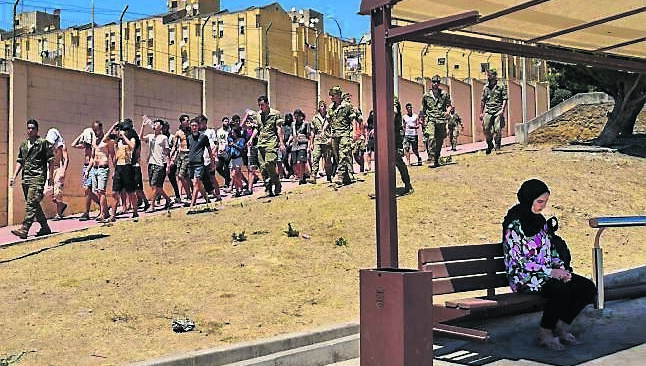
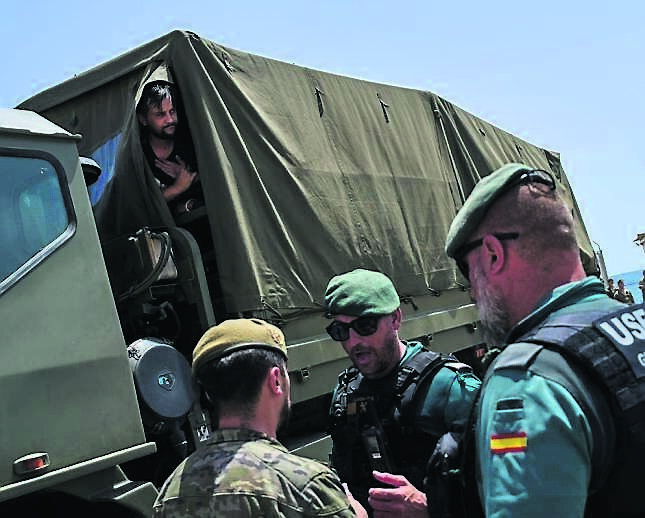
Spanish soldiers escort migrants back to the Moroccan border past a resident at a bus stop in Ceuta. While the arrival of so many people was an issue, a wave of social media posts omitted to mention that most of the migrants returned to Morocco within days. Picture: Bernat Armangue/AP
It's a tragedy that happened twice. The first question was obvious: How did tens of thousands of people reach one of Europe’s most heavily fortified borders in little more than a day? The second was asked far less often: Why does Spain have a border in Africa at all?
The events in Ceuta were extraordinary.
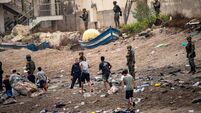
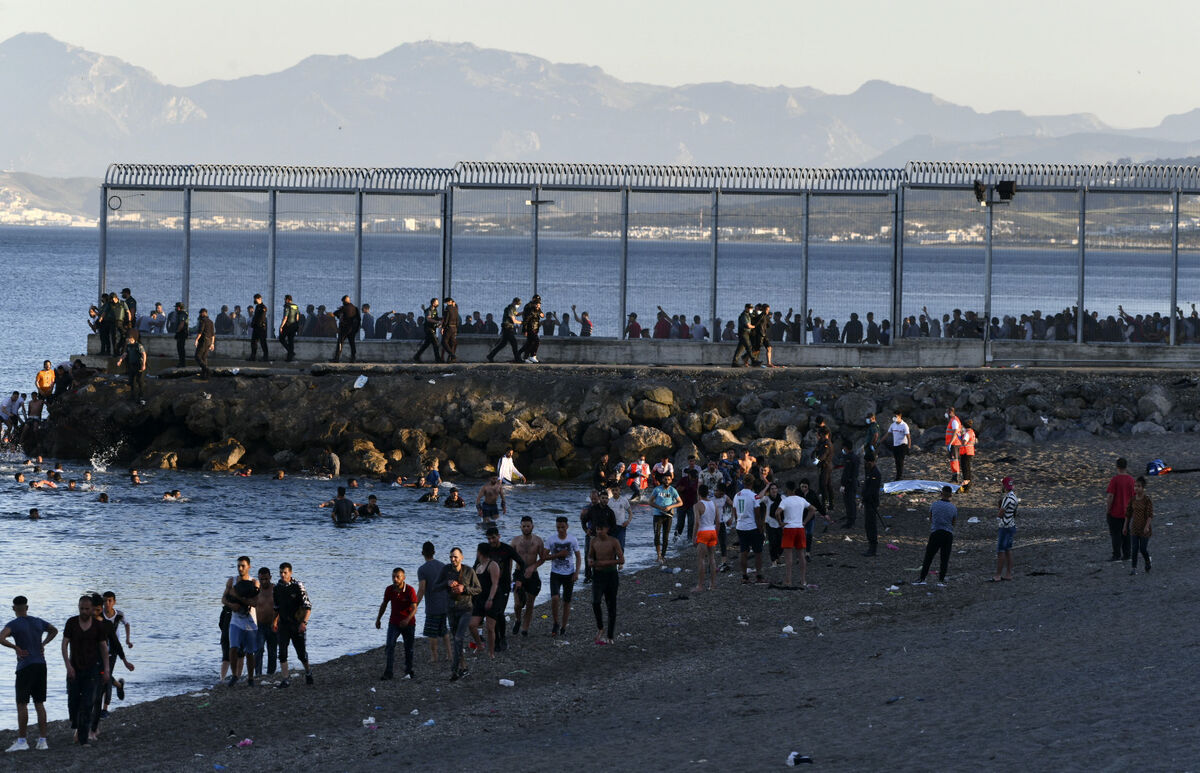
Encouraged by false information circulating online, people travelled from across Morocco towards the small Spanish territory on the North African coast. Many entered by land or sea. Some drowned. Others were crushed amid the chaos.
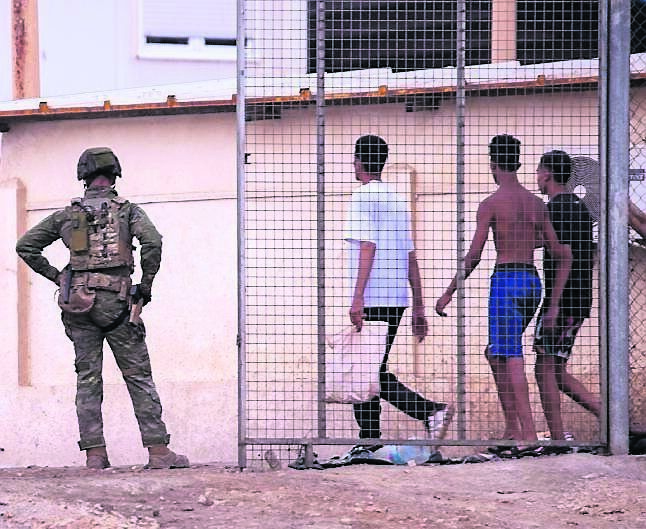
Most of those who reached Ceuta returned to Morocco within days, their belief that they could travel onwards into Europe exposed as a dangerous fiction.
The tragedy itself was real.
So too were the questions it raised about border security, trafficking networks, Moroccan co-operation, and the ability of social media to turn rumour into mass human movement.
But these events happen twice now. First, they happen on the ground. Then they happen again online, where the contest is no longer merely over what occurred but what it means.
Read More
Within hours, Ceuta had escaped its geography. Politicians, campaigners, influencers, governments, and anonymous accounts reached for the same images and drafted them into entirely different arguments.
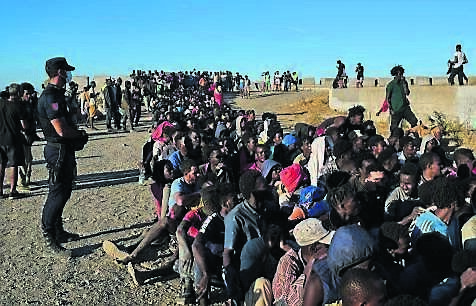
To some, the scenes represented an invasion of Europe. To others, they exposed the cruelty of its border regime. Some saw the hand of people-smugglers and platform algorithms. Others suspected deliberate pressure from Morocco or interference by states seeking to deepen Europe’s political divisions.
Migration is uniquely suited to this process.
It combines almost everything the attention economy rewards: Fear, identity, economics, morality, race, national sovereignty, and dramatic imagery.
A short video of people swimming around a border fence carries an emotional power that no chart of migration trends can match.
The physical event may last hours. Its political afterlife can continue indefinitely. That was the real distinction in the Ceuta coverage.
The disinformation that apparently persuaded thousands of Moroccans that the border had somehow opened is one story.
Liz Carolan examined that tragedy in these pages last week: The burner accounts, influencer-style videos, and false promises that encouraged people to risk their lives.
What happened afterwards is another. The images were detached from their original context and circulated as proof of whatever their distributors already believed.
Donald Trump, Elon Musk, European political leaders, and far-right campaigners far beyond Spain entered the argument.
Governments questioned Madrid’s migration policies. Some introduced or proposed border measures even though Ceuta is outside the main Schengen passport-free area and those who entered could not simply proceed to mainland Spain.
The spectacle became larger than the security implications.
This is not to minimise what happened. The arrival of such enormous numbers in a city of roughly 84,000 people was dramatic and legitimately concerning. Governments have a duty to control borders, protect residents, and prevent migration systems from being overwhelmed.
But proportionality was among the first casualties of the online reaction.
A crisis that had largely receded within days was presented as evidence of a permanent continental emergency: Before the facts had settled, the symbolism had hardened.
Ceuta’s history helps explain why. Spain regards Ceuta and nearby Melilla as integral parts of the Spanish state. Morocco, which calls the city Sebta, has never recognised Spanish sovereignty over either territory and has claimed them since gaining independence in 1956.
To most Europeans, Ceuta is the EU’s southern frontier. To many Moroccans, it is an unresolved remnant of European colonial possession on African soil.
Acknowledging this does not require accepting Morocco’s claim. Nor does it excuse any decision by Moroccan authorities to relax border enforcement, should evidence eventually establish that one was made.
It simply changes the starting point.
Europe asks how so many people crossed the border. Morocco also asks why a European border remains there.
Read More
Africanews reported last week that residents near the frontier saw normal Moroccan checkpoints but no exceptional security mobilisation as crowds gathered.
Mohamed Benaissa of the Northern Observatory for Human Rights said police reinforcements arrived only after hundreds had already crossed.
Morocco denied easing controls, attributing the movement to misleading social-media content, traffickers, and confusion over Spanish migration law.
No conclusive evidence has emerged that the Moroccan leadership ordered officers to stand aside.
The uncertainty matters. So does the precedent.
During a diplomatic dispute in 2021, more than 10,000 people entered Ceuta after Morocco appeared to loosen enforcement.
The immediate disagreement involved Spain’s decision to provide medical treatment to Brahim Ghali, the leader of the Polisario Front, which contests Moroccan control of Western Sahara. The border became part of a much broader geopolitical argument.
That episode exposed the central weakness in Europe’s migration strategy. The EU has spent years outsourcing much of its border control to neighbouring states. Morocco is paid, courted, and treated as a strategic partner partly because European governments depend upon its security forces to stop migrants before they reach European territory.
This may reduce arrivals. It also creates leverage. Riccardo Fabiani of the International Crisis Group told Africanews that the latest events could remind Spain how dependent it remains upon Moroccan co-operation to secure Ceuta.
Whether or not Moroccan capital Rabat deliberately engineered the surge, the crisis demonstrated how quickly that dependency can become a strategic vulnerability.
Looked at from outside Europe, the emphasis changes again.
A review of Chinese official and media commentary found less interest in blaming a single actor than in what Ceuta revealed about European fragmentation.
Chinese analysts focused on the gulf between southern states seeking solidarity and governments elsewhere demanding harder borders.
One commentator wrote that the crisis had torn through Europe’s appearance of unity, while scholars argued that the underlying problem was structural — a union with a shared external border but no durable agreement on responsibility, relocation, or migration policy.
The Chinese reading should not be treated as disinterested truth. Beijing has its own geopolitical calculations and relationships with both Madrid and Rabat.
But the perspective is useful precisely because it begins somewhere else.
European coverage naturally saw a crisis at Europe’s border. African coverage examined Moroccan agency, sovereignty, and Western Sahara. Chinese coverage saw European division and institutional weakness. The global right saw content. Each perspective revealed something. Each left something out.
That is the difficulty confronting journalism in the attention economy. Complex events contain several overlapping truths, but the platforms through which we increasingly understand them favour one-dimensional explanations. Certainty travels quickly. Context arrives late, if it arrives at all.
Ireland is geographically removed from Ceuta but fully embedded in the same information system.
We will not import Spain’s territorial dispute with Morocco. We can, however, import the language, images, and political reflexes produced by it. Increasingly, local Irish migration issues are absorbed into international narratives developed in countries with different histories, pressures, and failures.
An accommodation dispute can become evidence of a European conspiracy. A protest can be repackaged for overseas audiences. An isolated crime can be made to carry the weight of an entire migration system.
The danger is not that people will have strong views. Migration places real pressure on housing, public services, and political trust. Governments that dismiss those concerns leave the field open to those most willing to exploit them.
The danger is that events become symbolic before they are understood.
Ceuta was a migration crisis, a humanitarian tragedy, a diplomatic confrontation, an information operation, and an argument about colonial history.
It was also a warning about the political world into which every future migration event will now arrive.
The people at the border were moving through water, fences, and crowds. The rest of us were moving through narratives.
And, long after most had returned home, the second Ceuta remained — detached from geography, stripped of complication, and endlessly useful to anybody who needed the images to prove a point. https://www.irishexaminer.com/world/arid-41892940.html
CONNECT WITH US TODAY



Be the first to know the latest news and updates