Joanna Donnelly: Our cynical relationship with fine weather is born of experience
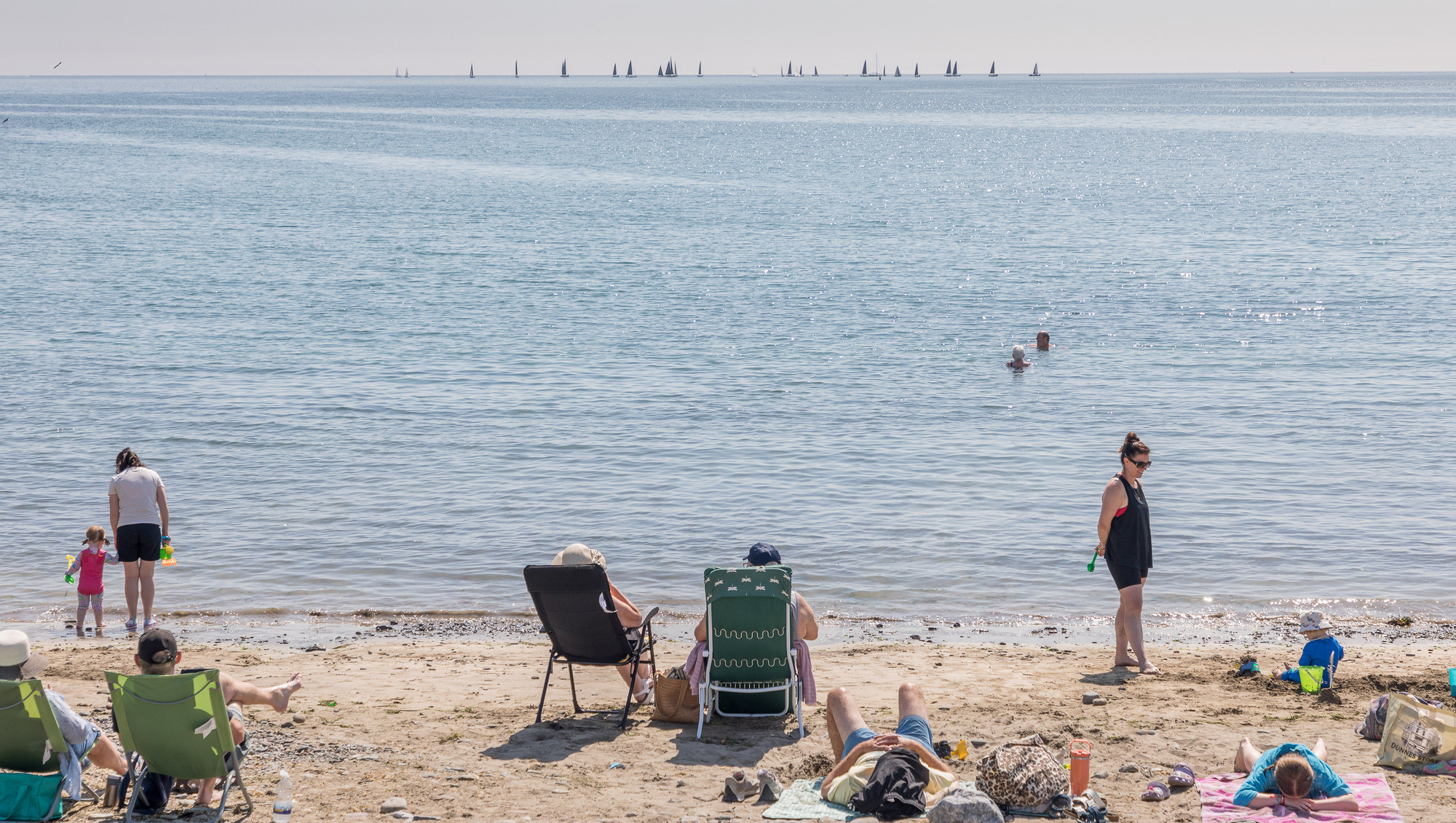
People enjoying the hot weather at Fountainstown beach in Co Cork. Picture: David Creedon
How long is it going to last? That’s the question I’m asked most these days. The Irish have a very cynical relationship with fair weather. And that’s fair enough — that cynicism is born out of a history of climate dictated by a maritime airmass. Sunshine and showers are our bread and butter.
In my book, , I describe the climate of Ireland as a Goldilocks climate: not too hot, not too cold, not too wet and not too dry. It’s just right.
The technical term is a temperate climate. Sitting on the western edge of northern Europe, our climate is strongly influenced by two streams — the Jet Stream is a core of strong winds situated at about 30,000ft above the surface of the earth dividing cold air from the poles with tropical air from the south. It steers the low-pressure systems across the Atlantic right in to our path. That’s what brings the wind and the rain.
The other stream is the Gulf Stream — it’s a warm water current that comes out of the Gulf of Mexico. It is responsible for warming the air above the ocean and it keeps our temperatures within a comfortable range.
So when at the start of July I started talking about anticyclonic conditions and high-pressure blocks, the scepticism of my small band of followers on social media was warranted. Blocking highs bring long periods of dry weather.
In the winter, these days can become very cold as heat is radiated away from the earth and each day is colder than the day before. In the summer we get heatwaves.
Read More
A few years ago, the definition of a heatwave in Ireland was changed — it used to be five days in a row with temperatures 5C above the seasonal norm. That had to be changed when it was realised we could technically get a heatwave in January.
Now the definition is five days in a row with temperatures above 25C. There is no universal definition for obvious reasons — the people of Spain and North Africa might very well laugh in to their sleeves at our paltry 25C. They have their own temperature maxes and mins to contend with.
The reason there are only a few really memorable heatwaves to recall in Ireland is because of that temperate, Goldilocks climate.
The longest heatwave ever recorded in Ireland was 14 days in 1976, and it was following a period of exceptionally dry conditions that lasted several years and extended all across Europe.
The highest temperature record for the 20th century in Ireland was recorded in this period, 32.5C at Boora in Co Offaly on June 29, 1976. That summer, there were more than one spell of hot, sunny days and another heatwave lasted nine days.
The other notably hot summer in present memory was 1995, when a heatwave was recorded lasting eight days in June and another lasting six days in August.

I started working for Met Éireann that summer and was training at Casement Aerodrome, trying to learn how to be a weather observer. There were 34 consecutive days of temperatures over 20C and my instructor used to say to me “Joanna, if there were any rain, we’d measure it in this [bone dry] barrel, and if there were any clouds in the sky we’d count them.” It was a summer of non stop blue skies and parched fields.
As it turns out, 1976 was an El Nino year, but 1995 was not — it was the opposite, an El Nina year.
The phenomenon of the El Nino refers to the variation in the usual weather patterns observed across the globe when warm water currents oscillate across the Pacific Ocean. The warmer oceans heat the air above them, resulting in larger, hotter anticyclones. These naturally occurring oscillations can last years and the pattern is not fixed.
The El Nina periods, the cooler periods, usually last longer, the shorter El Nino periods having more dramatic impacts in terms of heatwaves and floods across the world.
Since industrialisation, we’ve been generating additional greenhouse gases from our activity. The increase in the amounts of carbon dioxide, methane and water vapour means the atmosphere holds more heat. Now when we enter an El Nino cycle, the additional heat available leads to extreme heatwaves across the world.
Back home in Ireland, our Goldilocks, temperate climate insulates us from the extremes observed by our close neighbours in Europe.
As for this spell of weather and how long it’s going to last? Well, let’s just say there’s no sign of it going anywhere, with yet another anticyclone expected for the days to come.
Check out the Irish Examiner's WEATHER CENTRE for regularly updated short and long range forecasts wherever you are.
CONNECT WITH US TODAY



Be the first to know the latest news and updates