Marion McKeone: America today is in no mood for a birthday party
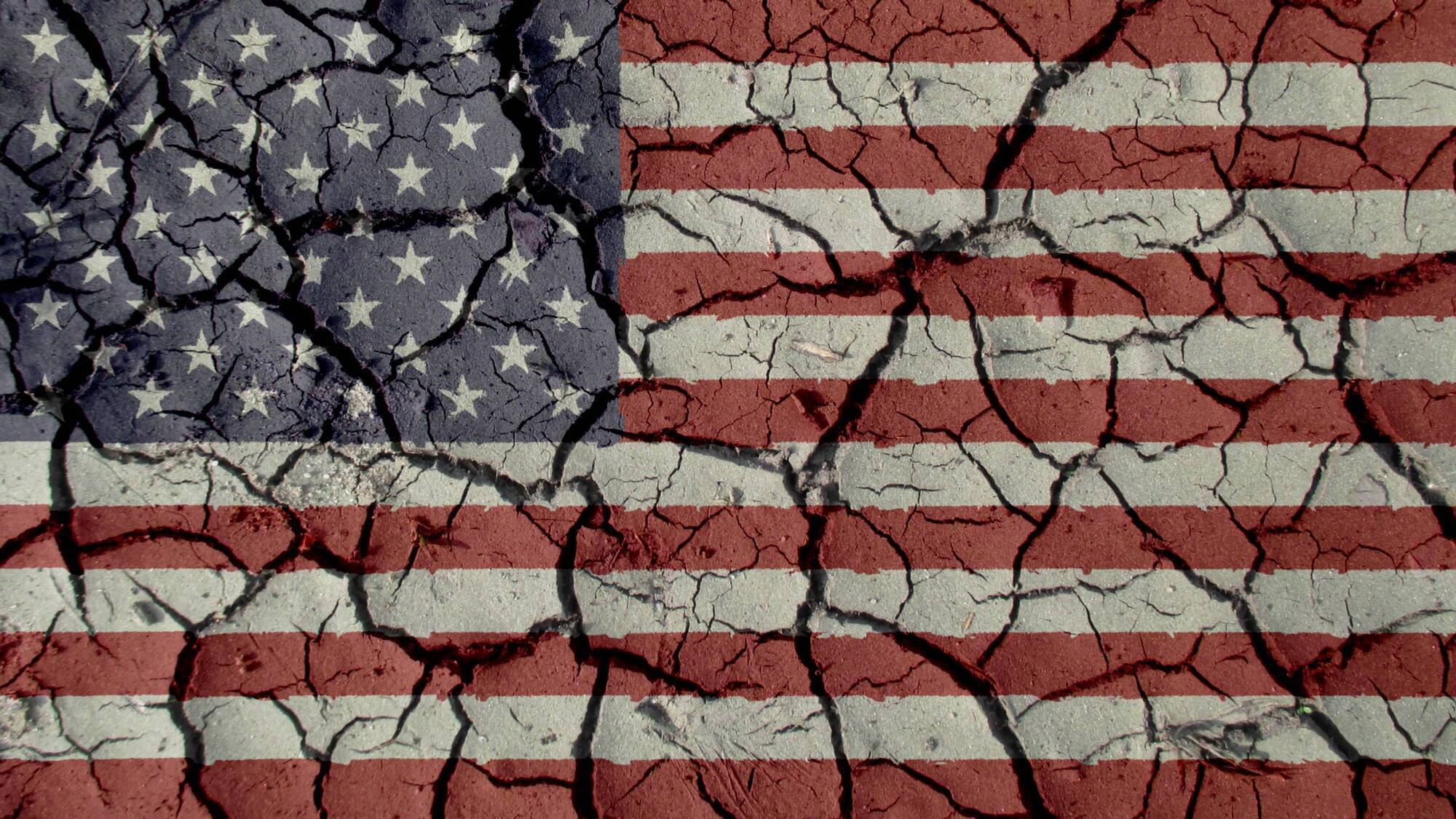
America’s leaders are blithely ignoring the two biggest challenges that are hurtling down the tracks. Picture: iStock
Happy birthday America.
If you want to nitpick, there’s some question about whether or not today is, in fact, America’s 250th birthday.
It’s certainly the 250th anniversary of the adopting of the Declaration of Independence; which, with characteristic American hubris, took place barely a year into an eight-year war with the British Empire, the outcome of which was by no means certain.
Until the signing of the Treaty of Independence in 1783, celebrations were premature at best. But the 1776 declaration was audacious and aspirational, capturing the essence of the spirit that would fuel the great American experiment over the next 250 years.
America wasn’t birthed as a democratic republic until September 17, 1787, when a weary but triumphant Benjamin Franklin emerged from Philadelphia’s Hall of Independence. Asked whether the US constitution they had haggled over for 116 days established a republic or a monarchy, the 81-year-old Franklin replied “a republic, if you can keep it”.
Read More
His response was both a declaration of triumph and a warning. They had delivered the largest democracy since the ancient Romans and the Greeks toyed with idea of representative systems of government. But its survival was by no means guaranteed.
Over the next two and a half centuries, America fulfilled — and exceeded — the ambitions of its founders; becoming — through fits and starts, wars and fierce civil unrest — an ever more inclusive, if perennially flawed, democracy. One that eventually extended its rights and protections to all its citizens but never atoned for the two original sins upon which it was founded: Slavery and genocide.
There were periods of overreach, regression, and isolationism, but America became a tireless source of innovation and creativity, a bottomless font of energy and optimism and a defender of the freedoms of smaller nations. It rescued Europe from tyranny and fascism in the first and second world wars. The Marshall Plan laid the foundation for 80 years of European peace and prosperity.
It gave us light bulbs and telephones, airplanes and assembly lines, vaccines that eradicated diseases, and innovations that made all our lives better — rockets to the moon and accessible air travel, televisions and sound systems, cars and fridges, fast food and fashion, Hollywood and rock'n'roll, the internet, social media, and countless other inventions that made life easier, safer, more fun.
At its best, American innovation and idealism entertained, enthralled, and inspired
All of this, you would imagine, should make today a day of enormous pride for the US, a day when American democracy is celebrated at home and feted abroad. It is anything but: America’s democracy has never been in worse shape.
The ideals of its founding fathers are barely recognisable in a nation divided by a chasm of suspicion, fear, and hatred. The richest and most powerful country in the world is teetering on the brink of decline, its institutions retreating from their roles or colluding in the authoritarian creep of the current administration.
All powerful nations wax and wane. America peaked in the late 1990s as the world’s undisputed military and economic superpower. Historic budget surpluses allowed for massive investment in medical research and technological innovation.
Its national debt stood at a relatively paltry $5.7tn. US overseas interventions oversaw the end of the war in Bosnia through the Dayton Accords, ushered in peace in the North with the Good Friday Agreement, laid the foundation for peace in the Middle East with the Oslo Accords, and came agonisingly close to achieving it with the 2000 Camp David Summit.
There was little to suggest that within a decade, America would be reeling from a devastating terrorist attack, two wars, and the greatest financial meltdown since the 1929 depression. The September 11 attacks were arguably the beginning of the end of America’s global dominance. A slew of disastrous foreign policy decisions culminated in two decades of war in Iraq and Afghanistan cost more than $6tn, with ongoing expenditure on veterans’ care expected to cost another $2.2tn.

Reckless domestic deregulation triggered the 2008 fiscal implosion, devastating the lives of tens of millions of ordinary Americans who lost their jobs and homes, even as congress voted to spend hundreds of billions bailing out banks and corporations. The seeds of the Make America Great Again (Maga) movement were sown amid this economic turmoil, and nurtured with a seething resentment of corporate America and congress.
Historian and Yale professor Timothy Snyder warns that democracies crumble from within. When citizens stop trusting the institutions of democracy — the executive, the legislature, and the judiciary — they start to erode and crumble. The media’s role as democracy’s watchdog has been undermined by its own shortcomings and marginalised by social media outlets that profit from the dissemination of disinformation.
Bungled bread and circuses
America today is in no mood for a party. The 250th celebrations scheduled in Washington have turned into a debacle that serve as a metaphor for the state of the nation. A bungled bread and circuses attempt to distract from a grim reality. The US is at a crossroads, the sort of historical juncture that faced many former empires and superpowers that toppled or faded into obscurity, because they were unable to overcome the challenges that now face the US.
From Byzantium to Britain, empires throughout history have declined or outright collapsed for the same reasons; overexpansion, corruption, a failure to adapt, and the civil unrest that is generated when social inequality that reaches a tipping point.

America is bedeviled by each of these; its national debt has soared to $38tn, a staggering 564% increase over the past quarter of a century.
The flagrant self-dealing that has seen Donald Trump enrich himself to the tune of $2bn during the first year of his second term has allowed America’s centi-billionaires to increase their wealth exponentially since his return to power.
The top 1% of American earners control 30% of the nation’s wealth while, between them, the bottom 50% own just 3%.
Government investment in research, education, and healthcare has ground to a halt, along with the cheap labour provided by immigration, the life blood of America’s hospitality, agriculture, construction, and home care industries
Foreign students, hampered by hostility and visa restrictions, are choosing top universities in Canada and Europe over America’s famed Ivy League colleges.
America’s leaders are blithely ignoring the two biggest challenges that are hurtling down the tracks; the impact of new technology on its labour force and the impact of climate change on its cities and food sources.
Over the coming decades, millions of US citizens living around New Orleans and Miami will be forced to relocate, as their homes are submerged by rapidly rising sea levels. Millions of jobs will be lost to AI and automation. Neither congress nor the White House has any strategy or plan to deal with these certainties.

Historians seeking to pinpoint the event, if not the moment, that marked America’s inflection point as a diminished global power may settle on Trump’s war of choice in Iran — arguably the worst foreign policy decision of any US president. Even if the current negotiations achieve a peace of sorts, America’s humiliation and the limits of its military might have been exposed for the world to see; the global economic cost has yet to be realised.
The tectonic plates of global power were shifting before the US-Israeli attack. America’s western allies, stunned by Trump’s abandonment of Ukraine, the capriciousness of his trade wars, and his threat to annex Greenland, have responded to a US foreign policy that veers between truculent isolationism and belligerent imperialism with a realignment of their own.
The significance of Canadian prime minister Mark Carney’s speech at Davos, in which he acknowledged rupture in global governance and the demise of the US-led rules based international order will be measured by the degree to which mid-sized nations respond to his exhortation to construct a new global order. Even if the US and its Western allies mend fences in a post-Trump era, as seems likely, American influence has been diminished.
Winston Churchill remarked that America could be relied upon to do the right thing, when all other options have failed. Given its history of innovation and ability to self-correct, there are grounds for optimism that American democracy will survive for another 250 years.
But there are enormous challenges ahead. America at 250 may be looked back on as aberration, a midlife crisis, the low point from which it pivots to a new era of peace and prosperity. Or it may mark the beginning of a great nation’s terminal decline.

Cancel anytime
CONNECT WITH US TODAY
Be the first to know the latest news and updates